Division of Gastroenterology, Tohoku University Hospital, Sendai City, Japan.
PLoS One. 2013 May 23;8(5):e63672. doi: 10.1371/journal.pone.0063672. Print 2013.
1,25(OH)2 vitamin D3 can affect immune cells. However, the mechanism responsible for the favorable effects of 1(OH) vitamin D3, which becomes 1,25(OH)2 vitamin D3 in the liver, is not clear. The aim of this study is to analyze the immunological response of 1(OH) vitamin D3 supplementation in CH-C patients.
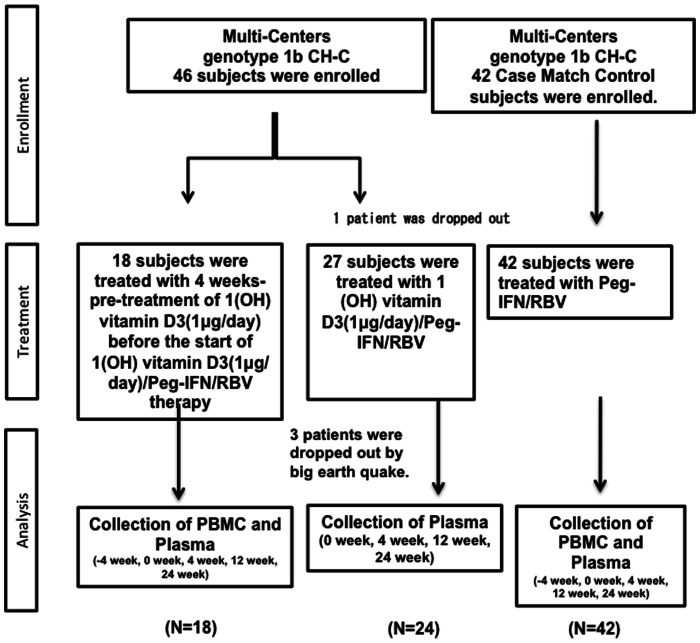
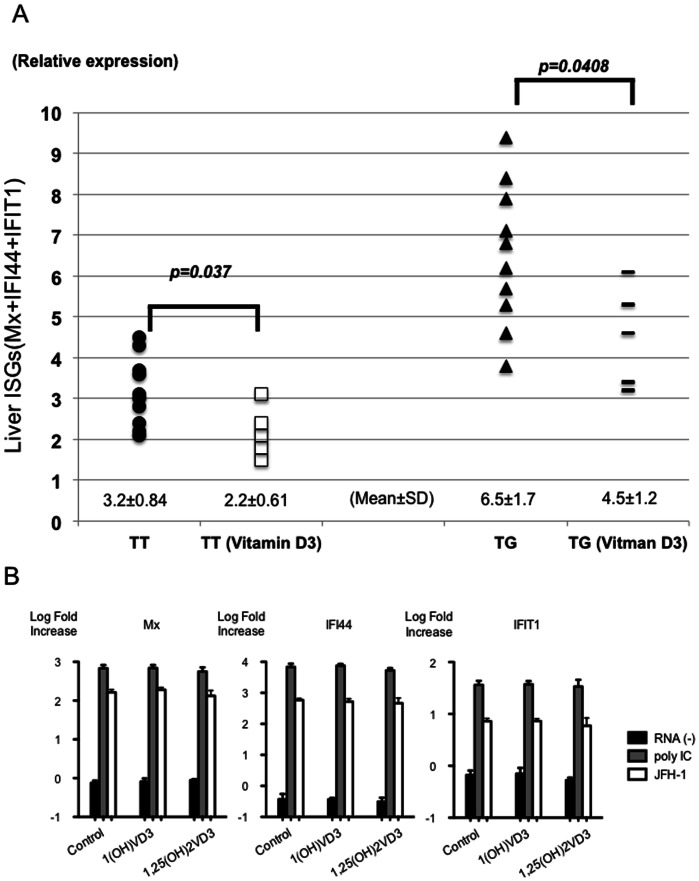
Forty-two CH-C patients were treated with 1(OH) vitamin D3/Peg-IFNα/RBV. Forty-two case-matched controls were treated with Peg-IFNα/RBV. The expression of Interferon-stimulated genes (ISGs)-mRNA in the liver biopsy samples and JFH-1 replicating Huh-7 cells were quantified by real-time PCR. Ten kinds of cytokines in the plasma were quantified during treatment by using a suspension beads array. A trans-well co-culture system with peripheral blood mononuclear cells (PBMCs) and Huh-7 cells was used to analyze the effect of 1(OH) vitamin D3. The activities of the Th1 response were compared between subjects treated with 1(OH) vitamin D3/Peg-IFN/RBV and those treated with Peg-IFN/RBV therapy alone.
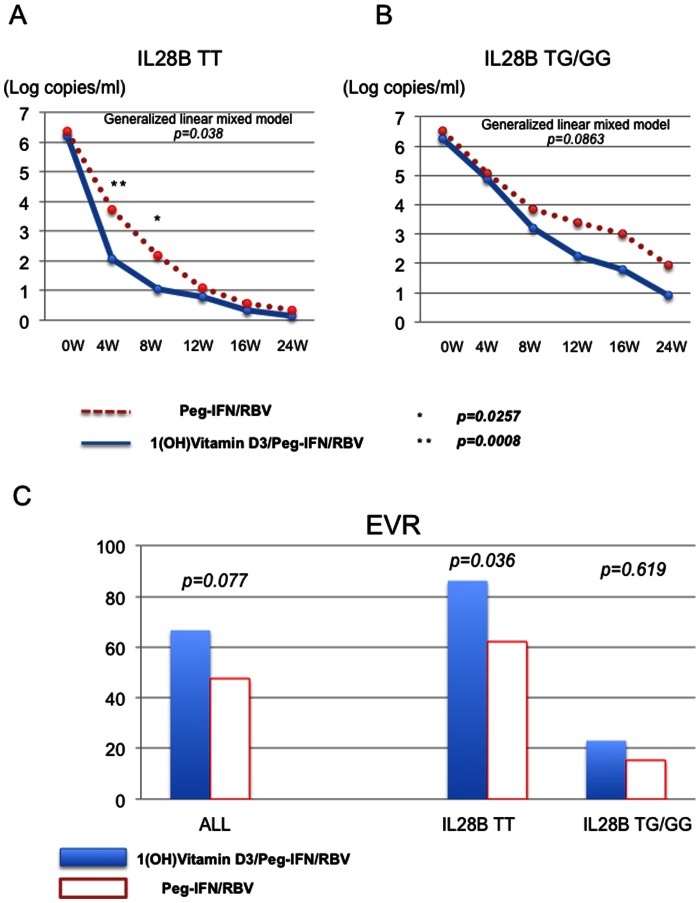
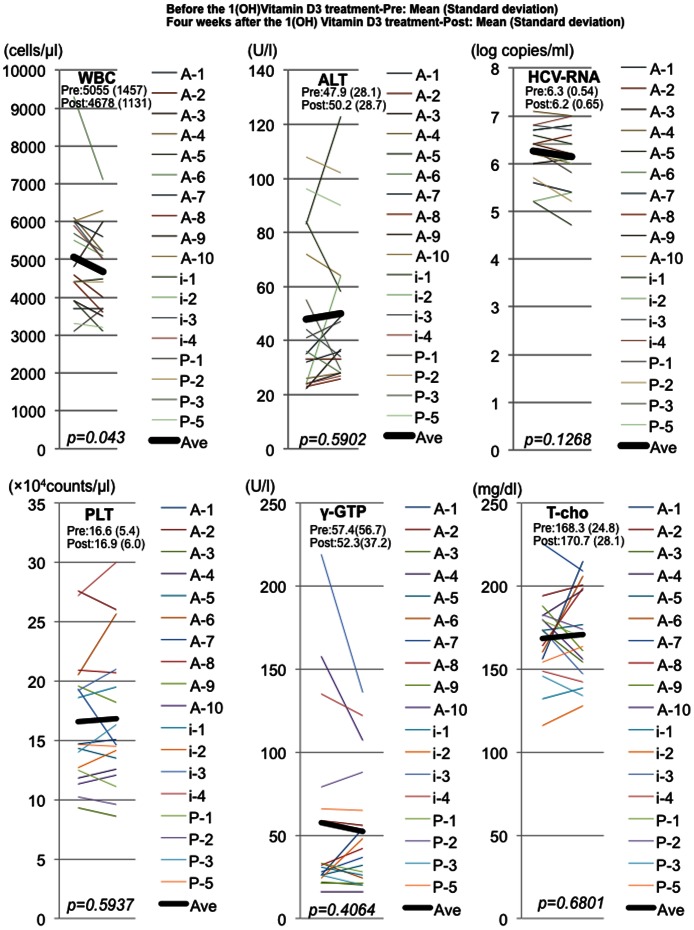
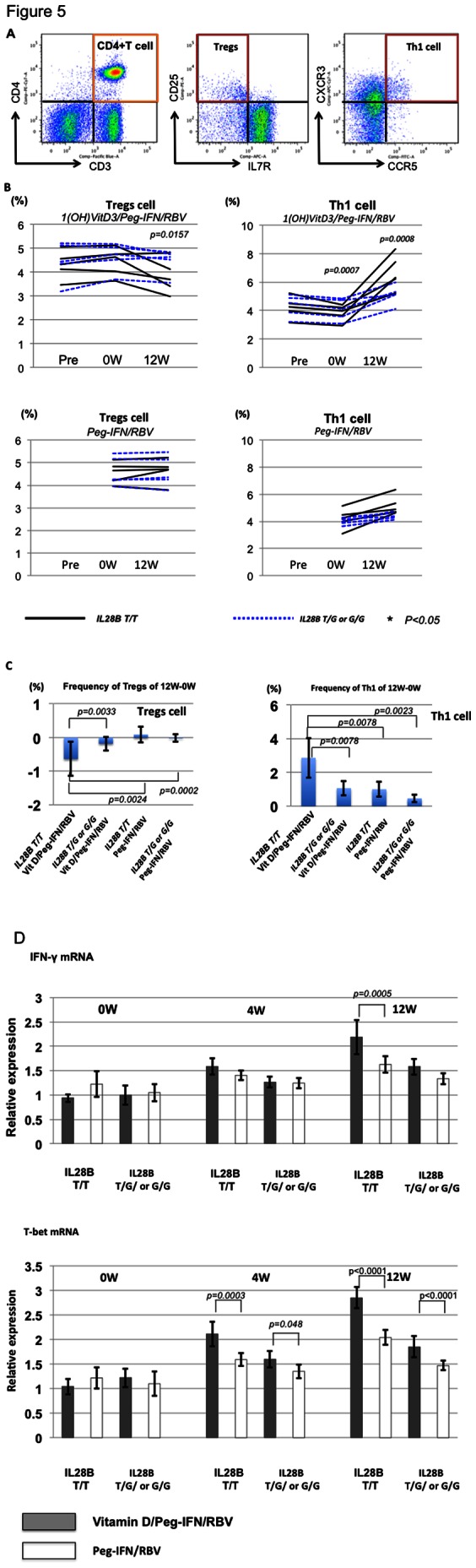
1(OH) vitamin D3/Peg-IFN/RBV treatment could induce rapid viral reduction, especially in IL28B T/T polymorphism. Several kinds of cytokines including IP-10 were significantly decreased after 4 weeks of 1(OH) vitamin D3 treatment (p<0.05). Th1 responses in the subjects treated with 1(OH) vitamin D3/Peg-IFN/RBV were significantly higher than those treated with Peg-IFN/RBV at 12 weeks after Peg-IFN/RBV therapy (p<0.05). The expression of ISGs in the patient's liver biopsy samples was significantly lower than in those treated without 1(OH) vitamin D3 (p<0.05).
1(OH) vitamin D3 could improve the sensitivity of Peg-IFN/RBV therapy on HCV-infected hepatocytes by reducing the IP-10 production from PBMCs and ISGs expression in the liver.
1,25(OH)2 维生素 D3 可影响免疫细胞。然而,1(OH)维生素 D3 成为肝脏中的 1,25(OH)2 维生素 D3 的有利作用的机制尚不清楚。本研究旨在分析 CH-C 患者补充 1(OH)维生素 D3 的免疫反应。
42 例 CH-C 患者接受 1(OH)维生素 D3/聚乙二醇干扰素α/利巴韦林治疗。42 例病例匹配的对照患者接受聚乙二醇干扰素α/利巴韦林治疗。采用实时 PCR 定量肝活检样本和 JFH-1 复制 Huh-7 细胞中的干扰素刺激基因(ISGs)-mRNA 表达。在治疗期间通过悬浮珠阵列定量血浆中的十种细胞因子。使用外周血单个核细胞(PBMC)和 Huh-7 细胞的 Trans-well 共培养系统分析 1(OH)维生素 D3 的作用。比较接受 1(OH)维生素 D3/聚乙二醇干扰素/利巴韦林治疗和单独接受聚乙二醇干扰素/利巴韦林治疗的患者的 Th1 反应活性。
1(OH)维生素 D3/聚乙二醇干扰素/利巴韦林治疗可迅速降低病毒载量,尤其是在 IL28B T/T 多态性中。1(OH)维生素 D3 治疗 4 周后,几种细胞因子(包括 IP-10)明显降低(p<0.05)。接受 1(OH)维生素 D3/聚乙二醇干扰素/利巴韦林治疗的患者在接受聚乙二醇干扰素/利巴韦林治疗 12 周后,Th1 反应明显高于接受聚乙二醇干扰素/利巴韦林治疗的患者(p<0.05)。患者肝活检样本中的 ISGs 表达明显低于未接受 1(OH)维生素 D3 治疗的患者(p<0.05)。
1(OH)维生素 D3 通过减少 PBMC 中 IP-10 的产生和肝脏中 ISGs 的表达,可提高 HCV 感染肝细胞对聚乙二醇干扰素/利巴韦林治疗的敏感性。