School of Marine and Tropical Biology, James Cook University, Townsville, Queensland, Australia.
PLoS One. 2013 May 22;8(5):e64168. doi: 10.1371/journal.pone.0064168. Print 2013.
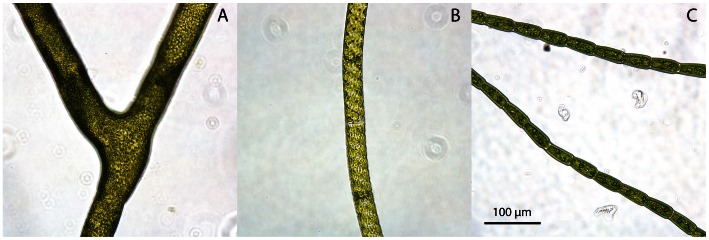
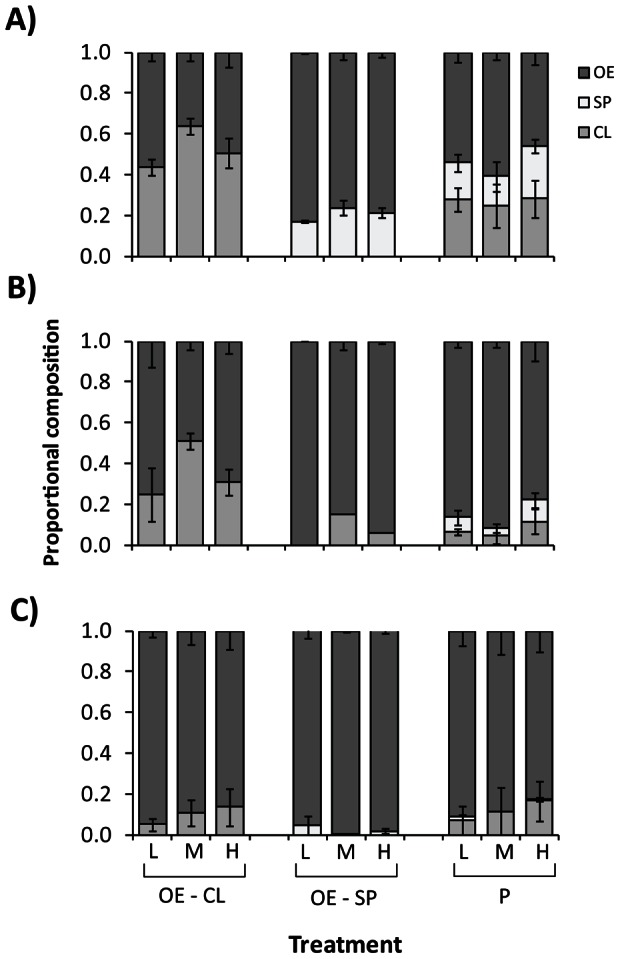
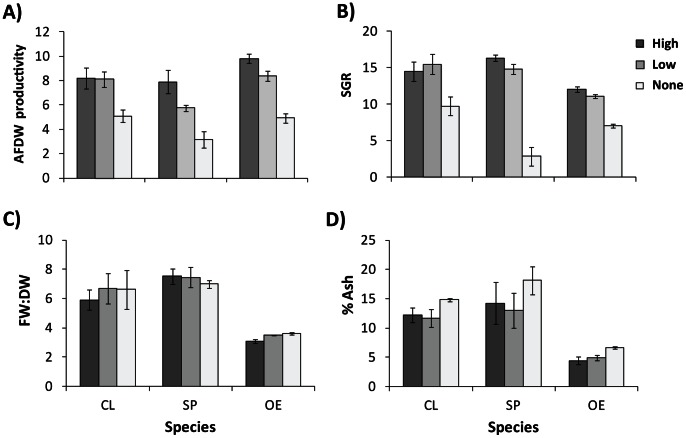
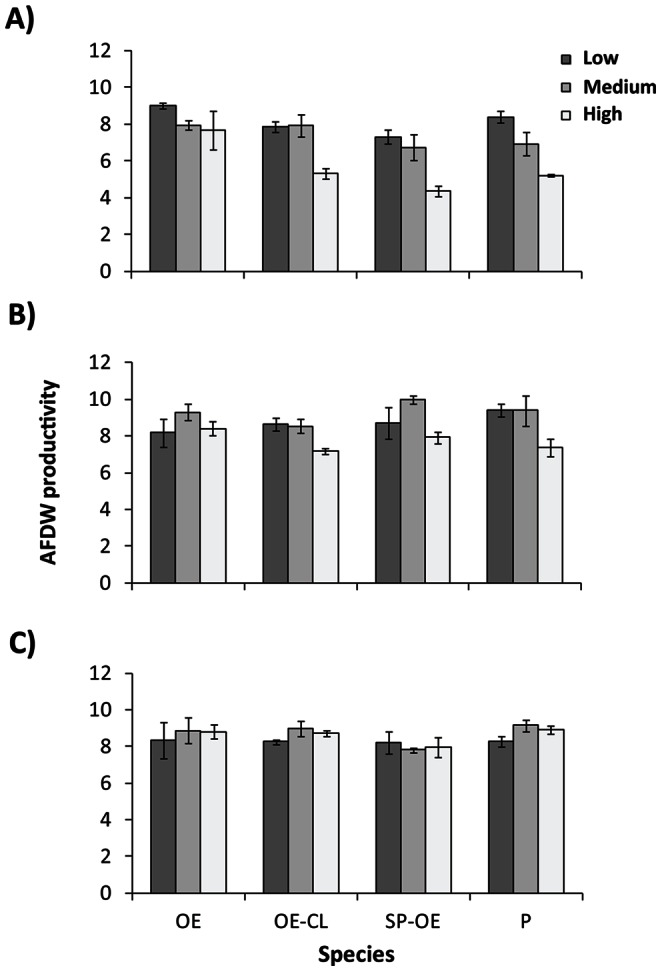
Intensive cultivation of freshwater macroalgae is likely to increase with the development of an algal biofuels industry and algal bioremediation. However, target freshwater macroalgae species suitable for large-scale intensive cultivation have not yet been identified. Therefore, as a first step to identifying target species, we compared the productivity, growth and biochemical composition of three species representative of key freshwater macroalgae genera across a range of cultivation conditions. We then selected a primary target species and assessed its competitive ability against other species over a range of stocking densities. Oedogonium had the highest productivity (8.0 g ash free dry weight m⁻² day⁻¹), lowest ash content (3-8%), lowest water content (fresh weigh: dry weight ratio of 3.4), highest carbon content (45%) and highest bioenergy potential (higher heating value 20 MJ/kg) compared to Cladophora and Spirogyra. The higher productivity of Oedogonium relative to Cladophora and Spirogyra was consistent when algae were cultured with and without the addition of CO₂ across three aeration treatments. Therefore, Oedogonium was selected as our primary target species. The competitive ability of Oedogonium was assessed by growing it in bi-cultures and polycultures with Cladophora and Spirogyra over a range of stocking densities. Cultures were initially stocked with equal proportions of each species, but after three weeks of growth the proportion of Oedogonium had increased to at least 96% (±7 S.E.) in Oedogonium-Spirogyra bi-cultures, 86% (±16 S.E.) in Oedogonium-Cladophora bi-cultures and 82% (±18 S.E.) in polycultures. The high productivity, bioenergy potential and competitive dominance of Oedogonium make this species an ideal freshwater macroalgal target for large-scale production and a valuable biomass source for bioenergy applications. These results demonstrate that freshwater macroalgae are thus far an under-utilised feedstock with much potential for biomass applications.
随着藻类生物燃料产业和藻类生物修复的发展,淡水大型藻类的集约化养殖可能会增加。然而,适合大规模集约化养殖的目标淡水大型藻类物种尚未确定。因此,作为确定目标物种的第一步,我们比较了三种代表关键淡水大型藻类属的物种在一系列培养条件下的生产力、生长和生物化学组成。然后,我们选择了一个主要目标物种,并在一系列放养密度下评估了其对其他物种的竞争能力。与 Cladophora 和 Spirogyra 相比,Oedogonium 的生产力最高(8.0 克无灰干重 m ⁻² 天 ⁻¹ ),灰分含量最低(3-8%),含水量最低(鲜重:干重比为 3.4),碳含量最高(45%),生物能潜力最高(高热值 20 MJ/kg)。当藻类在三种曝气处理下分别进行和不进行 CO₂ 添加的培养时,Oedogonium 相对于 Cladophora 和 Spirogyra 的较高生产力是一致的。因此,Oedogonium 被选为我们的主要目标物种。通过在一系列放养密度下将 Oedogonium 与 Cladophora 和 Spirogyra 进行双培养和多培养来评估 Oedogonium 的竞争能力。培养物最初以各物种的等比例接种,但经过三周的生长,Oedogonium-Spirogyra 双培养物中 Oedogonium 的比例增加到至少 96%(±7 S.E.),Oedogonium-Cladophora 双培养物中增加到 86%(±16 S.E.),多培养物中增加到 82%(±18 S.E.)。Oedogonium 的高生产力、生物能潜力和竞争优势使其成为大规模生产的理想淡水大型藻类目标物种,也是生物能源应用的有价值生物质源。这些结果表明,淡水大型藻类迄今为止是一种利用不足的原料,具有很大的生物质应用潜力。