Centers for Disease Control and Prevention, Atlanta, GA, USA.
AIDS. 2013 Mar 13;27(5):749-59. doi: 10.1097/QAD.0b013e32835ca29f.
To evaluate severe (grade 3/4) morbidity and mortality in HIV-exposed, uninfected infants.
: Secondary data analysis of The Breastfeeding, Antiretrovirals, and Nutrition (BAN) clinical trial.
BAN randomized 2369 mother-infant pairs to maternal, infant, or no extended antiretroviral prophylaxis during breastfeeding. Morbidity outcomes examined were pneumonia/serious febrile illness, diarrhea/growth faltering, and malaria. Infant death was defined as neonatal (≤30 days of life), and postneonatal (31 days to 48 weeks of life). Cox proportional hazards models were used to evaluate the effect of covariates on infant morbidity and mortality.
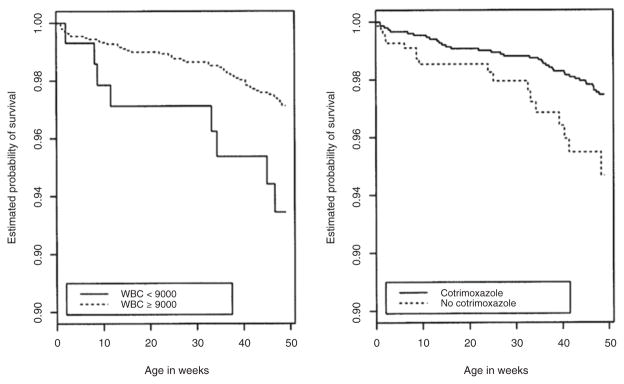
The rate of pneumonia/serious febrile illness was highest in the first 12 weeks (0.83/100 person-weeks) before rapidly decreasing; rates of all morbidity outcomes increased after 24 weeks. Rates of pneumonia/serious febrile illness and diarrhea/growth faltering were higher during the rainy season. Prophylactic infant cotrimoxazole significantly decreased the rates of all morbidity outcomes. White blood cell (WBC) count less than 9000/μl at birth was associated with increased diarrhea/growth faltering [adjusted hazard ratio (aHR) 1.73, P = 0.04] and malaria (aHR 2.18, P = 0.02). Low birth weight (2000-2499 g) was associated with neonatal death (aHR 12.3, P < 0.001). Factors associated with postneonatal death included rainy season (aHR 4.24, P = 0.002), infant cotrimoxazole (aHR 0.48, P = 0.03), and low infant WBC count at birth (aHR 2.53, P = 0.02).
Infant morbidity rates increased after 24 weeks, when BAN infants weaned. Introduction of prophylactic cotrimoxazole was associated with reduced rates of morbidity and mortality in HIV-exposed uninfected infants. Unexpectedly, a low WBC count at birth was significantly associated with later infant morbidity and mortality in this cohort.
评估 HIV 暴露但未感染婴儿的严重(3/4 级)发病率和死亡率。
母乳喂养、抗逆转录病毒和营养(BAN)临床试验的二次数据分析。
BAN 将 2369 对母婴对随机分配至母亲、婴儿或无延长抗逆转录病毒预防的母乳喂养。检查的发病率结果是肺炎/严重发热性疾病、腹泻/生长迟缓以及疟疾。婴儿死亡定义为新生儿(≤30 天的生命)和新生儿后期(31 天至 48 周的生命)。使用 Cox 比例风险模型评估协变量对婴儿发病率和死亡率的影响。
肺炎/严重发热性疾病的发生率在前 12 周(0.83/100 人周)最高,然后迅速下降;所有发病率结果的发生率在 24 周后增加。肺炎/严重发热性疾病和腹泻/生长迟缓的发生率在雨季更高。婴儿预防性复方新诺明显著降低了所有发病率结果的发生率。出生时白细胞(WBC)计数小于 9000/μl 与腹泻/生长迟缓增加相关(调整后的危险比[aHR]1.73,P=0.04)和疟疾(aHR 2.18,P=0.02)。低出生体重(2000-2499 g)与新生儿死亡相关(aHR 12.3,P<0.001)。与新生儿后期死亡相关的因素包括雨季(aHR 4.24,P=0.002)、婴儿复方新诺明(aHR 0.48,P=0.03)和出生时婴儿 WBC 计数低(aHR 2.53,P=0.02)。
当 BAN 婴儿断奶后,婴儿发病率在 24 周后增加。预防性复方新诺明的引入与 HIV 暴露未感染婴儿的发病率和死亡率降低相关。出乎意料的是,该队列中出生时白细胞计数低与后来婴儿发病率和死亡率显著相关。