Discipline of Psychology and Cognitive Neuroscience Research Cluster, School of Health and Human Sciences, Southern Cross University Coffs Harbour, NSW, Australia.
Front Hum Neurosci. 2013 May 15;7:190. doi: 10.3389/fnhum.2013.00190. eCollection 2013.
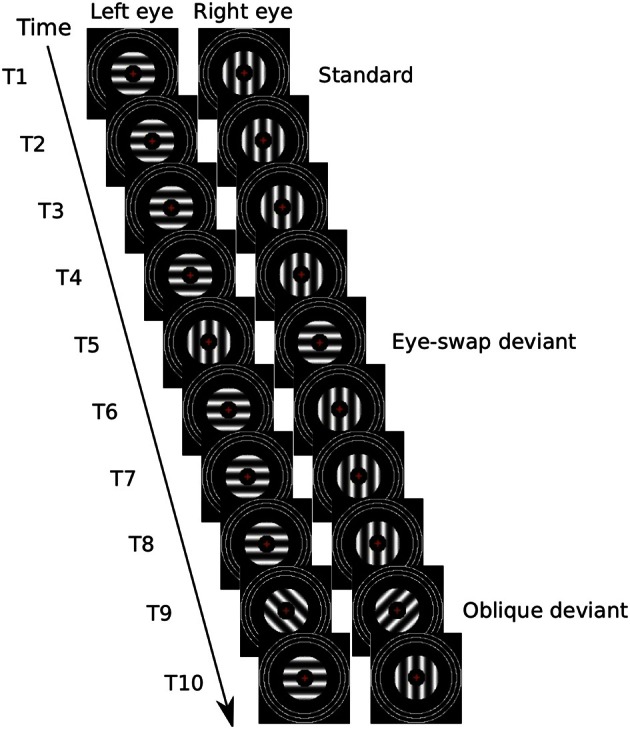
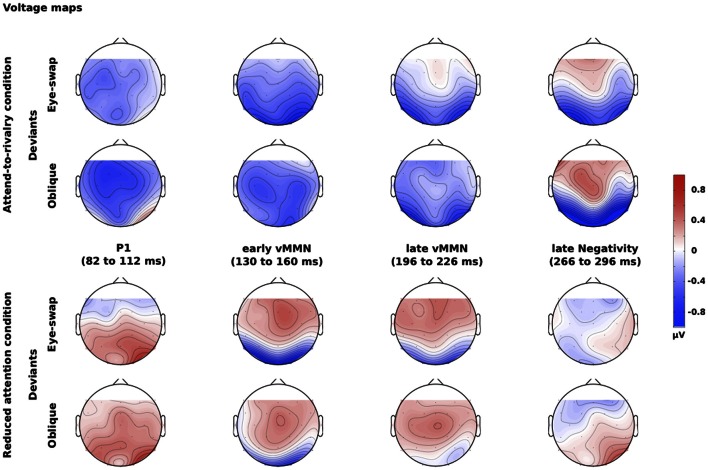
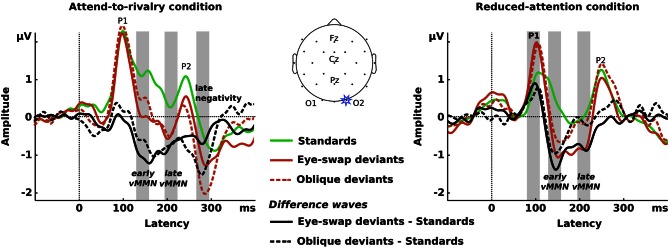
The visual mismatch negativity (vMMN) is a negative deflection in an event-related potential (ERP) between 200 and 400 ms after onset of an infrequent stimulus in a sequence of frequent stimuli. Binocular rivalry occurs when one image is presented to one eye and a different image is presented to the other. Although the images in the two eyes are unchanging, perception alternates unpredictably between the two images for as long as one cares to look. Binocular rivalry, therefore, provides a useful test of whether the vMMN is produced by low levels of the visual system at which the images are processed, or by higher levels at which perception is mediated. To investigate whether a vMMN can be evoked during binocular rivalry, we showed 80% standards comprising a vertical grating to one eye and a horizontal grating to the other and 20% deviants, in which the gratings either swapped between the eyes (eye-swap deviants) or changed their orientations by 45° (oblique deviants). Fourteen participants observed the stimuli in 16, 4-min blocks. In eight consecutive blocks, participants recorded their experiences of rivalry by pressing keys-we call this the attend-to-rivalry condition. In the remaining eight consecutive blocks, participants performed a demanding task at fixation (a 2-back task), also by pressing keys-we call this the reduced-attention condition. We found deviance-related negativity from about 140 ms to about 220 ms after onset of a deviant. There were two noticeable troughs that we call an early vMMN (140-160 ms) and a late vMMN (200-220 ms). These were essentially similar for oblique deviants and eye-swap deviants. They were also essentially similar in the attend-to-rivalry conditions and the reduced-attention conditions. We also found a late, deviance-related negativity from about 270 to about 290 ms in the attend-to-rivalry conditions. We conclude that the vMMN can be evoked during the ever-changing perceptual changes of binocular rivalry and that it is sensitive to the eye of origin of binocular-rivalry stimuli. This is consistent with the vMMN's being produced by low levels of the visual system.
视觉失匹配负波(vMMN)是在一个频繁刺激序列中,当一个不频繁的刺激出现时,在 200 到 400 毫秒之间的事件相关电位(ERP)中的一个负偏转。双眼竞争发生在一只眼睛呈现一个图像,而另一只眼睛呈现一个不同的图像时。尽管两只眼睛中的图像是不变的,但只要有人愿意看,感知就会不可预测地在这两个图像之间交替。因此,双眼竞争为研究 vMMN 是否是由处理图像的视觉系统的较低水平产生的,或者是由感知所介导的较高水平产生的,提供了一个有用的测试方法。为了研究 vMMN 是否可以在双眼竞争期间产生,我们向一只眼睛呈现垂直光栅,向另一只眼睛呈现水平光栅,作为 80%的标准刺激,而 20%的偏差刺激中,光栅在两只眼睛之间交换(眼交换偏差刺激)或改变其方向 45°(倾斜偏差刺激)。14 名参与者在 16 个 4 分钟的块中观察刺激。在连续的 8 个块中,参与者通过按键记录他们的竞争体验——我们称之为关注竞争条件。在剩余的 8 个连续块中,参与者在注视点执行一项艰巨的任务(2 次回溯任务),同样通过按键记录——我们称之为注意力减少条件。我们发现,在偏差刺激出现后约 140 毫秒至 220 毫秒,出现与偏差相关的负性。有两个明显的低谷,我们称之为早期 vMMN(140-160 毫秒)和晚期 vMMN(200-220 毫秒)。对于倾斜偏差刺激和眼交换偏差刺激,这两个波基本相似。在关注竞争条件和注意力减少条件下,它们也基本相似。我们还在关注竞争条件下发现了一个从大约 270 到大约 290 毫秒的与偏差相关的晚期负性。我们的结论是,vMMN 可以在双眼竞争的不断变化的知觉变化期间被激发,并且它对双眼竞争刺激的起源眼敏感。这与 vMMN 由视觉系统的较低水平产生是一致的。