Department of Pharmacy, Pharmaceutical Outcomes Research and Policy Program, University of Washington, Seattle, Washington, USA.
Genet Med. 2013 Nov;15(11):873-81. doi: 10.1038/gim.2013.63. Epub 2013 May 30.
Little is known about the factors that influence patients' preferences for the return of incidental findings from genome sequencing. This study identified attributes of incidental findings that were important to patients and developed a discrete-choice experiment instrument to quantify patient preferences.
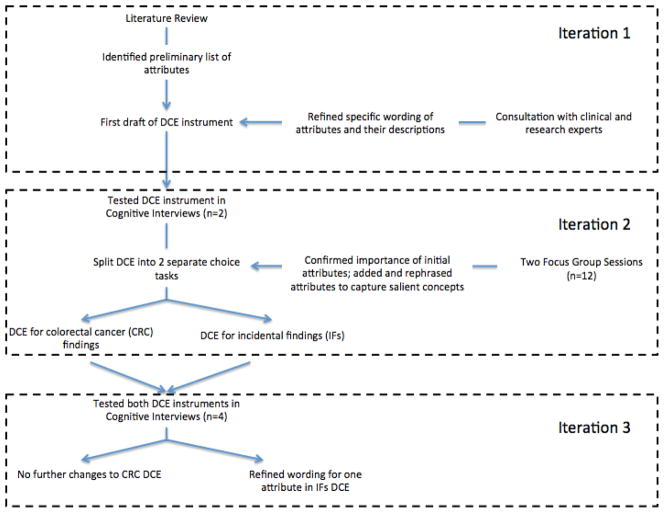
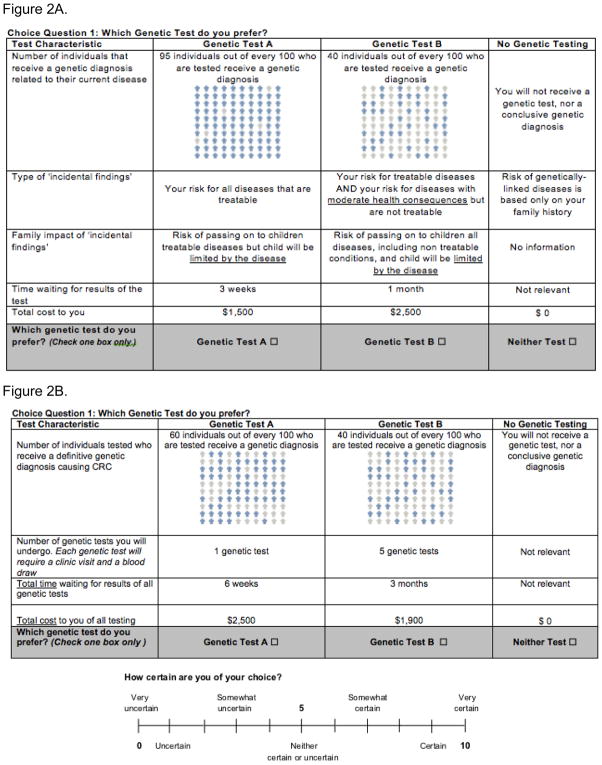
An initial set of key attributes and attribute levels was developed from a literature review and in consultation with experts. The attributes' salience and communication were refined using focus group methodology (n = 12) and cognitive interviews (n = 6) with patients who had received conventional genetic testing for familial colorectal cancer or polyposis syndromes. The attributes and levels used in the hypothetical choices presented to participants were identified using validated experimental design techniques.
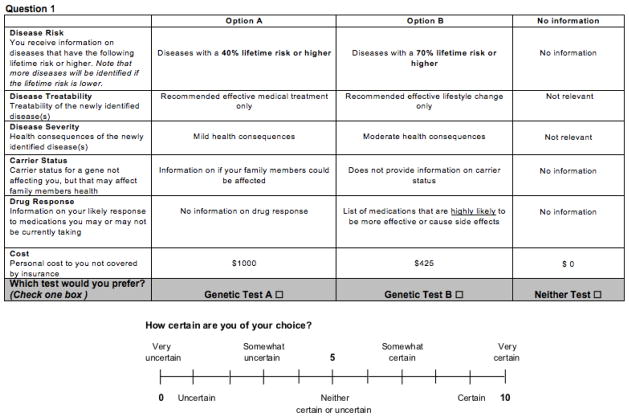
The final discrete-choice experiment instrument incorporates the following attributes and levels: lifetime risk of disease (5, 40, 70%); disease treatability (medical, lifestyle, none); disease severity (mild, moderate, severe); carrier status (yes, no); drug response likelihood (high, moderate, none); and test cost ($250, $425, $1,000, $1,900).
Patient preferences for incidental genomic findings are likely influenced by a complex set of diverse attributes. Quantification of patient preferences can inform patient-provider communication by highlighting the attributes of incidental findings that matter most to patients and warrant further discussion.
对于影响患者对基因组测序偶然发现物返还偏好的因素知之甚少。本研究确定了对患者重要的偶然发现物属性,并开发了一项离散选择实验工具来量化患者偏好。
从文献回顾和与专家协商中确定了一组初始关键属性和属性水平。使用焦点小组方法(n = 12)和与接受过家族性结直肠癌或息肉病综合征常规遗传检测的患者进行的认知访谈(n = 6),对属性的显著性和可传达性进行了细化。参与者提出的假设选择中使用的属性和水平是使用经过验证的实验设计技术确定的。
最终的离散选择实验工具包含以下属性和水平:疾病终生风险(5、40、70%);疾病可治疗性(医学、生活方式、无);疾病严重程度(轻度、中度、重度);携带者状态(是、否);药物反应可能性(高、中、无);和测试成本($250、$425、$1000、$1900)。
偶然基因组发现物的患者偏好可能受到一系列复杂多样的属性的影响。通过突出偶然发现物对患者最重要且需要进一步讨论的属性,对患者偏好进行量化可以为医患沟通提供信息。