Department of Biological Sciences, Virginia Tech, Blacksburg, Virginia, USA.
PLoS Biol. 2013;11(5):e1001570. doi: 10.1371/journal.pbio.1001570. Epub 2013 May 28.
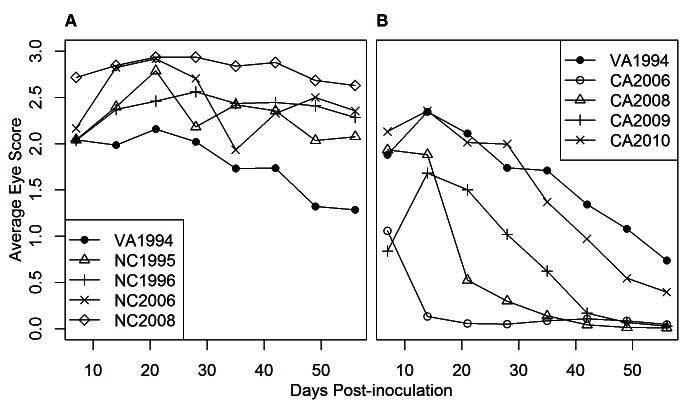
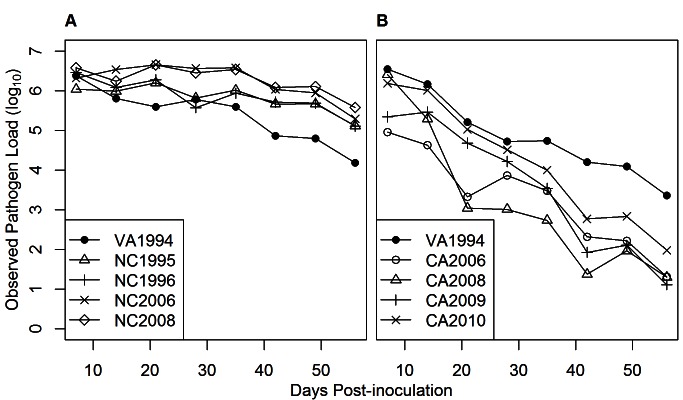
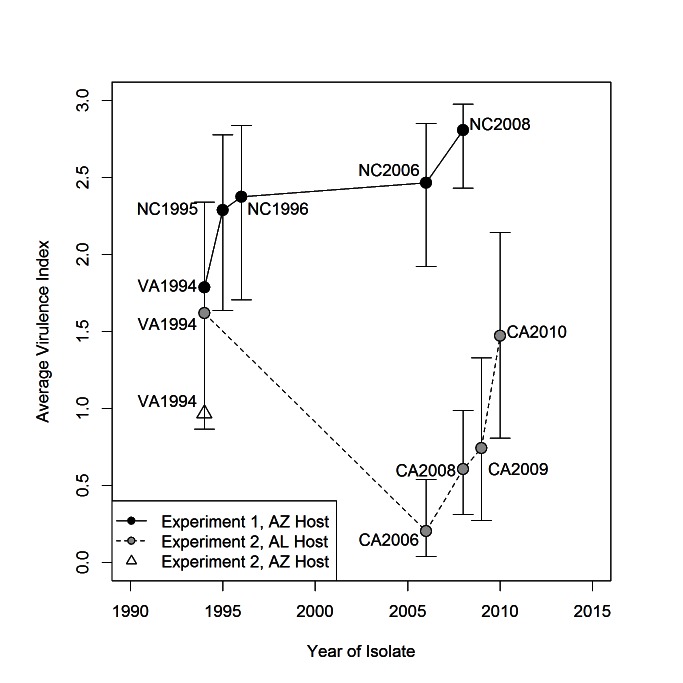
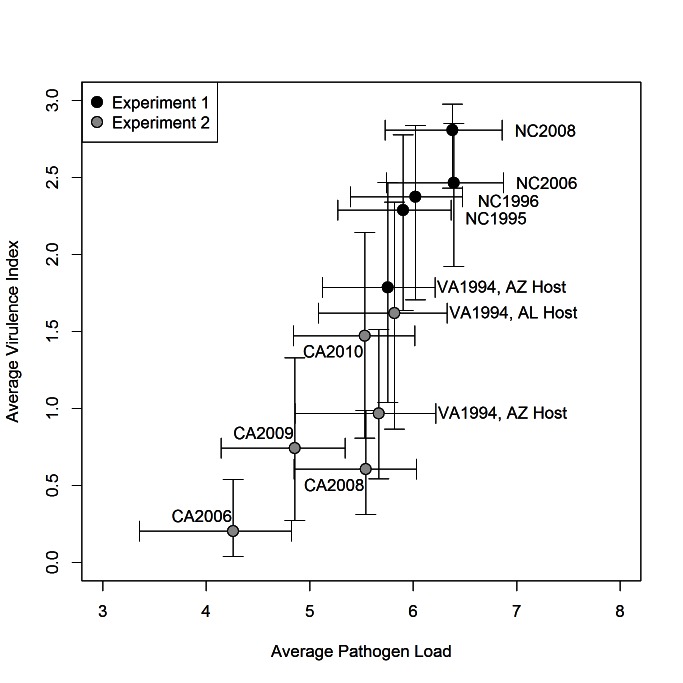
The evolution of higher virulence during disease emergence has been predicted by theoretical models, but empirical studies of short-term virulence evolution following pathogen emergence remain rare. Here we examine patterns of short-term virulence evolution using archived isolates of the bacterium Mycoplasma gallisepticum collected during sequential emergence events in two geographically distinct populations of the host, the North American house finch (Haemorhous [formerly Carpodacus] mexicanus). We present results from two complementary experiments, one that examines the trend in pathogen virulence in eastern North American isolates over the course of the eastern epidemic (1994-2008), and the other a parallel experiment on Pacific coast isolates of the pathogen collected after M. gallisepticum established itself in western North American house finch populations (2006-2010). Consistent with theoretical expectations regarding short-term or dynamic evolution of virulence, we show rapid increases in pathogen virulence on both coasts following the pathogen's establishment in each host population. We also find evidence for positive genetic covariation between virulence and pathogen load, a proxy for transmission potential, among isolates of M. gallisepticum. As predicted by theory, indirect selection for increased transmission likely drove the evolutionary increase in virulence in both geographic locations. Our results provide one of the first empirical examples of rapid changes in virulence following pathogen emergence, and both the detected pattern and mechanism of positive genetic covariation between virulence and pathogen load are consistent with theoretical expectations. Our study provides unique empirical insight into the dynamics of short-term virulence evolution that are likely to operate in other emerging pathogens of wildlife and humans.
理论模型预测了疾病出现期间毒力的进化,但对病原体出现后短期毒力进化的实证研究仍然很少。在这里,我们使用在宿主北美雀形目鸟(家朱雀(Haemorhous [原 Carpodacus] mexicanus))的两个地理上不同的种群中连续出现的事件中收集的细菌支原体(Mycoplasma gallisepticum)的存档分离株来检查短期毒力进化的模式。我们提出了两个互补实验的结果,一个实验研究了在东部北美分离株中病原体毒力在东部流行期间的趋势(1994-2008 年),另一个实验则是对在西部北美家朱雀种群中建立了病原体后收集的太平洋沿岸病原体分离株的平行实验(2006-2010 年)。与有关毒力短期或动态进化的理论预期一致,我们发现病原体在每个宿主种群中建立后,在两个海岸上的病原体毒力都迅速增加。我们还发现了在支原体(Mycoplasma gallisepticum)的分离株中,毒力与病原体载量之间存在正遗传协变的证据,而病原体载量是传播潜力的代理。正如理论所预测的那样,间接选择增加了传播的可能性,这可能导致了在两个地理位置上毒力的进化增加。我们的研究结果提供了在病原体出现后毒力迅速变化的首批实证示例之一,并且在毒力和病原体载量之间检测到的正遗传协变的模式和机制与理论预期一致。我们的研究为野生动物和人类其他新兴病原体的短期毒力进化动态提供了独特的实证见解。