Max Planck Institute for Mathematics, Leipzig, Germany.
PLoS One. 2013 May 27;8(5):e63400. doi: 10.1371/journal.pone.0063400. Print 2013.
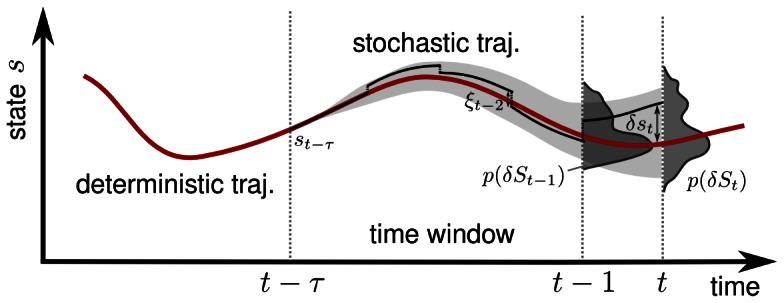
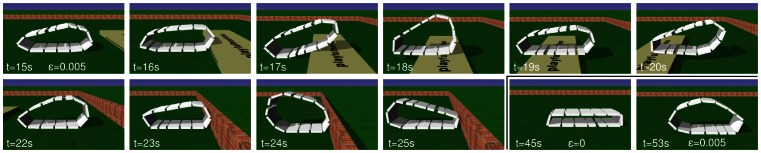
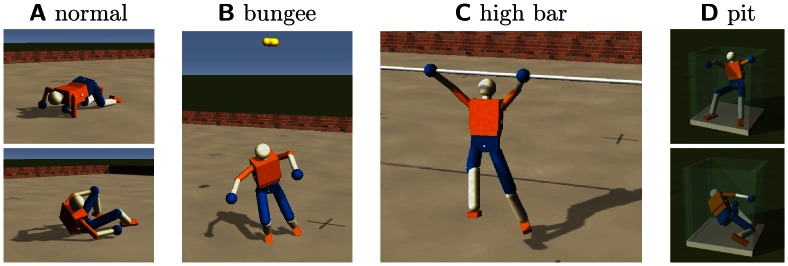
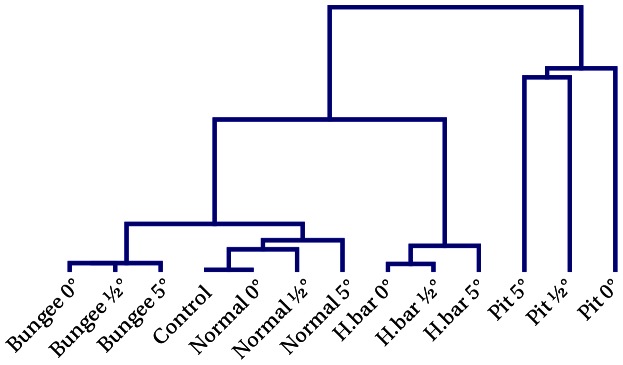
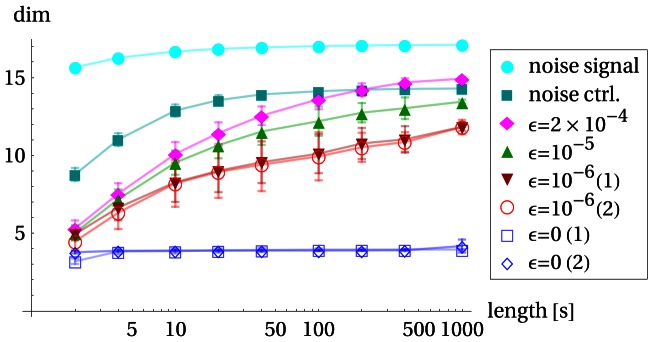
Information theory is a powerful tool to express principles to drive autonomous systems because it is domain invariant and allows for an intuitive interpretation. This paper studies the use of the predictive information (PI), also called excess entropy or effective measure complexity, of the sensorimotor process as a driving force to generate behavior. We study nonlinear and nonstationary systems and introduce the time-local predicting information (TiPI) which allows us to derive exact results together with explicit update rules for the parameters of the controller in the dynamical systems framework. In this way the information principle, formulated at the level of behavior, is translated to the dynamics of the synapses. We underpin our results with a number of case studies with high-dimensional robotic systems. We show the spontaneous cooperativity in a complex physical system with decentralized control. Moreover, a jointly controlled humanoid robot develops a high behavioral variety depending on its physics and the environment it is dynamically embedded into. The behavior can be decomposed into a succession of low-dimensional modes that increasingly explore the behavior space. This is a promising way to avoid the curse of dimensionality which hinders learning systems to scale well.
信息论是表达驱动自主系统的原则的有力工具,因为它具有领域不变性并且允许直观的解释。本文研究了将传感器运动过程的预测信息(PI),也称为剩余熵或有效度量复杂度,用作生成行为的驱动力的用途。我们研究了非线性和非平稳系统,并引入了时间局部预测信息(TiPI),这使我们能够在动态系统框架中推导出精确的结果以及控制器参数的显式更新规则。通过这种方式,在行为层面制定的信息原则被转化为突触的动力学。我们用一些具有高维机器人系统的案例研究来支持我们的结果。我们展示了具有分散控制的复杂物理系统中的自发协同作用。此外,一个共同控制的仿人机器人根据其物理特性和动态嵌入的环境,发展出高度的行为多样性。行为可以分解为一系列低维模式,这些模式越来越多地探索行为空间。这是一种有前途的方法,可以避免阻碍学习系统良好扩展的维数灾难。