Intensive Care Unit, Department of Anesthesiology and Critical Care Medicine, Estaing Hospital, CHU Clermont-Ferrand, Université d'Auvergne Clermont Ferrand 1, Clermont-Ferrand, France.
PLoS One. 2013 May 27;8(5):e64083. doi: 10.1371/journal.pone.0064083. Print 2013.
Postextubation distress after a successful spontaneous breathing trial (SBT) is associated with increased morbidity and mortality. Lung ultrasound determination of changes in lung aeration predicts weaning failure. It remains unknown whether this derecruitment is related to alveolar epithelial dysfunction or not.
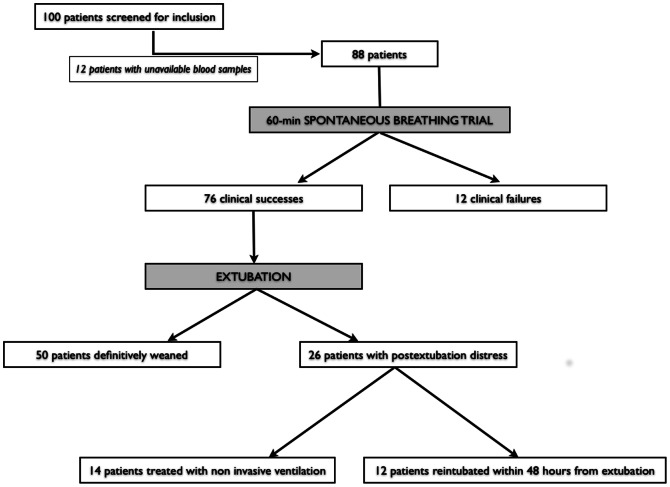
To verify whether lung alveolar type I epithelial cell injury marker sRAGE (soluble form of the receptor for advanced glycation end-products) is predictive of postextubation distress and weaning failure or not, and to verify whether plasma sRAGE levels can be related to lung derecruitment during the process of weaning from mechanical ventilation or not. INTERVENTIONS MEASUREMENTS: 88 patients from 2 intensive care units were included in this observational prospective study. Plasma sRAGE levels were measured in duplicate by ELISA before, at the end of a 60-minute SBT, and 4 hours after extubation. To quantify lung aeration, a lung ultrasound score was calculated.
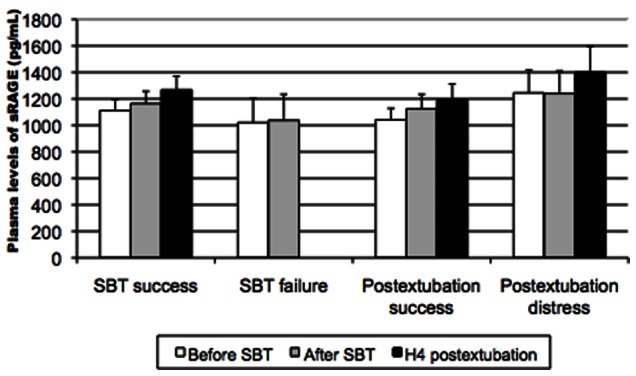
34% of extubated patients experienced postextubation distress. Patients with or without postextubation distress had comparable sRAGE levels before SBT, after SBT, and 4 hours after extubation. In patients with postextubation distress, sRAGE levels were not predictive of the need for mechanical ventilation. sRAGE levels were not associated with lung aeration as assessed by echography. Patients who succeeded SBT (86%) and those who failed (14%) had no differences in sRAGE levels, before (median 1111 vs 1021 pg/mL, p = 0,87) and at the end of SBT (1165 vs 1038 pg/mL, p = 0.74).
Plasma levels of sRAGE do not predict postextubation distress or SBT failure/success in patients weaning from mechanical ventilation. Lung aeration loss during a successful weaning trial predicts postextubation distress, but may not be evaluable by plasma levels of sRAGE, a marker of alveolar type I epithelial cell injury.
ClinicalTrials.gov NCT01098773.
成功自主呼吸试验(SBT)后的拔管后不适与发病率和死亡率增加有关。肺超声确定的肺充气变化可预测脱机失败。尚不清楚这种去募集是否与肺泡上皮功能障碍有关。
验证肺泡 I 型上皮细胞损伤标志物 sRAGE(晚期糖基化终产物受体的可溶性形式)是否可预测拔管后不适和脱机失败,并验证血浆 sRAGE 水平是否与机械通气脱机过程中的肺去募集有关。
这项观察性前瞻性研究纳入了来自 2 个重症监护病房的 88 例患者。通过 ELISA 重复测量患者在 SBT 前、SBT 结束时和拔管后 4 小时的血浆 sRAGE 水平。为了量化肺充气,计算了肺超声评分。
34%的拔管患者出现拔管后不适。有无拔管后不适的患者在 SBT 前、SBT 后和拔管后 4 小时的 sRAGE 水平无差异。在有拔管后不适的患者中,sRAGE 水平不能预测需要机械通气。sRAGE 水平与超声评估的肺充气无相关性。成功通过 SBT 的患者(86%)和未通过的患者(14%)的 sRAGE 水平无差异,在 SBT 前(中位数 1111 比 1021 pg/mL,p=0.87)和 SBT 结束时(中位数 1165 比 1038 pg/mL,p=0.74)。
在从机械通气中脱机的患者中,血浆 sRAGE 水平不能预测拔管后不适或 SBT 失败/成功。成功脱机试验期间的肺充气损失可预测拔管后不适,但可能无法通过 sRAGE 水平评估,sRAGE 是肺泡 I 型上皮细胞损伤的标志物。
ClinicalTrials.gov NCT01098773。