State Key Laboratory of Oncology in South China, Guangzhou, China.
PLoS One. 2013 May 28;8(5):e64158. doi: 10.1371/journal.pone.0064158. Print 2013.
C-reactive protein (CRP) is a biomarker of the inflammatory response, and it shows significant prognostic value for several types of solid tumors. The prognostic significance of CRP for lymphoma has not been fully examined. We evaluated the prognostic role of baseline serum CRP levels in patients with extranodal natural killer (NK)/T-cell lymphoma (ENKTL).
We retrospectively analyzed 185 patients with newly diagnosed ENKTL. The prognostic value of the serum CRP level was evaluated for the low-CRP group (CRP≤10 mg/L) versus the high-CRP group (CRP>10 mg/L). The prognostic value of the International Prognostic Index (IPI) and the Korean Prognostic Index (KPI) were evaluated and compared with the newly developed prognostic model.
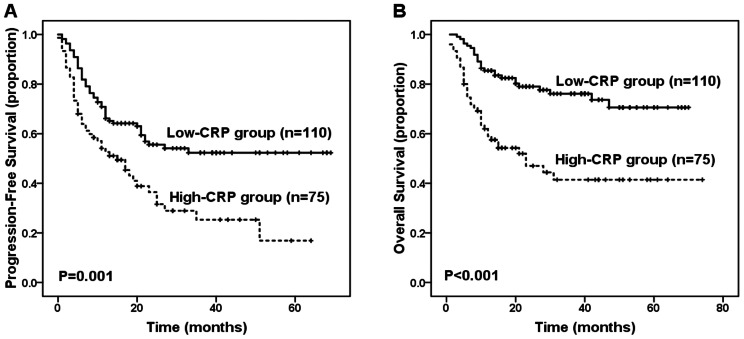
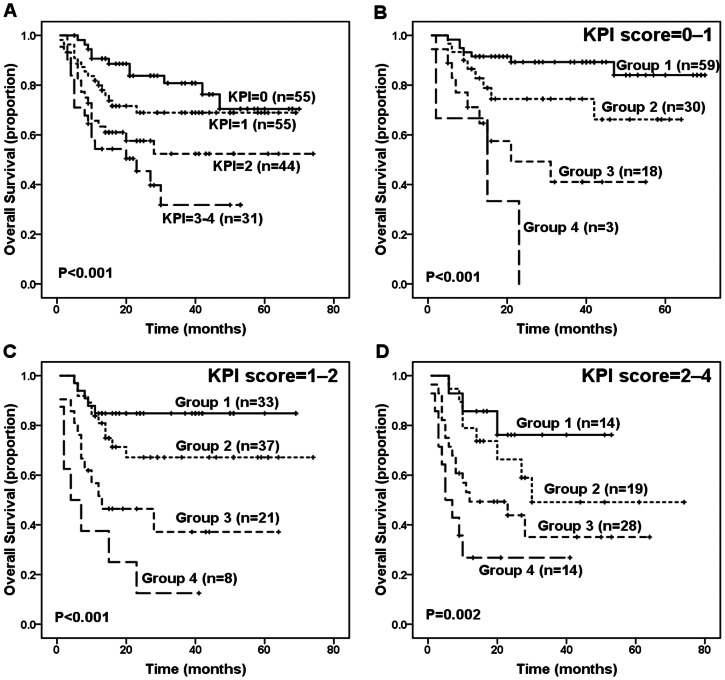
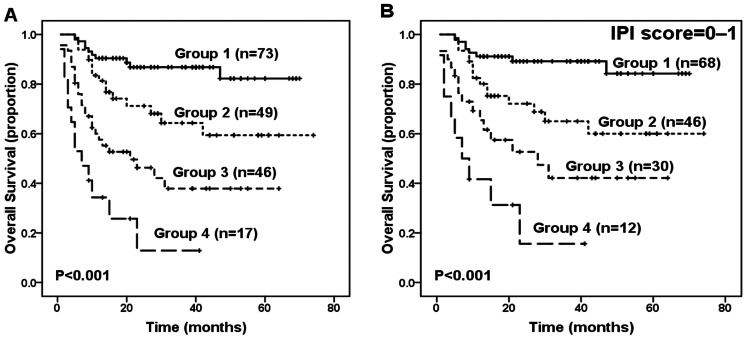
Patients in the high-CRP group tended to display increased adverse clinical characteristics, lower rates of complete remission (P<0.001), inferior progression-free survival (PFS, P = 0.001), and inferior overall survival (OS, P<0.001). Multivariate analysis demonstrated that elevated serum CRP levels, age >60 years, hypoalbuminemia, and elevated lactate dehydrogenase levels were independent adverse predictors of OS. Based on these four independent predictors, we constructed a new prognostic model that identified 4 groups with varying OS: group 1, no adverse factors; group 2, 1 factor; group 3, 2 factors; and group 4, 3 or 4 factors (P<0.001). The novel prognostic model was found to be superior to both the IPI in discriminating patients with different outcomes in the IPI low-risk group and the KPI in distinguishing between the low- and intermediate-low-risk groups, the intermediate-low- and high-intermediate-risk groups, and the high-intermediate- and high-risk groups.
Our results suggest that pretreatment serum CRP levels represent an independent predictor of clinical outcome for patients with ENKTL. The prognostic value of the new prognostic model is superior to both IPI and KPI.
C 反应蛋白(CRP)是炎症反应的生物标志物,它对多种实体瘤具有显著的预后价值。CRP 对淋巴瘤的预后意义尚未得到充分研究。我们评估了基线血清 CRP 水平对结外自然杀伤(NK)/T 细胞淋巴瘤(ENKTL)患者的预后作用。
我们回顾性分析了 185 例新诊断的 ENKTL 患者。评估低 CRP 组(CRP≤10mg/L)与高 CRP 组(CRP>10mg/L)的血清 CRP 水平的预后价值。评估国际预后指数(IPI)和韩国预后指数(KPI)的预后价值,并与新开发的预后模型进行比较。
高 CRP 组患者表现出更多的不良临床特征,完全缓解率较低(P<0.001),无进展生存期(PFS,P=0.001)和总生存期(OS,P<0.001)更差。多因素分析表明,升高的血清 CRP 水平、年龄>60 岁、低白蛋白血症和升高的乳酸脱氢酶水平是 OS 的独立不良预测因素。基于这四个独立的预测因素,我们构建了一个新的预后模型,该模型将患者分为 4 组,OS 不同:组 1,无不良因素;组 2,1 个因素;组 3,2 个因素;组 4,3 个或 4 个因素(P<0.001)。新的预后模型在区分 IPI 低危组不同结局的患者和区分低危和中低危组、中低危和高中危组、高中危和高危组的 KPI 方面优于 IPI 和 KPI。
我们的结果表明,治疗前血清 CRP 水平是 ENKTL 患者临床结局的独立预测因素。新预后模型的预后价值优于 IPI 和 KPI。