School of Cancer Sciences, Birmingham Cancer Research UK Centre, Birmingham, United Kingdom.
PLoS One. 2013 May 27;8(5):e64868. doi: 10.1371/journal.pone.0064868. Print 2013.
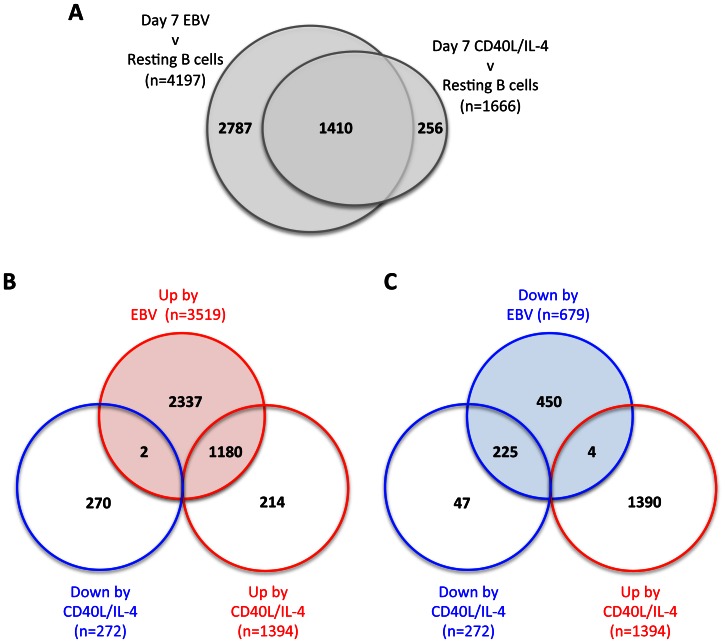
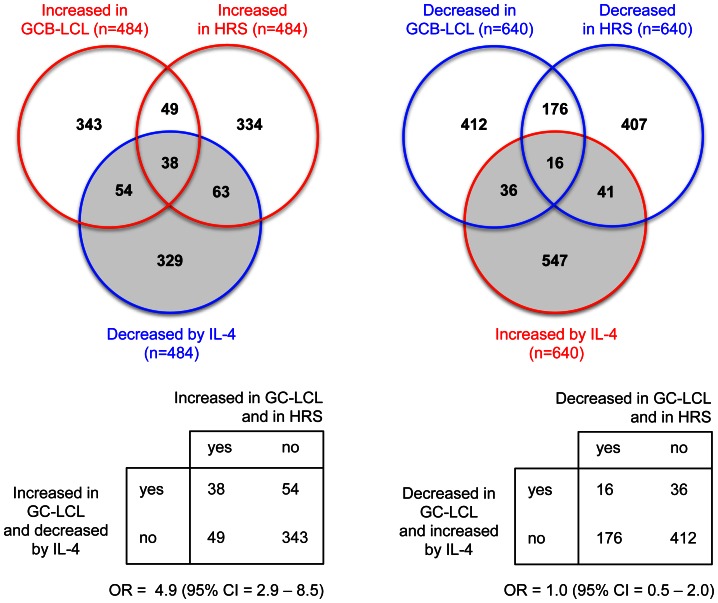
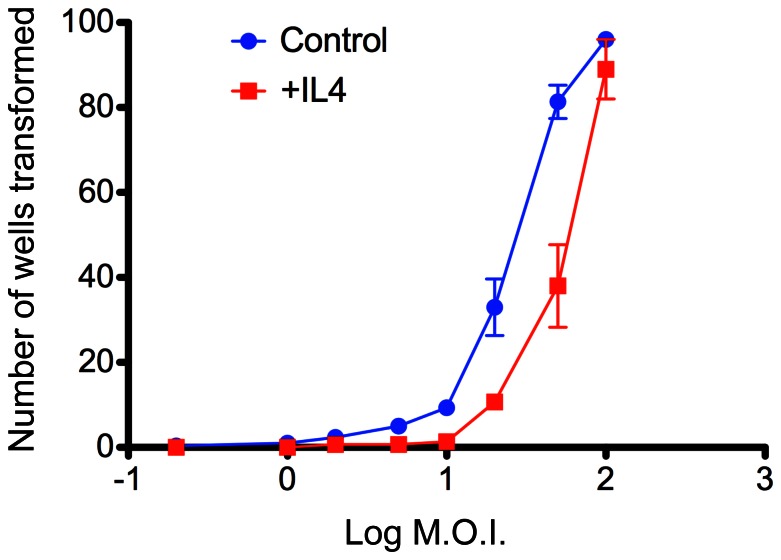
Epstein-Barr virus (EBV) is an oncogenic virus that is associated with the pathogenesis of several human lymphoid malignancies, including Hodgkin's lymphoma. Infection of normal resting B cells with EBV results in activation to lymphoblasts that are phenotypically similar to those generated by physiological stimulation with CD40L plus IL-4. One important difference is that infection leads to the establishment of permanently growing lymphoblastoid cell lines, whereas CD40L/IL-4 blasts have finite proliferation lifespans. To identify early events which might later determine why EBV infected blasts go on to establish transformed cell lines, we performed global transcriptome analyses on resting B cells and on EBV and CD40L/IL-4 blasts after 7 days culture. As anticipated there was considerable overlap in the transcriptomes of the two types of lymphoblasts when compared to the original resting B cells, reflecting common changes associated with lymphocyte activation and proliferation. Of interest to us was a subset of 255 genes that were differentially expressed between EBV and CD40L/IL-4 blasts. Genes which were more highly expressed in EBV blasts were substantially and significantly enriched for a set of interferon-stimulated genes which on further in silico analyses were found to be repressed by IL-4 in other cell contexts and to be up-regulated in micro-dissected malignant cells from Hodgkin's lymphoma biopsies when compared to their normal germinal center cell counterparts. We hypothesized that EBV and IL-4 were targeting and discordantly regulating a common set of genes. This was supported experimentally in our B cell model where IL-4 stimulation partially reversed transcriptional changes which follow EBV infection and it impaired the efficiency of EBV-induced B cell transformation. Taken together, these data suggest that the discordant regulation of interferon and IL-4 pathway genes by EBV that occurs early following infection of B cells has relevance to the development or maintenance of an EBV-associated malignancy.
EB 病毒(EBV)是一种致癌病毒,与几种人类淋巴恶性肿瘤的发病机制有关,包括霍奇金淋巴瘤。EBV 感染静止的 B 细胞会导致其激活为淋巴母细胞,其表型与生理刺激 CD40L 和 IL-4 产生的相似。一个重要的区别是,感染会导致永久性生长的淋巴母细胞系的建立,而 CD40L/IL-4 母细胞具有有限的增殖寿命。为了确定可能导致 EBV 感染母细胞继续建立转化细胞系的早期事件,我们对静止的 B 细胞以及 EBV 和 CD40L/IL-4 母细胞在培养 7 天后进行了全转录组分析。如预期的那样,与原始静止的 B 细胞相比,两种类型的淋巴母细胞的转录组有很大的重叠,反映了与淋巴细胞激活和增殖相关的常见变化。我们感兴趣的是一组 255 个基因,它们在 EBV 和 CD40L/IL-4 母细胞之间的表达存在差异。在 EBV 母细胞中表达更高的基因在一组干扰素刺激基因中显著富集,进一步的计算机分析发现,这些基因在其他细胞环境中被 IL-4 抑制,并且在霍奇金淋巴瘤活检中的恶性细胞与正常生发中心细胞相比时被上调。我们假设 EBV 和 IL-4 针对并失调地调节一组共同的基因。在我们的 B 细胞模型中,实验支持了这一假设,其中 IL-4 刺激部分逆转了 EBV 感染后的转录变化,并降低了 EBV 诱导的 B 细胞转化的效率。综上所述,这些数据表明,EBV 在感染 B 细胞后早期对干扰素和 IL-4 通路基因的失调调节与 EBV 相关恶性肿瘤的发生或维持有关。