National Institute of Allergy of Infectious Disease, National Institutes of Health, 12735 Twinbrook Parkway, Rockville, MD 20852, USA.
BMC Evol Biol. 2013 May 31;13:110. doi: 10.1186/1471-2148-13-110.
The var genes of the human malaria parasite Plasmodium falciparum are highly polymorphic loci coding for the erythrocyte membrane proteins 1 (PfEMP1), which are responsible for the cytoaherence of P. falciparum infected red blood cells to the human vasculature. Cytoadhesion, coupled with differential expression of var genes, contributes to virulence and allows the parasite to establish chronic infections by evading detection from the host's immune system. Although studying genetic diversity is a major focus of recent work on the var genes, little is known about the gene family's origin and evolutionary history.
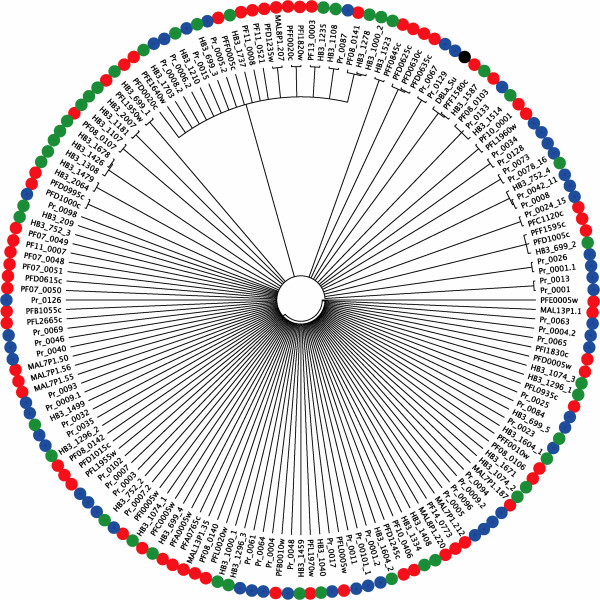
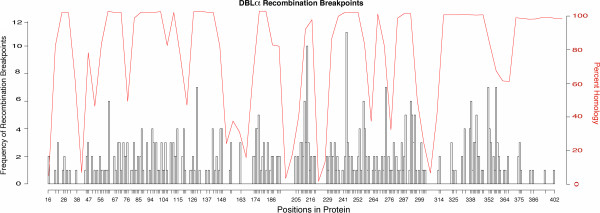
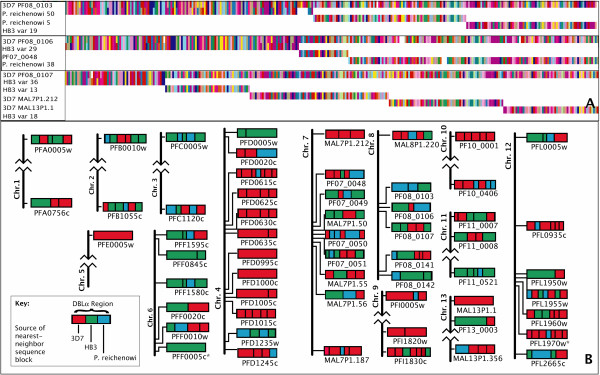
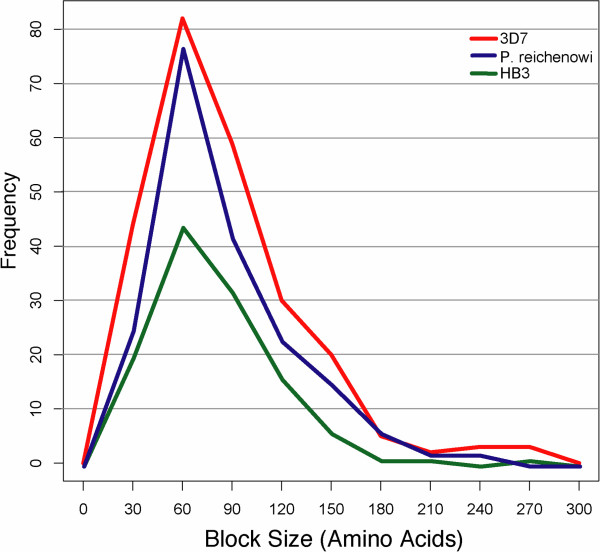
Using a novel hidden Markov model-based approach and var sequences assembled from additional isolates and species, we are able to reveal elements of both the early evolution of the var genes as well as recent diversifying events. We compare sequences of the var gene DBLα domains from divergent isolates of P. falciparum (3D7 and HB3), and a closely-related species, Plasmodium reichenowi. We find that the gene family is equally large in P. reichenowi and P. falciparum -- with a minimum of 51 var genes in the P. reichenowi genome (compared to 61 in 3D7 and a minimum of 48 in HB3). In addition, we are able to define large, continuous blocks of homologous sequence among P. falciparum and P. reichenowi var gene DBLα domains. These results reveal that the contemporary structure of the var gene family was present before the divergence of P. falciparum and P. reichenowi, estimated to be between 2.5 to 6 million years ago. We also reveal that recombination has played an important and traceable role in both the establishment, and the maintenance, of diversity in the sequences.
Despite the remarkable diversity and rapid evolution found in these loci within and among P. falciparum populations, the basic structure of these domains and the gene family is surprisingly old and stable. Revealing a common structure as well as conserved sequence among two species also has implications for developing new primate-parasite models for studying the pathology and immunology of falciparum malaria, and for studying the population genetics of var genes and associated virulence phenotypes.
人类疟原虫恶性疟原虫的 var 基因是高度多态性的基因座,编码红细胞膜蛋白 1(PfEMP1),其负责恶性疟原虫感染的红细胞与人类脉管系统的细胞附着。细胞附着,加上 var 基因的差异表达,有助于致病力,并使寄生虫通过逃避宿主免疫系统的检测而建立慢性感染。尽管研究 var 基因的遗传多样性是当前工作的主要重点,但对该基因家族的起源和进化历史知之甚少。
使用一种新颖的基于隐马尔可夫模型的方法和从其他分离株和物种中组装的 var 序列,我们能够揭示 var 基因早期进化的元素以及最近的多样化事件。我们比较了恶性疟原虫(3D7 和 HB3)和密切相关的物种恶性疟原虫 reichenowi 的 var 基因 DBLα 结构域的序列。我们发现基因家族在恶性疟原虫 reichenowi 和恶性疟原虫中同样庞大-恶性疟原虫 reichenowi 基因组中至少有 51 个 var 基因(与 3D7 中的 61 个和 HB3 中的 48 个相比)。此外,我们能够在恶性疟原虫和恶性疟原虫 reichenowi var 基因 DBLα 结构域之间定义同源序列的大连续块。这些结果表明,当代 var 基因家族的结构存在于恶性疟原虫和恶性疟原虫 reichenowi 分化之前,估计在 250 万至 600 万年前。我们还揭示了重组在序列的建立和多样性的维持中都发挥了重要且可追踪的作用。
尽管在恶性疟原虫群体内部和之间的这些基因座中发现了显著的多样性和快速进化,但这些结构域和基因家族的基本结构却非常古老且稳定。在两个物种之间揭示共同的结构和保守序列也对开发用于研究恶性疟原虫疟疾的病理学和免疫学以及研究 var 基因和相关毒力表型的种群遗传学的新灵长类寄生虫模型具有重要意义。