Department of Neurophysiology, Hamamatsu University School of Medicine, Hamamatsu 431-3192, Japan.
J Physiol. 2013 Aug 15;591(16):3901-17. doi: 10.1113/jphysiol.2013.257162. Epub 2013 Jun 3.
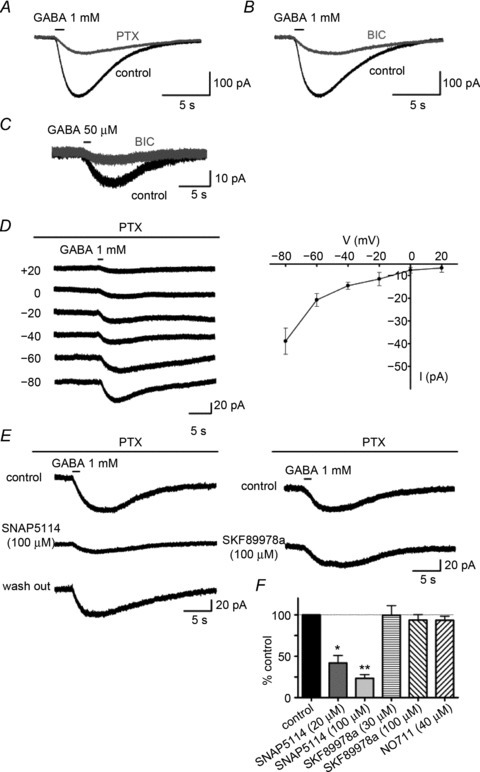
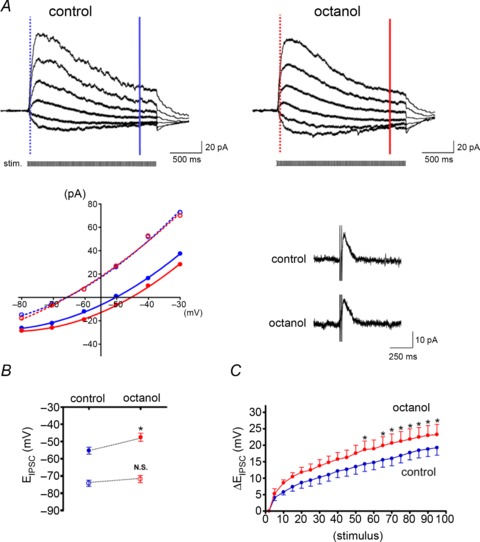
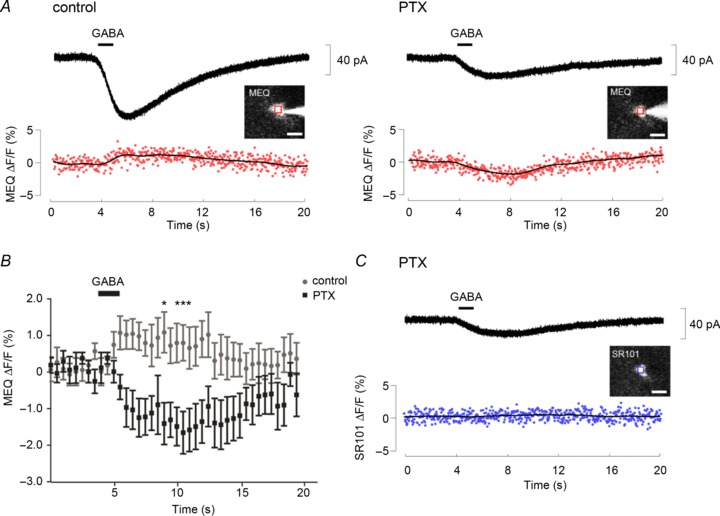
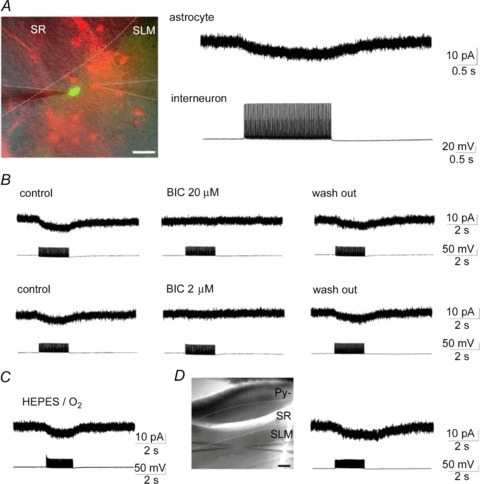
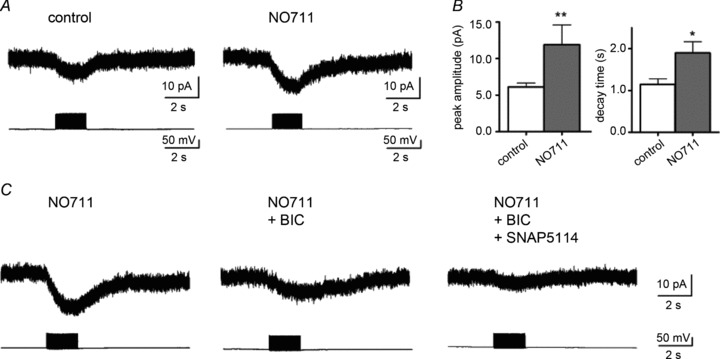
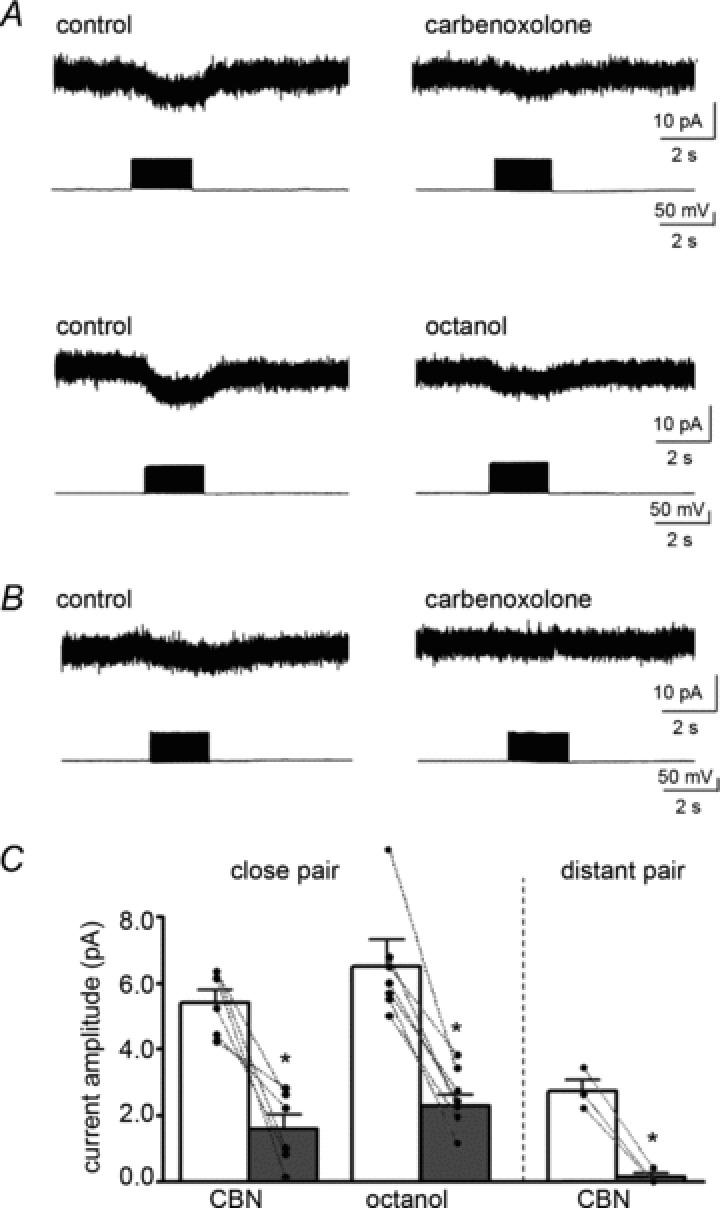
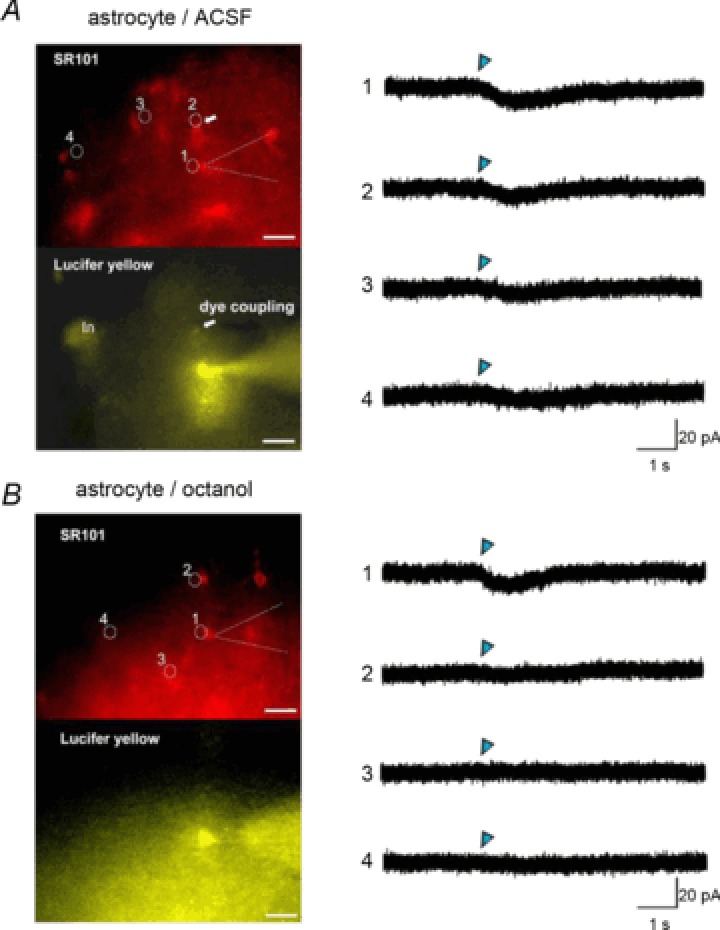
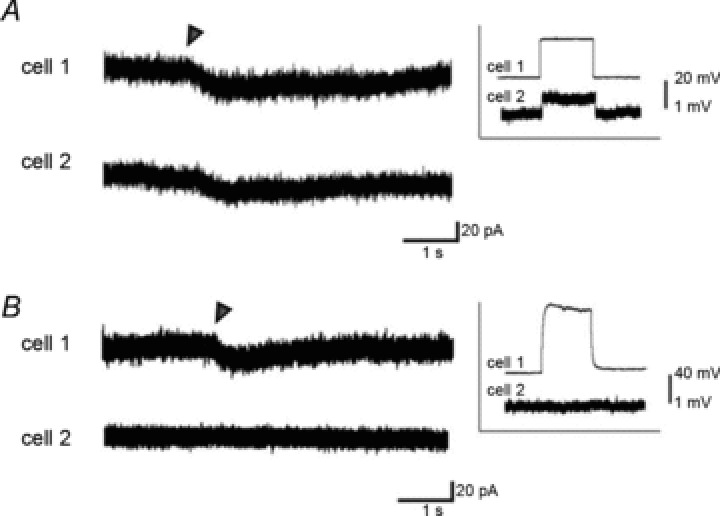
The electrophysiological properties and functional role of GABAergic signal transmission from neurons to the gap junction-coupled astrocytic network are still unclear. GABA-induced astrocytic Cl⁻ flux has been hypothesized to affect the driving force for GABAergic transmission by modulating [Cl⁻]o. Thus, revealing the properties of GABA-mediated astrocytic responses will deepen our understanding of GABAergic signal transmission. Here, we analysed the Cl⁻ dynamics of neurons and astrocytes in CA1 hippocampal GABAergic tripartite synapses, using Cl⁻ imaging during GABA application, and whole cell recordings from interneuron-astrocyte pairs in the stratum lacunosum-moleculare. Astrocytic [Cl⁻]i was adjusted to physiological conditions (40 mm). Although GABA application evoked bidirectional Cl⁻ flux via GABAA receptors and mouse GABA transporter 4 (mGAT4) in CA1 astrocytes, a train of interneuron firing induced only GABAA receptor-mediated inward currents in an adjacent astrocyte. A GAT1 inhibitor increased the interneuron firing-induced currents and induced bicuculline-insensitive, mGAT4 inhibitor-sensitive currents, suggesting that synaptic spillover of GABA predominantly induced the astrocytic Cl⁻ efflux because GABAA receptors are localized near the synaptic clefts. This GABA-induced Cl⁻ efflux was accompanied by Cl⁻ siphoning via the gap junctions of the astrocytic network because gap junction inhibitors significantly reduced the interneuron firing-induced currents. Thus, Cl⁻ efflux from astrocytes is homeostatically maintained within astrocytic networks. A gap junction inhibitor enhanced the activity-dependent depolarizing shifts of reversal potential of neuronal IPSCs evoked by repetitive stimulation to GABAergic synapses. These results suggest that Cl⁻ conductance within the astrocytic network may contribute to maintaining GABAergic synaptic transmission by regulating [Cl⁻]o.
神经元到缝隙连接偶联星形胶质细胞网络的 GABA 能信号传递的电生理特性和功能作用尚不清楚。GABA 诱导的星形胶质细胞 Cl⁻流通过调节 [Cl⁻]o 被假设为影响 GABA 能传递的驱动力。因此,揭示 GABA 介导的星形胶质细胞反应的特性将加深我们对 GABA 能信号传递的理解。在这里,我们使用 Cl⁻成像在 GABA 应用期间分析 CA1 海马 GABA 能三突触中的神经元和星形胶质细胞的 Cl⁻动力学,并在腔隙 - 分子层中的中间神经元 - 星形胶质细胞对中进行全细胞记录。将星形胶质细胞 [Cl⁻]i 调整为生理条件(40mm)。尽管 GABA 应用通过 GABAA 受体和小鼠 GABA 转运蛋白 4(mGAT4)在 CA1 星形胶质细胞中诱发双向 Cl⁻流,但一连串中间神经元放电仅在相邻星形胶质细胞中诱导 GABAA 受体介导的内向电流。GAT1 抑制剂增加了中间神经元放电诱导的电流,并诱导了不敏感于bicuculline、敏感于 mGAT4 抑制剂的电流,表明 GABA 的突触外溢主要诱导了星形胶质细胞 Cl⁻外流,因为 GABAA 受体位于突触小间隙附近。这种 GABA 诱导的 Cl⁻外流伴随着通过星形胶质细胞网络的缝隙连接的 Cl⁻虹吸,因为缝隙连接抑制剂显著降低了中间神经元放电诱导的电流。因此,星形胶质细胞内的 Cl⁻外流在星形胶质细胞网络内被维持在稳态。缝隙连接抑制剂增强了重复刺激 GABA 能突触时神经元 IPSC 反转电位的活性依赖性去极化偏移。这些结果表明,星形胶质细胞网络内的 Cl⁻电导可能通过调节 [Cl⁻]o 有助于维持 GABA 能突触传递。