School of Medicine and Pharmacology, University of Western Australia, Perth, Western Australia, Australia.
Nutr Diabetes. 2013 Jun 3;3(6):e72. doi: 10.1038/nutd.2013.15.
To examine if clustering of cardiometabolic risk factors in pregnancy predicts type 2 diabetes and cardiovascular disease (CVD) risk at 10 years in women with gestational diabetes mellitus (GDM).
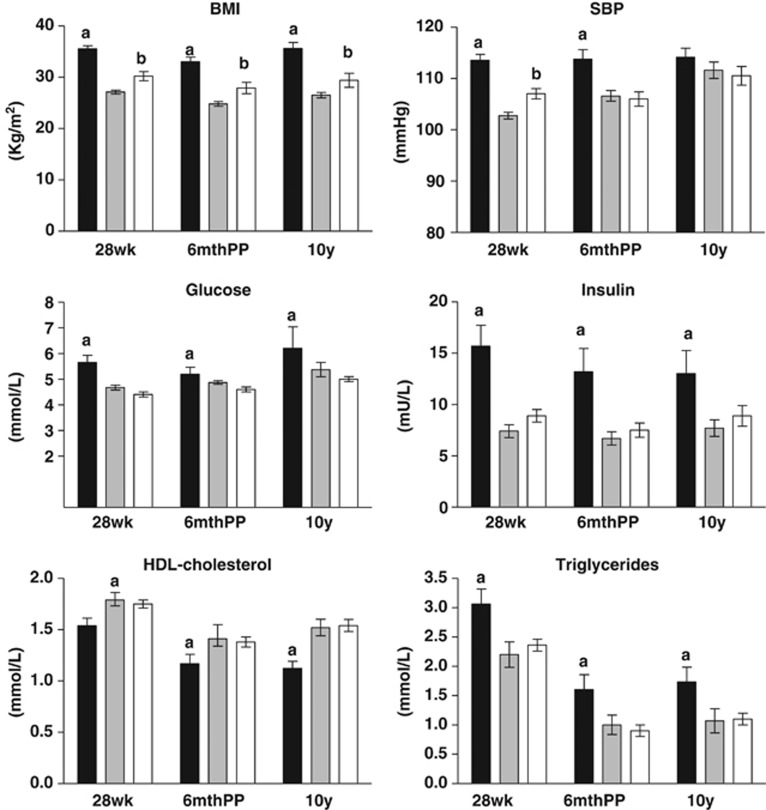
A prospective case-control study in 150 GDM and 72 overweight women with normal glucose tolerance (NGT) measured cardiometabolic risk factors (body mass index (BMI), systolic blood pressure (SBP), fasting glucose, insulin, and triglycerides and high-density lipoprotein (HDL) cholesterol) at 28 weeks gestation and 6 months and 10 years after pregnancy. Cluster analysis of cardiometabolic risk factors in pregnancy was used to stratify GDM as 'high' and 'low risk' for diabetes and CVD risk at 10 years. The data in pregnancy were used to determine a simple method for assessing risk of future diabetes.
BMI in the 150 GDM at study entry was similar to NGT, but 35% of GDM fell into a 'high-risk cluster' with elevated BMI, SBP, glucose, insulin and triglycerides and lower HDL levels. At 10 years, type 2 diabetes was sixfold higher in 'high-risk' GDM (odds ratio (OR)=6.75, confidence interval (CI)=2.0, 22.7, P=0.002) compared with 'low-risk' GDM and was not reported in NGT. The 'high-risk' cluster predicted type 2 diabetes better than BMI>30 (OR=2.13, CI=0.71, 6.4, P=0.179) or fasting glucose >5.5 mmol l(-1), (OR=4.56, CI=1.50, 13.85, P=0.007). We determined that GDM with any four of the cardiometabolic risk factors (BMI>30 kg m(-2), fasting glucose>5.0 mmol l(-1), insulin>7.8 mU l(-1), triglycerides >2.4 mmol l(-1), HDL<1.6 mmol l(-1) or SBP>105 mm Hg) in pregnancy would be in a 'high-risk' cluster.
A metabolic syndrome-like cluster in pregnant GDM identifies risk for type 2 diabetes providing an opportunity to focus on rigorous lifestyle interventions after delivery to reduce the burden of disease attributed to this condition.
探讨妊娠期间心血管代谢危险因素的聚集是否可预测妊娠期糖尿病(GDM)妇女 10 年后发生 2 型糖尿病和心血管疾病(CVD)的风险。
这是一项前瞻性病例对照研究,共纳入 150 例 GDM 患者和 72 例糖耐量正常(NGT)但超重的妇女,在妊娠 28 周、6 个月和 10 年后测量心血管代谢危险因素(体重指数(BMI)、收缩压(SBP)、空腹血糖、胰岛素、甘油三酯和高密度脂蛋白(HDL)胆固醇)。采用妊娠期间心血管代谢危险因素聚类分析将 GDM 分为“高”和“低”10 年糖尿病和 CVD 风险。妊娠期间的数据用于确定一种评估未来糖尿病风险的简单方法。
研究开始时,150 例 GDM 患者的 BMI 与 NGT 相似,但 35%的 GDM 患者存在 BMI、SBP、血糖、胰岛素、甘油三酯升高和 HDL 水平降低的“高危”聚类。10 年后,“高危”GDM 患者发生 2 型糖尿病的风险是“低危”GDM 患者的 6 倍(比值比(OR)=6.75,95%置信区间(CI)=2.0,22.7,P=0.002),而 NGT 患者未报告 2 型糖尿病。与 BMI>30(OR=2.13,CI=0.71,6.4,P=0.179)或空腹血糖>5.5mmol/L(OR=4.56,CI=1.50,13.85,P=0.007)相比,“高危”聚类对 2 型糖尿病的预测更好。我们确定妊娠期间存在任何四种心血管代谢危险因素(BMI>30kg/m²、空腹血糖>5.0mmol/L、胰岛素>7.8mU/L、甘油三酯>2.4mmol/L、HDL<1.6mmol/L 或 SBP>105mmHg)的 GDM 将处于“高危”聚类。
GDM 妊娠期间存在代谢综合征样聚类可预测 2 型糖尿病风险,为分娩后聚焦严格的生活方式干预以降低该疾病负担提供了机会。