Department of Neuroscience, Sheffield Institute for Translational Neuroscience (SITraN), University of Sheffield, Sheffield, UK.
Mol Ther. 2013 Aug;21(8):1486-96. doi: 10.1038/mt.2013.115. Epub 2013 Jun 4.
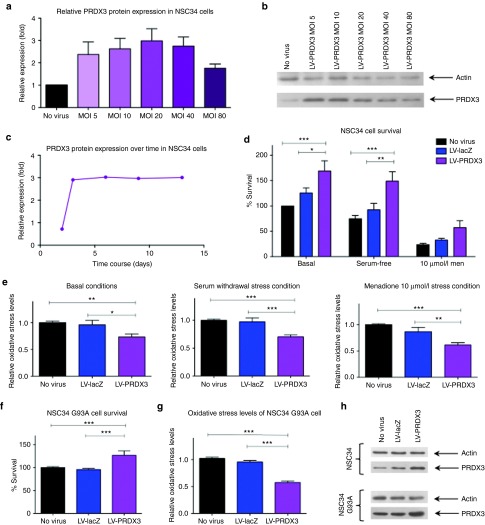
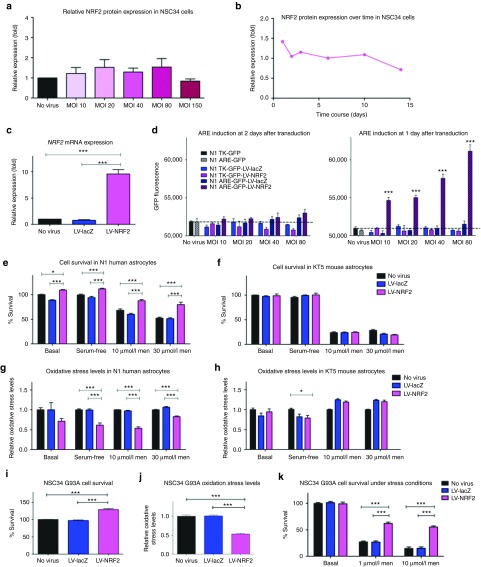
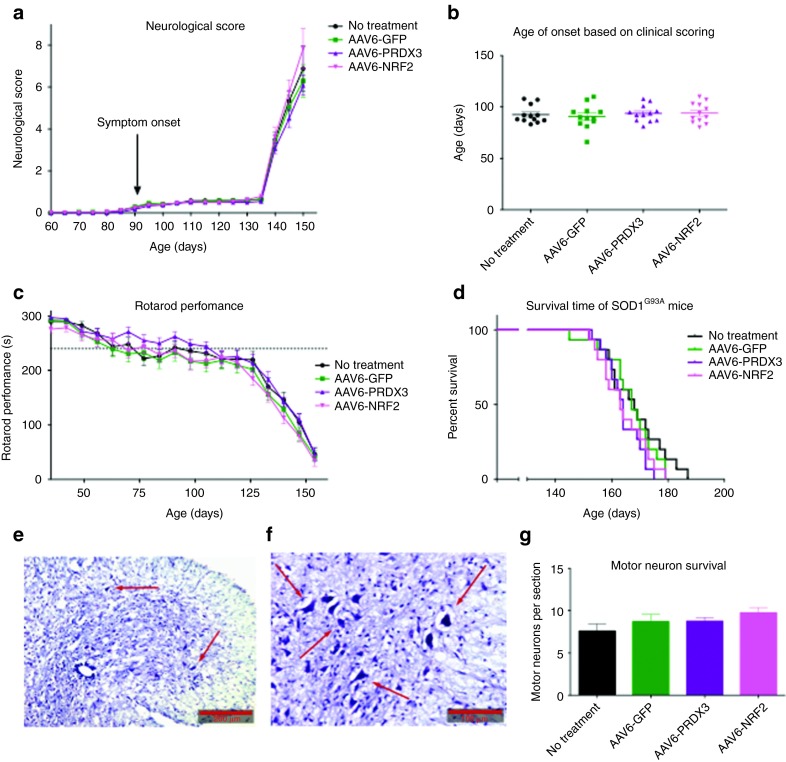
Amyotrophic lateral sclerosis (ALS) is a progressive neurodegenerative disorder with no effective treatment to date. Despite its multi-factorial aetiology, oxidative stress is hypothesized to be one of the key pathogenic mechanisms. It is thus proposed that manipulation of the expression of antioxidant genes that are downregulated in the presence of mutant SOD1 may serve as a therapeutic strategy for motor neuronal protection. Lentiviral vectors expressing either PRDX3 or NRF2 genes were tested in the motor neuronal-like NSC34 cell line, and in the ALS tissue culture model, NSC34 cells expressing the human SOD1(G93A) mutation. The NSC34 SOD1(G93A) cells overexpressing either PRDX3 or NRF2 showed a significant decrease in endogenous oxidation stress levels by 40 and 50% respectively compared with controls, whereas cell survival was increased by 30% in both cases. The neuroprotective potential of those two genes was further investigated in vivo in the SOD1(G93A) ALS mouse model, by administering intramuscular injections of adenoassociated virus serotype 6 (AAV6) expressing either of the target genes at a presymptomatic stage. Despite the absence of a significant effect in survival, disease onset or progression, which can be explained by the inefficient viral delivery, the promising in vitro data suggest that a more widespread CNS delivery is needed.
肌萎缩侧索硬化症(ALS)是一种进行性神经退行性疾病,目前尚无有效的治疗方法。尽管其病因复杂,但氧化应激被认为是关键的致病机制之一。因此,有人提出操纵在突变型 SOD1 存在的情况下下调的抗氧化基因的表达可能成为保护运动神经元的治疗策略。表达 PRDX3 或 NRF2 基因的慢病毒载体在运动神经元样 NSC34 细胞系和 ALS 细胞培养模型中进行了测试,其中 NSC34 细胞表达人类 SOD1(G93A)突变。与对照组相比,过表达 PRDX3 或 NRF2 的 NSC34 SOD1(G93A)细胞的内源性氧化应激水平分别显著降低了 40%和 50%,而两种情况下的细胞存活率均增加了 30%。通过在 SOD1(G93A)ALS 小鼠模型中在发病前阶段进行肌肉内注射表达目标基因的腺相关病毒血清型 6(AAV6),进一步研究了这两种基因的神经保护潜力。尽管在生存、发病或进展方面没有显著效果,这可以用低效的病毒传递来解释,但有希望的体外数据表明,需要更广泛的中枢神经系统传递。