Department of Neurology and Psychiatry, Saint Louis University School of Medicine, 1438 S. Grand Boulevard, St. Louis, MO 63104, USA.
CNS Drugs. 2013 Jun;27(6):469-78. doi: 10.1007/s40263-013-0077-7.
Immediate-release memantine (10 mg, twice daily) is approved in the USA for moderate-to-severe Alzheimer's disease (AD). This study evaluated the efficacy, safety, and tolerability of a higher-dose, once-daily, extended-release formulation in patients with moderate-to-severe AD concurrently taking cholinesterase inhibitors.
In this 24-week, double-blind, multinational study (NCT00322153), outpatients with AD (Mini-Mental State Examination scores of 3-14) were randomized to receive once-daily, 28-mg, extended-release memantine or placebo. Co-primary efficacy parameters were the baseline-to-endpoint score change on the Severe Impairment Battery (SIB) and the endpoint score on the Clinician's Interview-Based Impression of Change Plus Caregiver Input (CIBIC-Plus). The secondary efficacy parameter was the baseline-to-endpoint score change on the 19-item Alzheimer's Disease Cooperative Study-Activities of Daily Living (ADCS-ADL19); additional parameters included the baseline-to-endpoint score changes on the Neuropsychiatric Inventory (NPI) and verbal fluency test. Data were analyzed using a two-way analysis of covariance model, except for CIBIC-Plus (Cochran-Mantel-Haenszel test). Safety and tolerability were assessed through adverse events and physical and laboratory examinations.
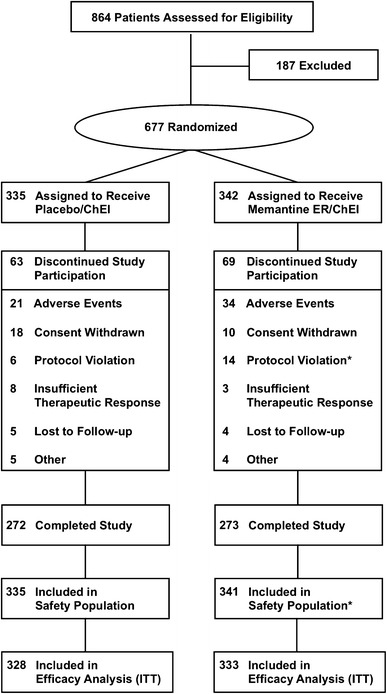
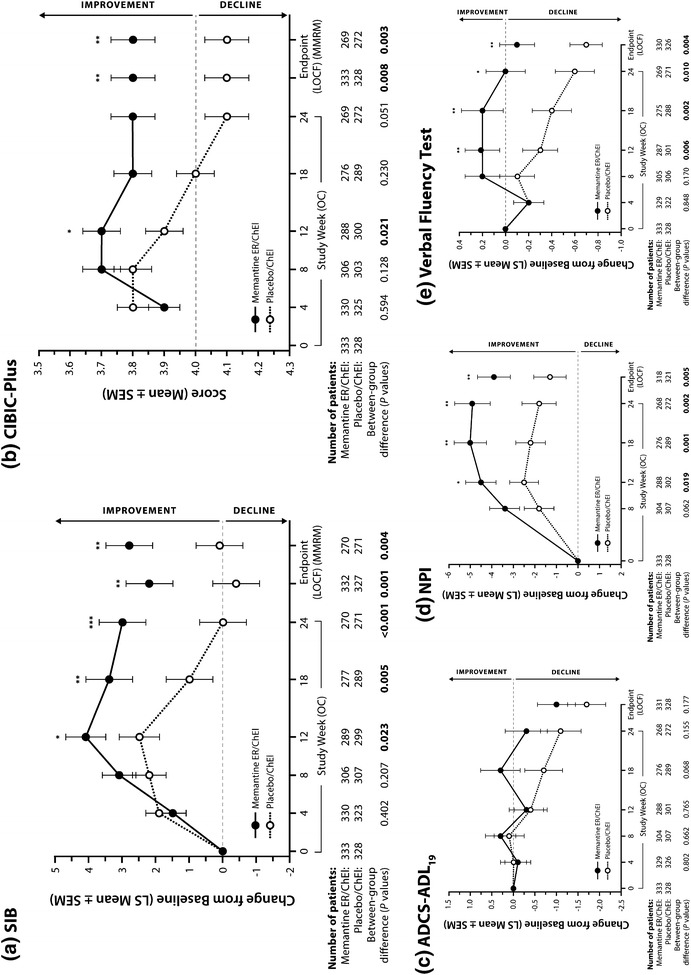
A total of 677 patients were randomized to receive extended-release memantine (n = 342) or placebo (n = 335); completion rates were 79.8 and 81.2 %, respectively. At endpoint (week 24, last observation carried forward), memantine-treated patients significantly outperformed placebo-treated patients on the SIB (least squares mean difference [95 % CI] 2.6 [1.0, 4.2]; p = 0.001), CIBIC-Plus (p = 0.008), NPI (p = 0.005), and verbal fluency test (p = 0.004); the effect did not achieve significance on ADCS-ADL19 (p = 0.177). Adverse events with a frequency of ≥5.0 % that were more prevalent in the memantine group were headache (5.6 vs. 5.1 %) and diarrhea (5.0 vs. 3.9 %).
Extended-release memantine was efficacious, safe, and well tolerated in this population.
在美国,速释美金刚(10 毫克,每日两次)被批准用于治疗中重度阿尔茨海默病(AD)。本研究评估了中重度 AD 患者同时服用胆碱酯酶抑制剂时,更高剂量、每日一次、延长释放美金刚的疗效、安全性和耐受性。
这是一项 24 周、双盲、多国研究(NCT00322153),纳入 AD 门诊患者(Mini-Mental State Examination 评分 3-14 分),随机接受每日一次、28 毫克延长释放美金刚或安慰剂治疗。主要疗效参数为严重损伤量表(SIB)基线至终点评分变化和临床医生访谈的基于变化的印象加照顾者输入(CIBIC-Plus)的终点评分。次要疗效参数为 19 项阿尔茨海默病合作研究日常生活活动量表(ADCS-ADL19)的基线至终点评分变化;其他参数包括神经精神问卷(NPI)和言语流畅性测试的基线至终点评分变化。数据采用双向协方差模型分析,除 CIBIC-Plus 外(Cochran-Mantel-Haenszel 检验)。通过不良事件和体格检查及实验室检查评估安全性和耐受性。
共有 677 例患者被随机分配接受延长释放美金刚(n=342)或安慰剂(n=335)治疗;完成率分别为 79.8%和 81.2%。在终点(第 24 周,末次观察值结转)时,与安慰剂组相比,接受美金刚治疗的患者在 SIB(最小二乘均数差值[95%CI]2.6[1.0, 4.2];p=0.001)、CIBIC-Plus(p=0.008)、NPI(p=0.005)和言语流畅性测试(p=0.004)上的表现明显更好;但在 ADCS-ADL19 上未达到显著差异(p=0.177)。在美金刚组中更常见且发生率≥5.0%的不良事件为头痛(5.6%比 5.1%)和腹泻(5.0%比 3.9%)。
延长释放美金刚在该人群中有效、安全且耐受良好。