Müller Christian P
Section of Addiction Medicine, Department of Psychiatry and Psychotherapy, Friedrich-Alexander-University of Erlangen-Nuremberg Erlangen, Germany.
Front Behav Neurosci. 2013 May 23;7:34. doi: 10.3389/fnbeh.2013.00034. eCollection 2013.
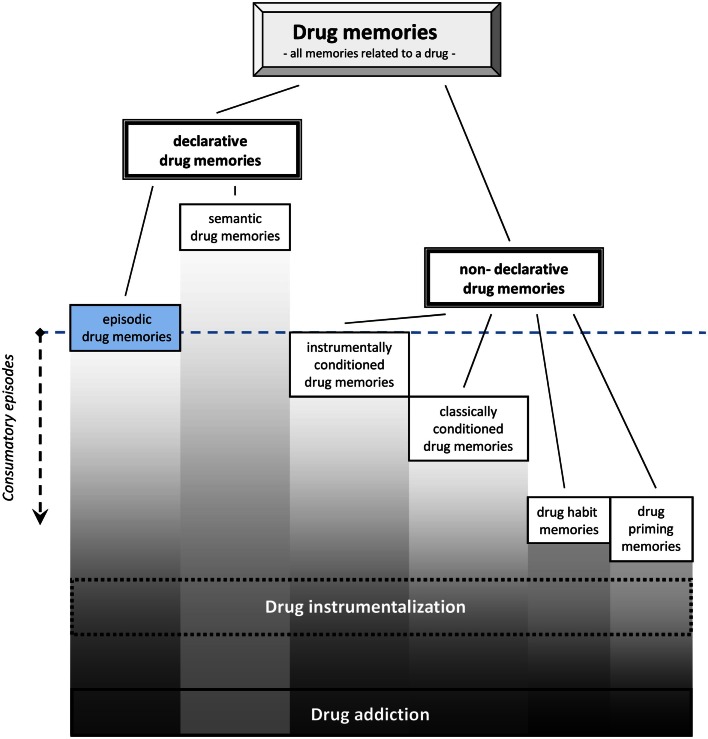
The majority of adult people in western societies regularly consume psychoactive drugs. While this consumption is integrated in everyday life activities and controlled in most consumers, it may escalate and result in drug addiction. Non-addicted drug use requires the systematic establishment of highly organized behaviors, such as drug-seeking and -taking. While a significant role for classical and instrumental learning processes is well established in drug use and abuse, declarative drug memories have largely been neglected in research. Episodic memories are an important part of the declarative memories. Here a role of episodic drug memories in the establishment of non-addicted drug use and its transition to addiction is suggested. In relation to psychoactive drug consumption, episodic drug memories are formed when a person prepares for consumption, when the drug is consumed and, most important, when acute effects, withdrawal, craving, and relapse are experienced. Episodic drug memories are one-trial memories with emotional components that can be much stronger than "normal" episodic memories. Their establishment coincides with drug-induced neuronal activation and plasticity. These memories may be highly extinction resistant and influence psychoactive drug consumption, in particular during initial establishment and at the transition to "drug instrumentalization." In that, understanding how addictive drugs interact with episodic memory circuits in the brain may provide crucial information for how drug use and addiction are established.
西方社会的大多数成年人经常使用精神活性药物。虽然这种使用融入了日常生活活动,且在大多数使用者中受到控制,但它可能会升级并导致药物成瘾。非成瘾性药物使用需要系统地建立高度有组织的行为,例如寻药和用药。虽然经典学习过程和工具性学习过程在药物使用和滥用中所起的重要作用已得到充分证实,但陈述性药物记忆在研究中很大程度上被忽视了。情景记忆是陈述性记忆的重要组成部分。本文提出情景性药物记忆在非成瘾性药物使用的形成及其向成瘾转变过程中发挥作用。就精神活性药物的使用而言,情景性药物记忆在一个人准备用药时、用药时以及最重要的是在经历急性效应、戒断反应、渴望和复发时形成。情景性药物记忆是带有情感成分的一次性记忆,其强度可能比“正常”情景记忆强得多。它们的形成与药物诱导的神经元激活和可塑性同时发生。这些记忆可能具有很强的抗消退能力,并会影响精神活性药物的使用,尤其是在初始形成阶段以及向“药物工具化”转变的过程中。因此,了解成瘾性药物如何与大脑中的情景记忆回路相互作用,可能会为药物使用和成瘾的形成提供关键信息。