Pacific Institute for Research and Evaluation, Inc,, 300 S. Fourth Street, Louisville, KY 40208, USA.
Subst Abuse Treat Prev Policy. 2013 Jun 4;8:20. doi: 10.1186/1747-597X-8-20.
This article focuses on examining drug abuse treatment (DAT) in El Salvador highlighting gang vs. non-gang membership differences in drug use and treatment outcomes.
Cross-sectional and prospective cohort designs were employed to examine the study aims. The 19 centers that met the study's inclusion criteria of one year or less in planned treatment offered varying treatment services: individual, group, family, and vocational therapy, dual diagnosis treatment, psychological testing, 12-step program, and outreach and re-entry aftercare. Most directors describe their treatment approach as "spiritual." Data were collected from 625 patients, directors, and staff from the 19 centers at baseline, of which 34 patients were former gang members. Seventy-two percent (72%) of the former patients (448) were re-interviewed six-months after leaving treatment and 48% were randomly tested for drug use.
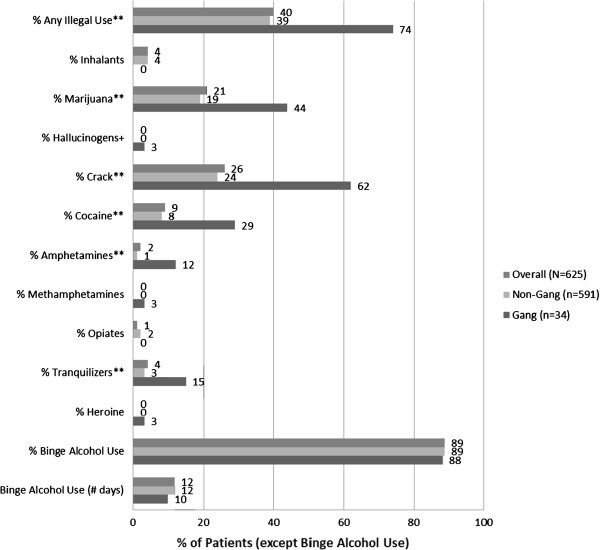
Eighty-nine percent (89%) of the DAT patients at baseline were classified as heavy alcohol users and 40% were using illegal drugs, i.e., crack, marijuana, cocaine, tranquilizers, opiates, and amphetamines. There were large decreases after treatment in heavy alcohol and illegal drug use, crime, and gang related risk activities. Gang members reported illegal drug use, crime, and gang related risk activity more than non-gang members, yet only 5% of the study participants were gang members; further, positive change in treatment outcomes among gang members were the same or larger as compared to non-gang members.
Alcohol use is the drug of choice among DAT patients in El Salvador with gang member patients having used illegal drugs more than non-gang members. The study shows that DAT centers successfully reduced the use of illegal drugs and alcohol among gang and non-gang members. Although our study could not include a control group, we believe that the DAT treatment centers in El Salvador contributed to producing this treatment success among former patients. These efforts should be continued and complemented by funding support from the Salvadoran government for DAT centers that obtain certification. In addition, tailored/alternative treatment modalities are needed for gang members in treatment for heavy drinking.
本文重点研究萨尔瓦多的药物滥用治疗 (DAT),突出帮派与非帮派成员在药物使用和治疗结果方面的差异。
采用横断面和前瞻性队列设计来检验研究目的。符合研究纳入标准(计划治疗时间为一年或更短)的 19 个中心提供了各种治疗服务:个体治疗、小组治疗、家庭治疗和职业治疗、双重诊断治疗、心理测试、12 步康复计划以及康复后重返社会的服务。大多数中心的主管将其治疗方法描述为“精神导向”。数据来自 19 个中心的 625 名患者、主管和工作人员,其中 34 名患者曾是帮派成员。在离开治疗后六个月,对 72%(72%)的前患者(448 人)进行了重新访谈,对 48%的人进行了随机药物使用测试。
基线时,89%(89%)的 DAT 患者被归类为重度酒精使用者,40%的人使用非法药物,即可卡因、大麻、可卡因、镇静剂、鸦片和安非他命。治疗后,重度酒精和非法药物使用、犯罪和帮派相关风险活动大幅减少。帮派成员报告的非法药物使用、犯罪和帮派相关风险活动比非帮派成员多,但只有 5%的研究参与者是帮派成员;此外,帮派成员的治疗结果改善与非帮派成员相同或更大。
酒精是萨尔瓦多 DAT 患者的首选药物,帮派成员比非帮派成员更常使用非法药物。研究表明,DAT 中心成功减少了帮派和非帮派成员中非法药物和酒精的使用。尽管我们的研究无法包括对照组,但我们认为萨尔瓦多的 DAT 治疗中心为前患者的治疗成功做出了贡献。这些努力应该继续,并得到萨尔瓦多政府对获得认证的 DAT 中心的资金支持。此外,需要为治疗重度酗酒的帮派成员提供定制/替代治疗模式。