Department of Public Health, Weill Cornell Medical College, New York, NY 93106-9660, USA.
J Interpers Violence. 2013 Oct;28(15):3004-22. doi: 10.1177/0886260513488684. Epub 2013 Jun 4.
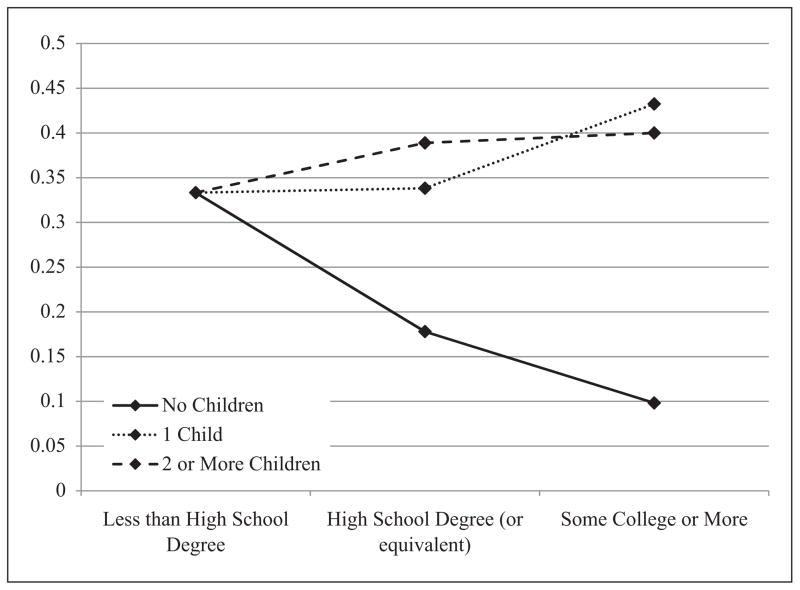
The purpose of the present study was to investigate risk and protective factors for intimate partner violence (IPV) victimization in a high-risk sample of predominantly minority young adults from low-income urban communities. Participants were 1,130 individuals (57.9% women) ages 21 to 26 who participated in a telephone interview assessing IPV victimization, violence-related behaviors, and sexual behaviors. Results indicated that about 20.9% of participants reported experiencing one or more IPV incidents in their lifetime. Based on previous research, we examined lifetime violence, lifetime number of sexual partners, number of children, education, and religious service attendance as predictors of IPV. Results from a multivariate logistic regression showed that lifetime violence-related behaviors, number of lifetime sexual partners, and number of children were significant risk factors for IPV. The link between children and IPV risk: (a) was moderated by education for women and men and (b) was stronger for women (vs. men). These findings suggest that training for coping with stress and anger, endorsement of safe sex practices, and greater support for education may be effective strategies for preventing and reducing IPV among high-risk populations.
本研究旨在探讨高风险的、以少数族裔为主的、来自低收入城市社区的年轻成年人中,亲密伴侣暴力(IPV)受害的风险和保护因素。参与者为 1130 人(57.9%为女性),年龄在 21 至 26 岁之间,他们通过电话访谈参与了 IPV 受害、与暴力相关的行为和性行为评估。结果表明,约 20.9%的参与者报告在其一生中经历过一次或多次 IPV 事件。基于先前的研究,我们将一生中的暴力行为、一生的性伴侣数量、子女数量、教育程度和参加宗教服务作为 IPV 的预测因素进行了检查。多变量逻辑回归的结果表明,一生中与暴力相关的行为、一生的性伴侣数量和子女数量是 IPV 的重要风险因素。儿童与 IPV 风险之间的联系:(a)因教育程度而对女性和男性产生了调节作用,以及(b)对女性(而非男性)的作用更强。这些发现表明,针对应对压力和愤怒的培训、支持安全性行为的措施,以及对教育的更大支持,可能是预防和减少高危人群中 IPV 的有效策略。