Human Genomics Laboratory, Pennington Biomedical Research Center, Baton Rouge, LA, USA.
Department of Nutrition, Laval University, Quebec City, Quebec, Canada.
Int J Obes (Lond). 2014 Feb;38(2):236-42. doi: 10.1038/ijo.2013.77. Epub 2013 May 20.
We have previously shown that 24 young lean men (12 pairs of identical twins) subjected to a standardized 353 MJ (84 000 kcal) overfeeding protocol over 100 days exhibited individual differences in body weight and composition gains. The mean (+s.d.) gains in fat mass (FM) and fat-free mass (FFM) were 5.4+1.9 kg and 2.7+1.5 kg for a total body energy (BE) gain of 221+75 MJ, representing 63% of the energy surplus consumed. We report here on the most important baseline correlates of these overfeeding-induced changes with the aim of identifying biomarkers of the response.
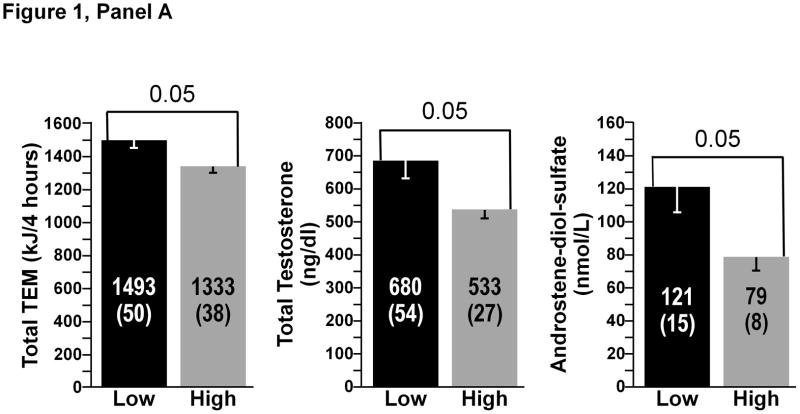
Baseline maximal oxygen uptake per kg body mass was negatively correlated with gains in weight, FM and BE (all P<0.05). Enzyme activities indicative of skeletal muscle oxidative potential correlated with gains in FM and BE (all P<0.05). Baseline thyroid-stimulating hormone levels in response to thyrotropin-releasing hormone stimulation correlated positively with changes in FM-to-FFM ratio (P<0.05). Plasma concentrations of androstenediol sulfate, dehydroepiandrosterone and 17-hydroxy pregnenolone were negatively correlated with gains in FM and BE (0.01<P<0.05), whereas the level of estrone was negatively correlated and androsterone glucoronide was positively correlated with FFM gains (P<0.05). Baseline leptin and abdominal fat cell size correlated positively with gains in weight, FM and BE (P<0.05). When compared with the six highest BE gainers, the six lowest gainers exhibited higher thermic effect of a meal (TEM) and plasma levels of total testosterone, cortisol, estradiol, androstenedione and androstenediol sulfate (all P<0.05). High baseline levels of total TEM, testosterone and androstenediol sulfate were associated with lower FM gains, whereas high baseline levels of FT4 and estrone were found in low-FFM gainers.
Although none of the variables exerted individually an overwhelmingly strong influence on overfeeding-induced changes, baseline FFM, maximal oxygen uptake, muscle oxidative capacity, androgens and leptin levels were the most consistent significant biomarkers of the responsiveness to chronic overfeeding.
我们之前曾表明,24 名年轻瘦男子(12 对同卵双胞胎)接受了为期 100 天、标准为 353 兆焦耳(84000 千卡)的过度喂养方案,其体重和组成增加存在个体差异。脂肪量(FM)和去脂体重(FFM)的平均(+标准差)增加量分别为 5.4+1.9 公斤和 2.7+1.5 公斤,全身能量(BE)增加量为 221+75 兆焦耳,占消耗能量过剩的 63%。我们在此报告这些过度喂养引起的变化的最重要基线相关性,目的是确定反应的生物标志物。
每公斤体质量最大耗氧量与体重、FM 和 BE 的增加呈负相关(均 P<0.05)。骨骼肌氧化潜能的酶活性与 FM 和 BE 的增加呈正相关(均 P<0.05)。促甲状腺激素释放激素刺激后的基础甲状腺刺激激素水平与 FM 与 FFM 比值的变化呈正相关(P<0.05)。硫酸雄烯二酮、脱氢表雄酮和 17-羟孕烯醇酮的血浆浓度与 FM 和 BE 的增加呈负相关(0.01<P<0.05),而雌酮呈负相关,雄酮葡萄糖醛酸呈正相关与 FFM 的增加(P<0.05)。基础瘦素和腹部脂肪细胞大小与体重、FM 和 BE 的增加呈正相关(P<0.05)。与 6 名 BE 增加最多的人相比,6 名 BE 增加最少的人表现出更高的餐后热效应(TEM)和总睾酮、皮质醇、雌二醇、雄烯二酮和硫酸雄烯二酮的血浆水平(均 P<0.05)。基础总 TEM、睾酮和硫酸雄烯二酮水平高与 FM 增加减少有关,而低 FFM 增加者的基础 FT4 和雌酮水平较高。
尽管没有一个变量单独对过度喂养引起的变化产生压倒性的强烈影响,但基础 FFM、最大耗氧量、肌肉氧化能力、雄激素和瘦素水平是对慢性过度喂养反应最一致的重要生物标志物。