National Medical University, Donetsk 83003, Ukraine.
Gastroenterol Res Pract. 2013;2013:431231. doi: 10.1155/2013/431231. Epub 2013 May 7.
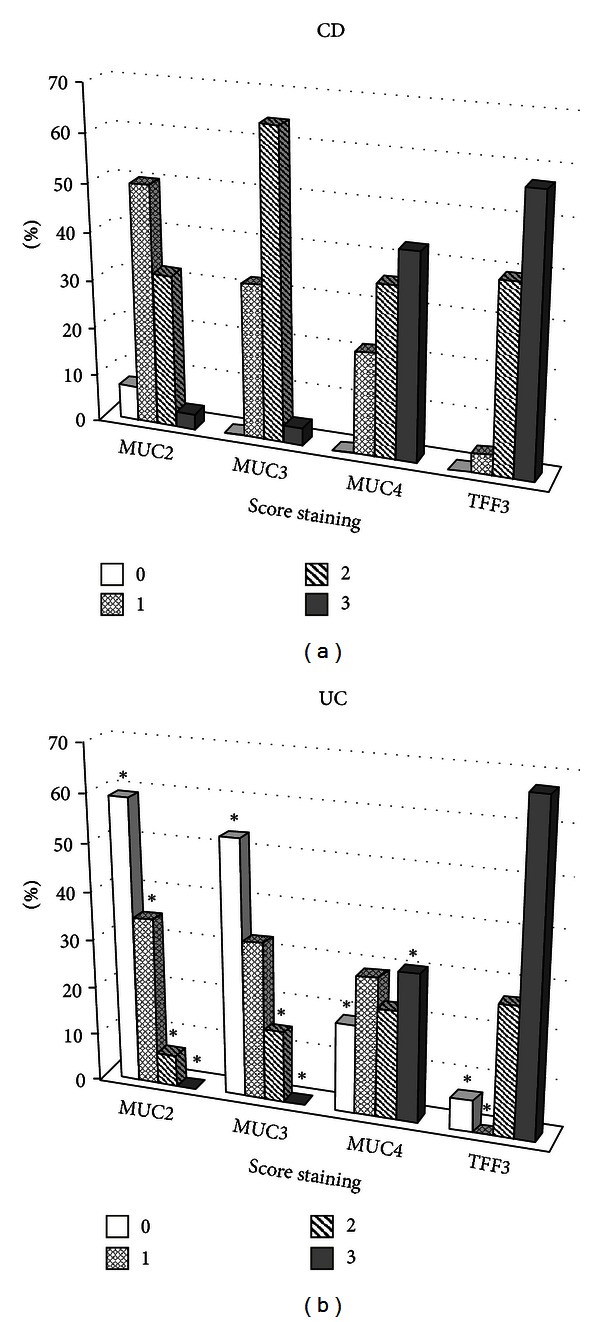
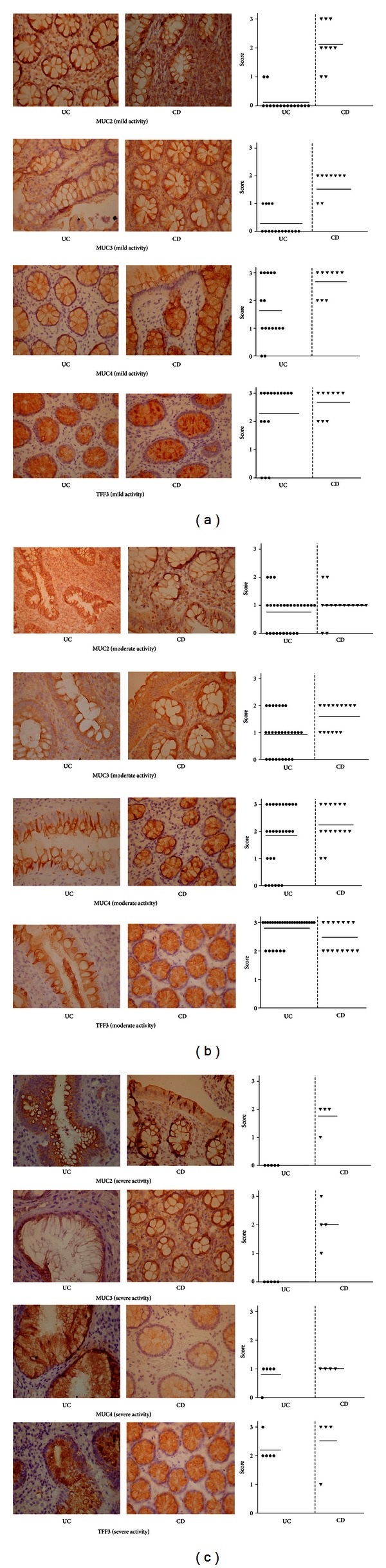
Background. The mucus layer in the gastrointestinal tract plays important role in host innate defense, regulation of secretion, and absorption processes, maintaining colonization resistance, which composes the integrity of protective mucus barrier in the large intestine. Investigations of mucin expression in the colon mucosa can improve the understanding of protective function of mucosal barrier in ulcerative colitis (UC) and Crohn's disease (CD). Materials and Methods. 77 patients with UC and CD were examined. Histological analysis of colon mucosa was done by standard method (haematoxylin-eosin, alcian blue at pH 1.0 and 2.5 to determine sulfated and nonsulfated glycosaminoglycans and glycoproteins, and goblet cells). To characterize the mucus production the PAS-reaction was performed. Immunohistochemistry was performed using monoclonal mouse antibodies raised against MUC2, MUC3, MUC4, and TFF3 (USBiological, USA). Results. The moderate expression of MUC2 and MUC3 (50.0% and 32.1%, P = 0.03) and high expression of MUC4 and TFF3 in the colon mucosa were observed in all patients with CD. The intensive labeling of MUC4 and TFF3 occurred more often (42.9% and 57.1%, P = 0.03) in patients with CD. The level of expression of secretory MUC2 and transmembrane MUC3 and MUC4 in all patients with UC was low, up to its complete absence (59.2% and 53.1% cases, P = 0.05). TFF3 expression had high and medium staining intensity in patients with UC. Conclusions. Different types of mucins synthesis, secretion, and expression were found in patients with UC and CD. The expression of mucin MUC2, MUC3, MUC4, and TFF3 correlated with the activity of disease and the extent of the inflammatory process in the large intestine. The most pronounced alteration of mucins expression was observed in patients with severe UC and CD.
胃肠道的黏液层在宿主先天防御、分泌调节和吸收过程中发挥重要作用,维持定植抵抗,构成大肠保护性黏液屏障的完整性。对结肠黏膜黏蛋白表达的研究可以提高对溃疡性结肠炎(UC)和克罗恩病(CD)黏膜屏障保护功能的认识。
检查了 77 例 UC 和 CD 患者。采用标准方法(苏木精-伊红、pH1.0 和 2.5 的阿尔辛蓝染色以确定硫酸化和非硫酸化糖胺聚糖和糖蛋白以及杯状细胞)进行结肠黏膜组织学分析。为了表征黏液产生,进行了 PAS 反应。使用针对 MUC2、MUC3、MUC4 和 TFF3 的单克隆小鼠抗体进行免疫组织化学(USBiological,美国)。
在所有 CD 患者中均观察到 MUC2 和 MUC3 的中度表达(50.0%和 32.1%,P=0.03)和 MUC4 和 TFF3 的高表达。在 CD 患者中,MUC4 和 TFF3 的强标记更常见(42.9%和 57.1%,P=0.03)。所有 UC 患者的分泌型 MUC2 和跨膜型 MUC3 和 MUC4 的表达水平较低,甚至完全缺失(59.2%和 53.1%病例,P=0.05)。UC 患者 TFF3 表达呈高和中染色强度。
在 UC 和 CD 患者中发现了不同类型的黏蛋白合成、分泌和表达。黏蛋白 MUC2、MUC3、MUC4 和 TFF3 的表达与疾病的活动度和大肠炎症过程的程度相关。在严重 UC 和 CD 患者中观察到最明显的黏蛋白表达改变。