Shanghai Research Center for Acupuncture and Meridians, Shanghai 201203, China ; Gongli Hospital, Pudong New District, Shanghai 200135, China.
Evid Based Complement Alternat Med. 2013;2013:878521. doi: 10.1155/2013/878521. Epub 2013 May 13.
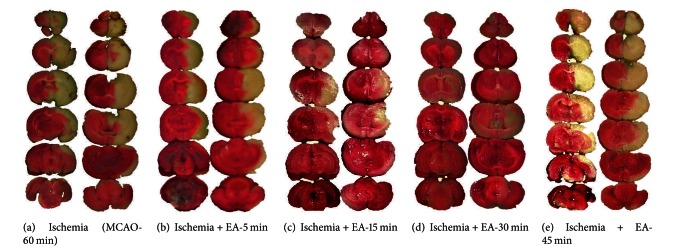
We explored the optimal duration of electroacupuncture (EA) stimulation for protecting the brain against ischemic injury. The experiments were carried out in rats exposed to right middle cerebral artery occlusion (MCAO) for 60 min followed by 24-hr reperfusion. EA was delivered to "Shuigou" (Du 26) and "Baihui" (Du 20) acupoints with sparse-dense wave (5/20 Hz) at 1.0 mA for 5, 15, 30, and 45 min, respectively. The results showed that 30 min EA, starting at 5 minutes after the onset of MCAO (EA during MCAO) or 5 minutes after reperfusion (EA after MCAO), significantly reduced ischemic infarct volume, attenuated neurological deficits, and decreased death rate with a larger reduction of the ischemic infarction in the former group. Also in the group of EA during MCAO, this protective benefit was positively proportional to the increase in the period of stimulation, that is, increased protection in response to EA from 5- to 30-min stimulation. In all groups, EA induced a significant increase in cerebral blood flow and promoted blood flow recovery after reperfusion, and both blood flow volume and blood cell velocity returned to the preischemia level in a short period of time. Surprisingly, EA for 45 min did not show reduction in the neurological deficits or the infarct volume and instead demonstrated an increase in death rate in this group. Although EA for 45 min still increased the blood flow during MCAO, it led to a worsening of perfusion after reperfusion compared to the group subjected only to ischemia. The neuroprotection induced by an "optimal" period (30 min) of EA was completely blocked by Naltrindole, a δ -opioid receptor (DOR) antagonist (10 mg/kg, i.v.). These findings suggest that earlier EA stimulation leads to better outcomes, and that EA-induced neuroprotection against ischemia depends on an optimal EA-duration via multiple pathways including DOR signaling, while "over-length" stimulation exacerbates the ischemic injury.
我们探讨了电针(EA)刺激保护大脑免受缺血性损伤的最佳持续时间。实验在暴露于右大脑中动脉闭塞(MCAO) 60 分钟后进行 24 小时再灌注的大鼠中进行。EA 通过稀疏-密集波(5/20 Hz)以 1.0 mA 施加于“水沟”(Du 26)和“百会”(Du 20)穴位,分别持续 5、15、30 和 45 分钟。结果表明,30 分钟 EA,在 MCAO 发作后 5 分钟(MCAO 期间的 EA)或再灌注后 5 分钟(MCAO 后的 EA)开始,可显著减小缺血性梗死体积,减轻神经功能缺损,并降低死亡率,前者组的缺血性梗死面积减小幅度更大。同样在 MCAO 期间的 EA 组中,这种保护作用与刺激时间的增加成正比,即随着 EA 从 5 分钟增加到 30 分钟刺激,保护作用增加。在所有组中,EA 均导致脑血流显著增加,并促进再灌注后的血流恢复,并且血流体积和血细胞速度在短时间内恢复到缺血前水平。令人惊讶的是,45 分钟的 EA 不仅没有减轻神经功能缺损或梗死体积,反而导致该组死亡率增加。尽管 45 分钟的 EA 仍增加了 MCAO 期间的血流量,但与仅缺血组相比,再灌注后的灌注情况恶化。“最佳”(30 分钟)EA 持续时间诱导的神经保护作用完全被纳曲酮(一种 δ-阿片受体(DOR)拮抗剂,10 mg/kg,iv)阻断。这些发现表明,较早的 EA 刺激可导致更好的结果,而 EA 诱导的对缺血的神经保护作用取决于通过包括 DOR 信号在内的多种途径的“最佳”EA 持续时间,而“过长”的刺激会加重缺血性损伤。