Koles Kate, Budnik Vivian
Department of Neurobiology; University of Massachusetts Medical School; Worcester, MA USA.
Cell Logist. 2012 Jul 1;2(3):169-173. doi: 10.4161/cl.21981.
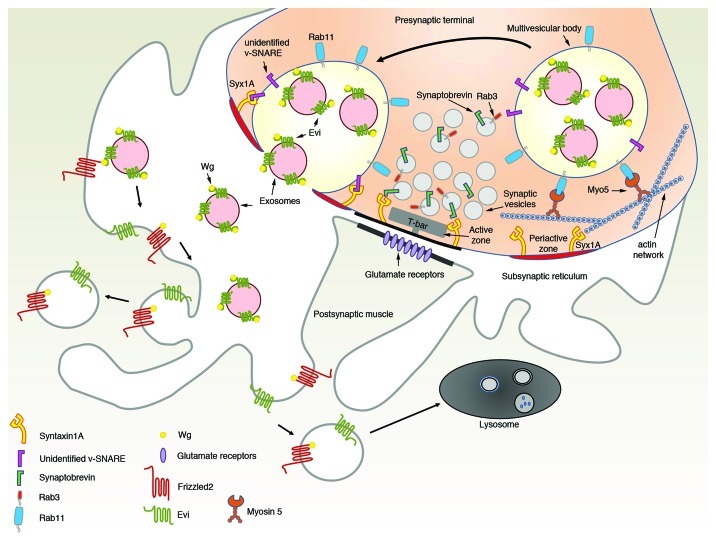
Exosomes, small secreted microvesicles, are implicated in intercellular communication in diverse cell types, transporting protein, lipid and nucleic acid cargo that impact the physiology of recipient cells. Besides the signaling function of exosomes they also serve as a mechanism to dispose obsolete cellular material. Particularly exciting is the involvement of exosomal communication in the nervous system, as this has important implications for brain development and function. The properties of exosomes are also beginning to entice the biomedical community since they represent potentially novel avenues for the targeted delivery of customized exosome cargo, such as miRNAs, during disease. Our findings implicating exosomes in trans-synaptic communication emerged from the serendipitous observation that at the Drosophila larval neuromuscular junction (NMJ) the release of a signaling molecule, Wnt1/Wingless (Wg) and its binding partner Evenness Interrupted (Evi)/Wntless (Wls)/Sprint (Srt), were released by motorneurons in association with vesicles, which we postulated to be exosomes. In our most recent paper using in vivo analysis at the Drosophila NMJ as well as in cultured insect cells we formally demonstrate that Evi rides in exosomes that are released to the extracellular space and identify some of the players involved in their release. In addition, a proteomic analysis of exosomes highlights novel potential function of exosomes.
外泌体是一种分泌型小囊泡,参与多种细胞类型的细胞间通讯,运输对受体细胞生理功能有影响的蛋白质、脂质和核酸货物。除了外泌体的信号传导功能外,它们还作为一种处理陈旧细胞物质的机制。特别令人兴奋的是外泌体通讯在神经系统中的参与,因为这对大脑发育和功能具有重要意义。外泌体的特性也开始吸引生物医学界,因为它们代表了在疾病期间靶向递送定制外泌体货物(如微小RNA)的潜在新途径。我们发现外泌体参与跨突触通讯,这一发现源于偶然观察到在果蝇幼虫神经肌肉接头(NMJ)处,一种信号分子Wnt1/无翅(Wg)及其结合伴侣不均衡中断(Evi)/无翅(Wls)/冲刺(Srt)与囊泡一起由运动神经元释放,我们推测这些囊泡是外泌体。在我们最近的论文中,我们利用果蝇NMJ的体内分析以及培养的昆虫细胞,正式证明Evi存在于释放到细胞外空间的外泌体中,并确定了一些参与其释放的因素。此外,对外泌体的蛋白质组学分析突出了外泌体的新潜在功能。