Retser Eugen, Schied Tanja, Skryabin Boris V, Vogl Thomas, Kanczler Janos M, Hamann Nina, Niehoff Anja, Hermann Sven, Eisenblätter Michel, Wachsmuth Lydia, Pap Thomas, van Lent Peter L E M, Loser Karin, Roth Johannes, Zaucke Frank, Ludwig Stephan, Wixler Viktor
ZMBE and University Hospital Muenster, Muenster, Germany.
Arthritis Rheum. 2013 Sep;65(9):2290-300. doi: 10.1002/art.38026.
To generate doxycycline-inducible human tumor necrosis factor α (TNFα)-transgenic mice to overcome a major disadvantage of existing transgenic mice with constitutive expression of TNFα, which is the limitation in crossing them with various knockout or transgenic mice.
A transgenic mouse line that expresses the human TNFα cytokine exclusively after doxycycline administration was generated and analyzed for the onset of diseases.
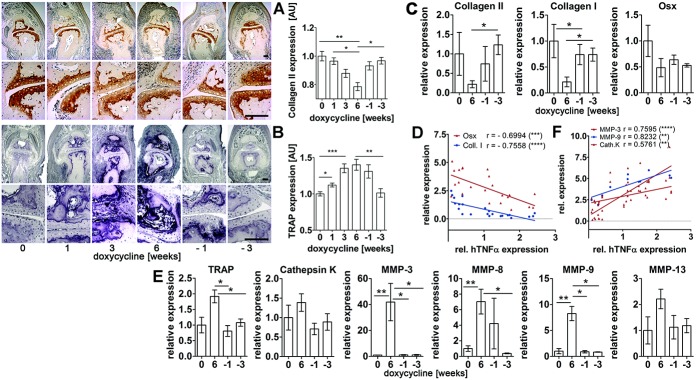
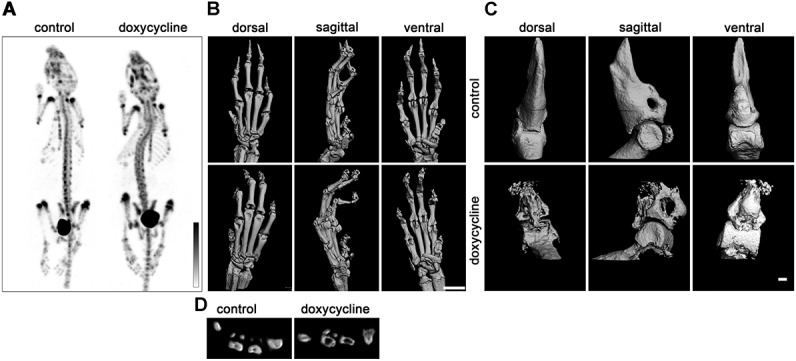
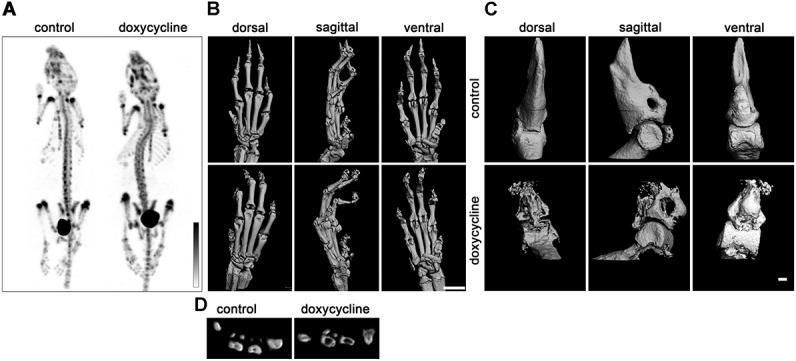
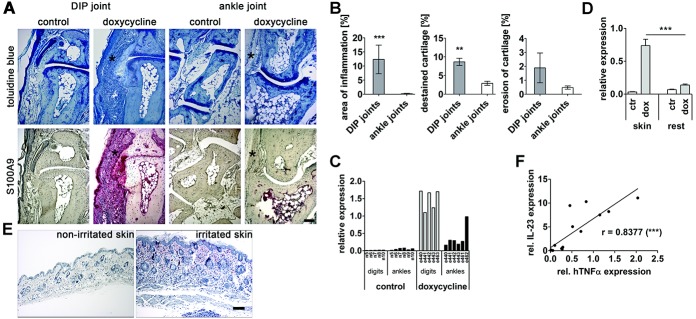
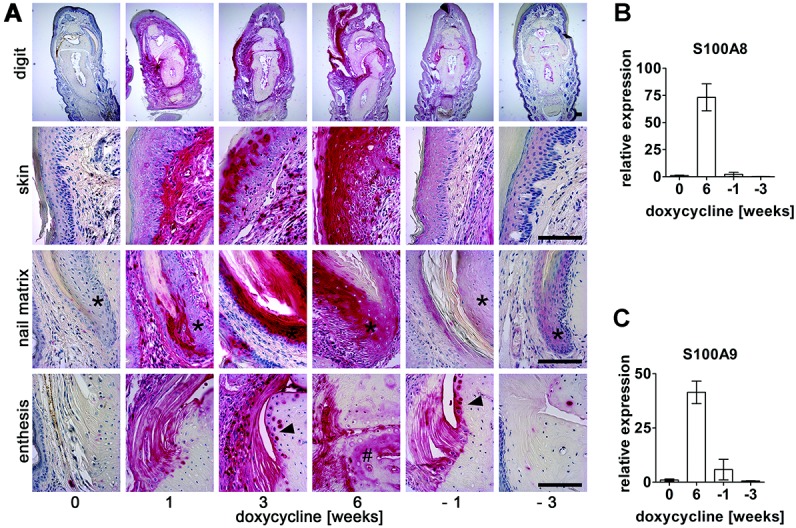
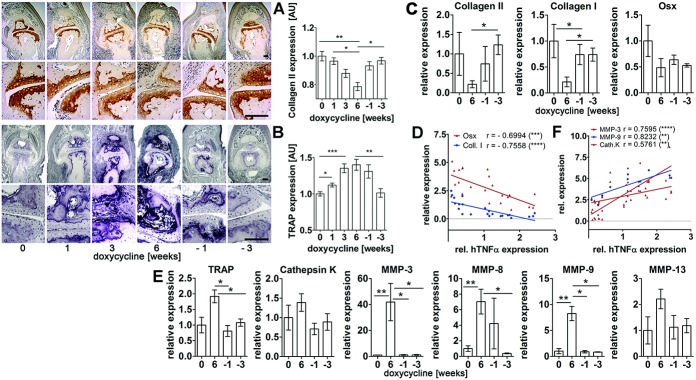
Doxycycline-inducible human TNFα-transgenic mice developed an inflammatory arthritis- and psoriasis-like phenotype, with fore and hind paws being prominently affected. The formation of "sausage digits" with characteristic involvement of the distal interphalangeal joints and nail malformation was observed. Synovial hyperplasia, enthesitis, cartilage and bone alterations, formation of pannus tissue, and inflammation of the skin epidermis and nail matrix appeared as early as 1 week after the treatment of mice with doxycycline and became aggravated over time. The abrogation of human TNFα expression by the removal of doxycycline 6 weeks after beginning stimulation resulted in fast resolution of the most advanced macroscopic and histologic disorders, and 3-6 weeks later, only minimal signs of disease were visible.
Upon doxycycline administration, the doxycycline-inducible human TNFα-transgenic mouse displays the major features of inflammatory arthritis. It represents a unique animal model for studying the molecular mechanisms of arthritis, especially the early phases of disease genesis and tissue remodeling steps upon abrogation of TNFα expression. Furthermore, unlimited crossing of doxycycline-inducible human TNFα-transgenic mice with various knockout or transgenic mice opens new possibilities for unraveling the role of various signaling molecules acting in concert with TNFα.
构建强力霉素诱导型人肿瘤坏死因子α(TNFα)转基因小鼠,以克服现有组成型表达TNFα的转基因小鼠的一个主要缺点,即其在与各种基因敲除或转基因小鼠杂交方面的局限性。
构建一种仅在给予强力霉素后才表达人TNFα细胞因子的转基因小鼠品系,并对疾病的发病情况进行分析。
强力霉素诱导型人TNFα转基因小鼠出现了炎性关节炎和银屑病样表型,前爪和后爪均受到显著影响。观察到形成了具有特征性的远端指间关节受累和指甲畸形的“腊肠指”。早在用强力霉素处理小鼠1周后就出现了滑膜增生、附着点炎、软骨和骨改变、血管翳组织形成以及皮肤表皮和甲床炎症,且随着时间的推移病情加重。在开始刺激6周后去除强力霉素可消除人TNFα的表达,从而使最严重的宏观和组织学病变迅速消退,3至6周后,仅可见轻微的疾病迹象。
给予强力霉素后,强力霉素诱导型人TNFα转基因小鼠表现出炎性关节炎的主要特征。它代表了一种独特的动物模型,用于研究关节炎的分子机制,尤其是疾病发生的早期阶段以及TNFα表达消除后的组织重塑步骤。此外,强力霉素诱导型人TNFα转基因小鼠与各种基因敲除或转基因小鼠的无限制杂交为阐明与TNFα协同作用的各种信号分子的作用开辟了新的可能性。