Department of Nutritional Sciences, University of Toronto, and Office of Biotechnology and Population Health, Public Health Agency of Canada, Toronto, Canada.
Prev Chronic Dis. 2013 Jun 6;10:E91. doi: 10.5888/pcd10.120230.
Vitamin D may modulate cardiometabolic disease risk, although the relationship has not been investigated in the general Canadian population. Understanding this relationship may inform public health strategies to curb the incidence of cardiometabolic disease in Canada and elsewhere. The objectives of this study were to examine the association between vitamin D and traditional and novel biomarkers of cardiometabolic disease and to describe the extent of the month-to-month fluctuations of vitamin D in the Canadian population.
We examined the association between plasma 25-hydroxyvitamin D and a range of cardiometabolic risk biomarkers in participants (n = 1,928; age range, 16-79 years) from the Canadian Health Measures Survey. We conducted linear regressions analyses (adjusted for sex, waist circumference, physical activity, hormone use, and season) to assess the relationship between 25-hydroxyvitamin D and biomarkers of dysglycemia, dyslipidemia, and inflammation in the study population. We repeated analyses stratified by sex, and we evaluated monthly fluctuations in 25-hydroxyvitamin D in men and women.
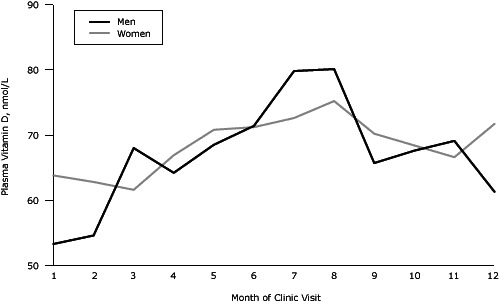
We observed wide month-to-month variations in 25-hydroxyvitamin D; fluctuations were more pronounced in men. Plasma 25-hydroxyvitamin D was inversely associated with insulin, insulin resistance, triglycerides, total cholesterol, low-density lipoprotein cholesterol, and the ratio of total to high-density lipoprotein cholesterol but not with fasting glucose, apolipoprotein A1, apolipoprotein B, C-reactive protein, fibrinogen, or homocysteine. This pattern varied between men and women.
Vitamin D may modulate various metabolic processes and may influence cardiometabolic disease risk in Canadians. These findings may have public health implications when recommending vitamin D for the prevention of cardiometabolic disease and related conditions.
维生素 D 可能会调节心血管代谢疾病的风险,尽管在加拿大普通人群中尚未对此关系进行研究。了解这种关系可能有助于制定公共卫生策略,以遏制加拿大和其他地方心血管代谢疾病的发病率。本研究的目的是研究维生素 D 与心血管代谢疾病的传统和新型生物标志物之间的关系,并描述加拿大人群中维生素 D 月变化幅度。
我们研究了加拿大健康测量调查(Canadian Health Measures Survey)参与者(n=1928;年龄范围 16-79 岁)血浆 25-羟维生素 D 与一系列心血管代谢风险生物标志物之间的关系。我们进行了线性回归分析(根据性别、腰围、体力活动、激素使用和季节进行调整),以评估 25-羟维生素 D 与研究人群中血糖异常、血脂异常和炎症生物标志物之间的关系。我们按性别进行了重复分析,并评估了男性和女性 25-羟维生素 D 的月波动。
我们观察到 25-羟维生素 D 的月变化幅度很大;波动在男性中更为明显。血浆 25-羟维生素 D 与胰岛素、胰岛素抵抗、甘油三酯、总胆固醇、低密度脂蛋白胆固醇和总胆固醇与高密度脂蛋白胆固醇的比值呈负相关,但与空腹血糖、载脂蛋白 A1、载脂蛋白 B、C 反应蛋白、纤维蛋白原或同型半胱氨酸无关。这种模式在男性和女性之间有所不同。
维生素 D 可能调节各种代谢过程,并可能影响加拿大人的心血管代谢疾病风险。在推荐维生素 D 预防心血管代谢疾病和相关疾病时,这些发现可能具有公共卫生意义。