Shaban Sami, McLean Michelle
Department of Medical Education, Faculty of Medicine and Health Sciences, United Arab Emirates University, Al Ain, United Arab Emirates.
Adv Med Educ Pract. 2011 May 17;2:139-48. doi: 10.2147/AMEP.S19391. Print 2011.
The purpose of this study was to examine the predictive potential of multiple indicators (eg, preadmission scores, unit, module and clerkship grades, course and examination scores) on academic performance at medical school, with a view to identifying students at risk.
An analysis was undertaken of medical student grades in a 6-year medical school program at the Faculty of Medicine and Health Sciences, United Arab Emirates University, Al Ain, United Arab Emirates, over the past 14 years.
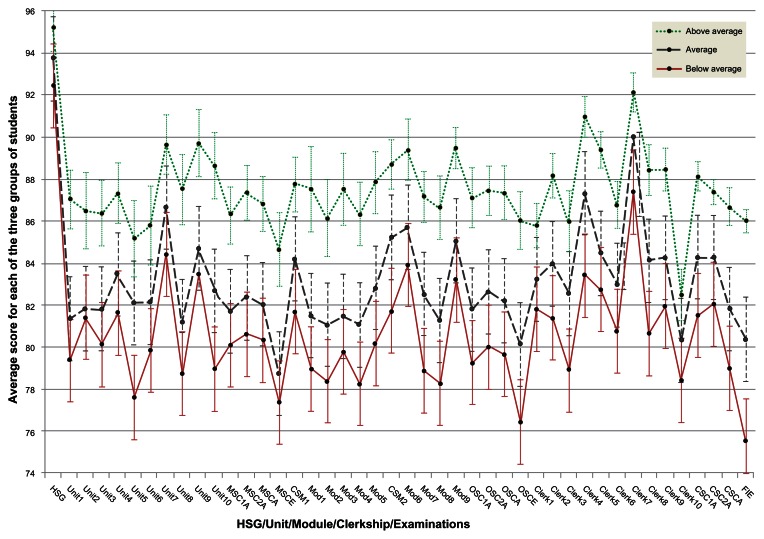
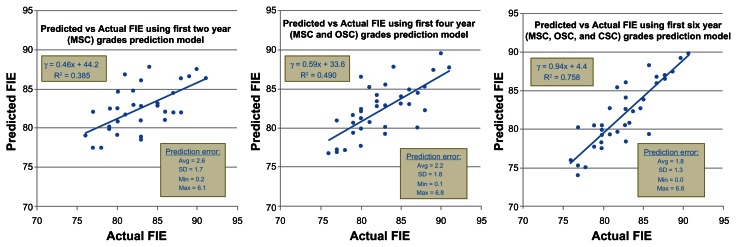
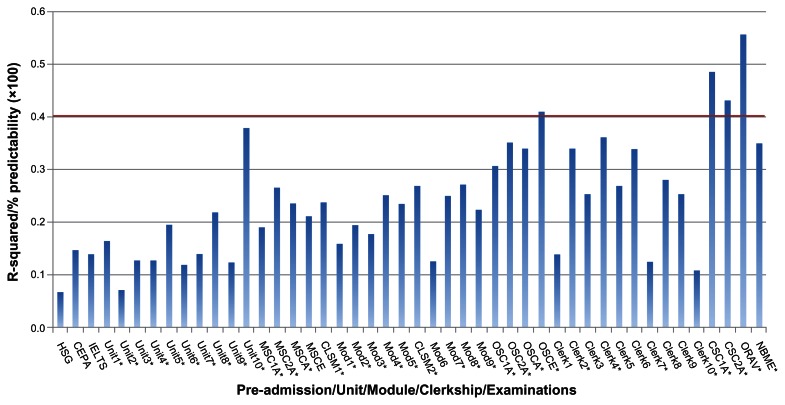
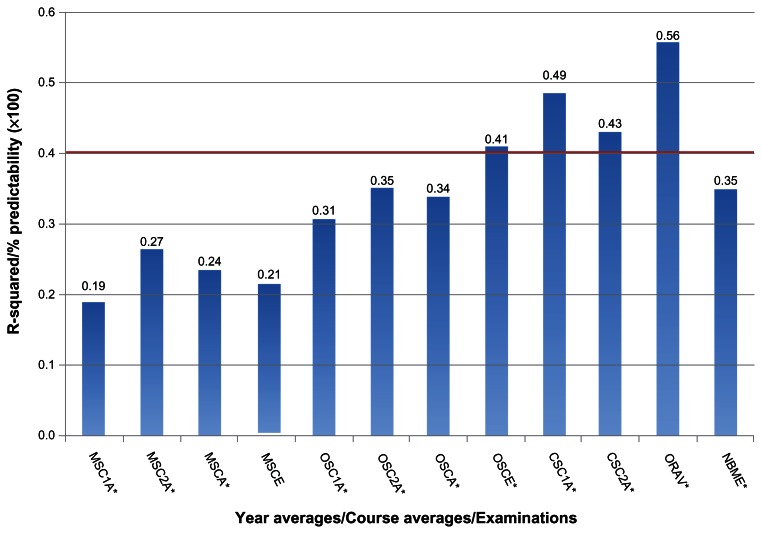
While high school scores were significantly (P < 0.001) correlated with the final integrated examination, predictability was only 6.8%. Scores for the United Arab Emirates university placement assessment (Common Educational Proficiency Assessment) were only slightly more promising as predictors with 14.9% predictability for the final integrated examination. Each unit or module in the first four years was highly correlated with the next unit or module, with 25%-60% predictability. Course examination scores (end of years 2, 4, and 6) were significantly correlated (P < 0.001) with the average scores in that 2-year period (59.3%, 64.8%, and 55.8% predictability, respectively). Final integrated examination scores were significantly correlated (P < 0.001) with National Board of Medical Examiners scores (35% predictability). Multivariate linear regression identified key grades with the greatest predictability of the final integrated examination score at three stages in the program.
This study has demonstrated that it may be possible to identify "at-risk" students relatively early in their studies through continuous data archiving and regular analysis. The data analysis techniques used in this study are not unique to this institution.
本研究旨在探讨多个指标(如入学前分数、单元、模块和见习成绩、课程和考试分数)对医学院校学业表现的预测潜力,以便识别有风险的学生。
对阿联酋艾因市阿联酋大学医学院和健康科学学院过去14年6年制医学课程的医学生成绩进行了分析。
虽然高中成绩与最终综合考试显著相关(P<0.001),但预测能力仅为6.8%。阿联酋大学入学评估(普通教育能力评估)分数作为预测指标的前景稍好一些,对最终综合考试的预测能力为14.9%。前四年的每个单元或模块与下一个单元或模块高度相关,预测能力为25%-60%。课程考试成绩(第2、4和6年末)与该两年期的平均成绩显著相关(P<0.001)(预测能力分别为59.3%、64.8%和55.8%)。最终综合考试成绩与美国国家医学考试委员会的成绩显著相关(P<0.001)(预测能力为35%)。多变量线性回归确定了该课程三个阶段对最终综合考试成绩预测能力最强的关键成绩。
本研究表明,通过持续的数据存档和定期分析,有可能在学生学习过程中相对较早地识别出“有风险”的学生。本研究中使用的数据分析技术并非该机构所独有。