Fisheries and Oceans Canada St. John's, NF, Canada ; Department of Biology, Marine Gene Probe Laboratory, Dalhousie University Halifax, NS, Canada ; Ocean Sciences Center and Biology Department, Memorial University of Newfoundland St. John's, NF, Canada.
Evol Appl. 2013 Apr;6(3):450-61. doi: 10.1111/eva.12026. Epub 2013 Jan 21.
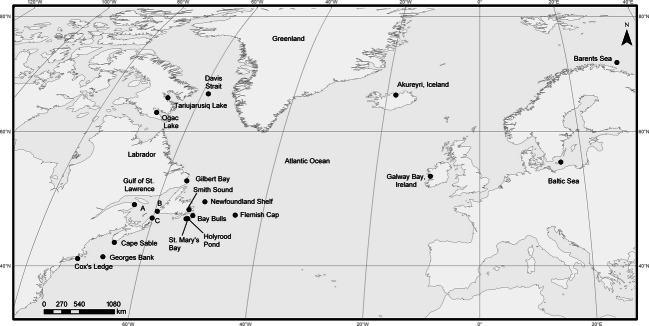
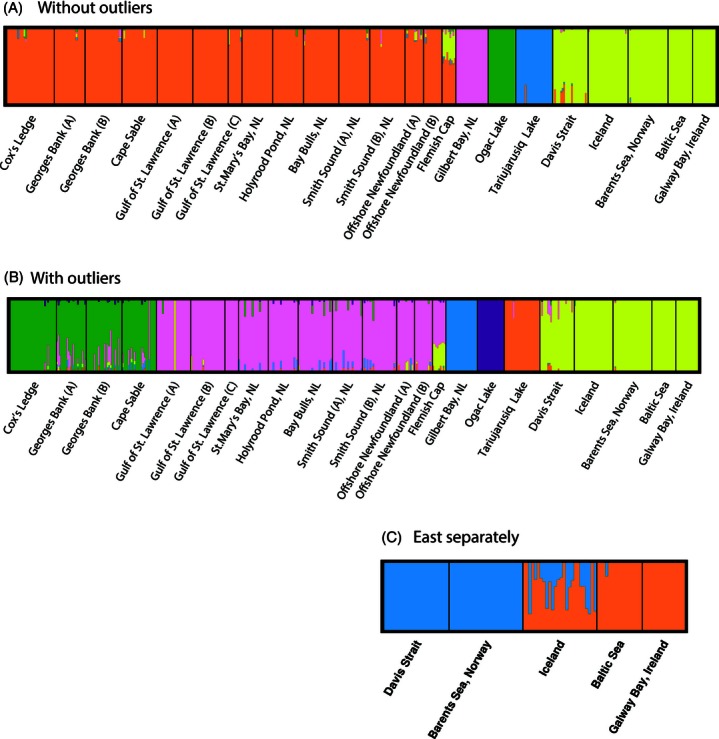
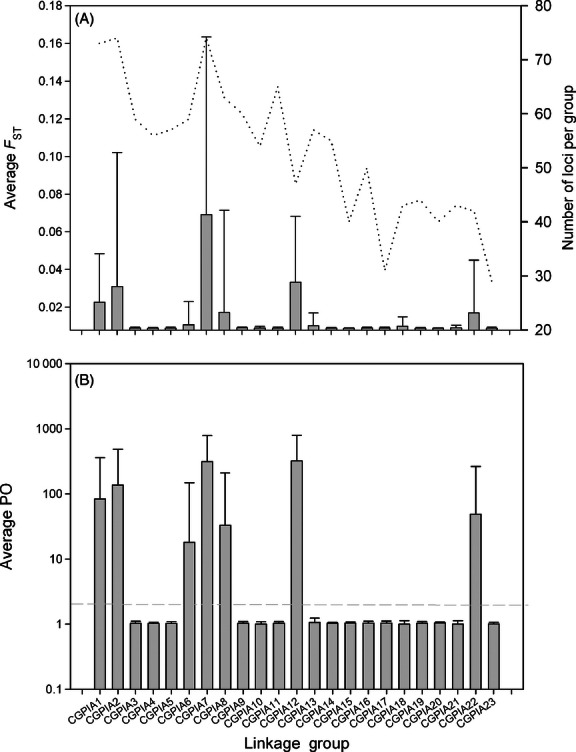
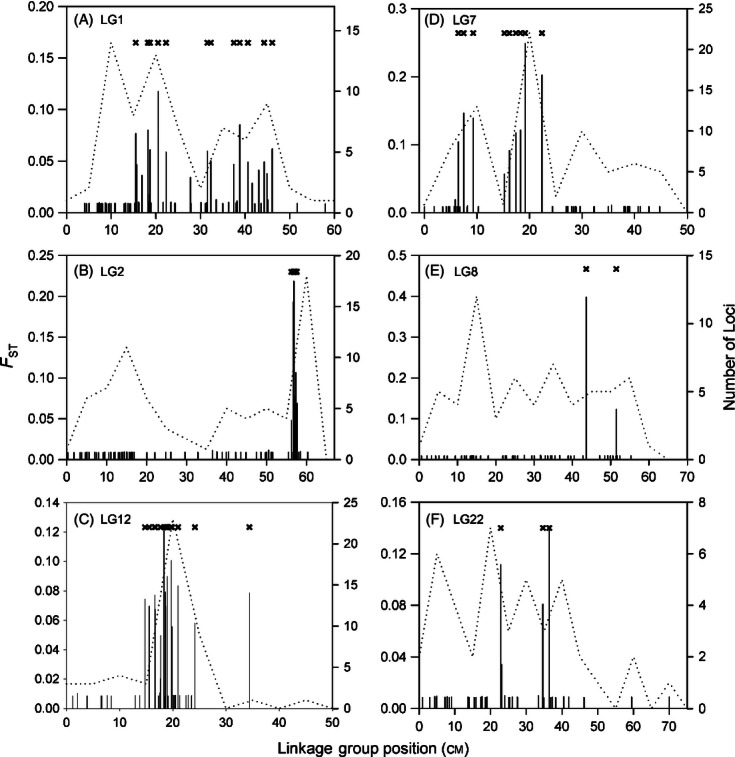
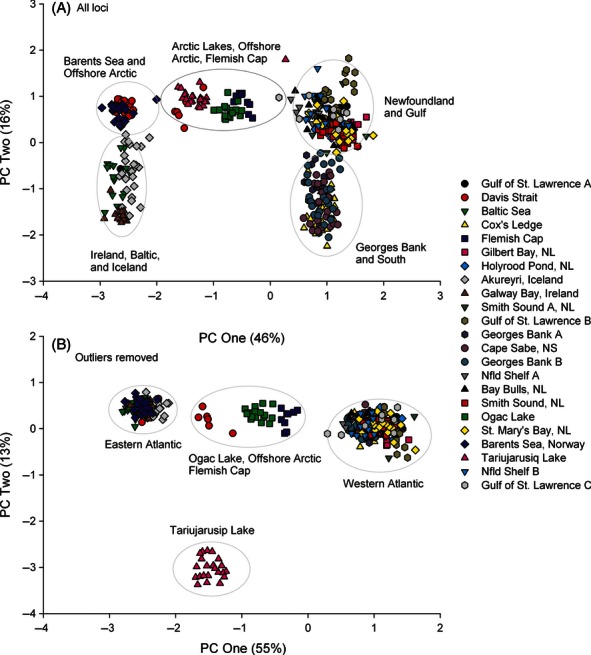
As populations diverge, genomic regions associated with adaptation display elevated differentiation. These genomic islands of adaptive divergence can inform conservation efforts in exploited species, by refining the delineation of management units, and providing genomic tools for more precise and effective population monitoring and the successful assignment of individuals and products. We explored heterogeneity in genomic divergence and its impact on the resolution of spatial population structure in exploited populations of Atlantic cod, Gadus morhua, using genome wide expressed sequence derived single nucleotide polymorphisms in 466 individuals sampled across the range. Outlier tests identified elevated divergence at 5.2% of SNPs, consistent with directional selection in one-third of linkage groups. Genomic regions of elevated divergence ranged in size from a single position to several cM. Structuring at neutral loci was associated with geographic features, whereas outlier SNPs revealed genetic discontinuities in both the eastern and western Atlantic. This fine-scale geographic differentiation enhanced assignment to region of origin, and through the identification of adaptive diversity, fundamentally changes how these populations should be conserved. This work demonstrates the utility of genome scans for adaptive divergence in the delineation of stock structure, the traceability of individuals and products, and ultimately a role for population genomics in fisheries conservation.
随着种群的分化,与适应相关的基因组区域表现出更高的分化。这些适应性分化的基因组岛屿可以为受捕捞物种的保护工作提供信息,通过细化管理单元的划定,并提供基因组工具,以更精确和有效地进行种群监测,以及成功地对个体和产品进行分配。我们利用在整个范围内采样的 466 个个体的全基因组表达序列衍生的单核苷酸多态性,探讨了大西洋鳕鱼(Gadus morhua)受捕捞种群中基因组分化的异质性及其对空间种群结构分辨率的影响。偏离检验确定了 5.2%的 SNP 存在升高的分化,与三分之一的连锁群中的定向选择一致。升高分化的基因组区域大小从单个位置到几个厘摩不等。中性基因座的结构与地理特征有关,而偏离 SNP 则揭示了大西洋东部和西部的遗传不连续性。这种精细的地理分化增强了对起源地的归属,通过识别适应性多样性,从根本上改变了这些种群应该如何被保护。这项工作证明了基因组扫描在确定种群结构、个体和产品的可追溯性方面的适应性分化的有效性,最终为种群基因组学在渔业保护中的作用提供了依据。