Semini Iris, Batona Georges, Lafrance Christian, Kessou Léon, Gbedji Eugène, Anani Hubert, Alary Michel
The World Bank, Washington, DC, USA.
AIDS Care. 2013;25 Suppl 1(Suppl 1):S30-9. doi: 10.1080/09540121.2013.784392.
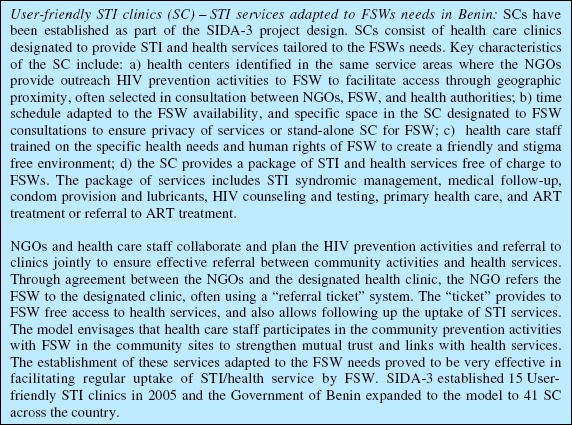
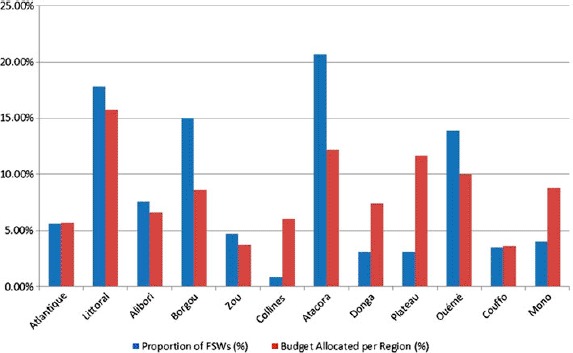
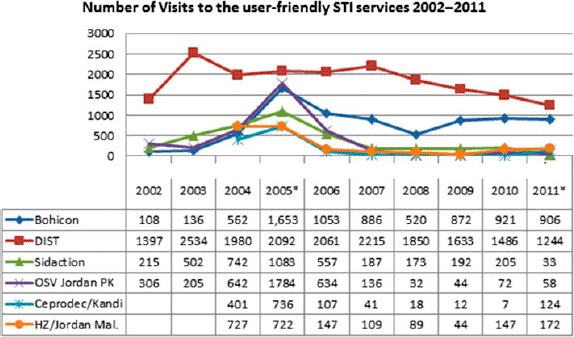
HIV response has entered a new era shaped by evidence that the combination of interventions impacts the trajectory of the epidemic. Even proven interventions, however, can be ineffective if not to scale, appropriately implemented, and with the right combination. Benin is among the pioneering countries that prioritized HIV prevention for sex workers and clients early on. Effective implementation up to 2006 resulted in consistent condom use among sex workers increasing from 39% to 86.2% and a decline in prevalence of gonorrhea from 5.4% to 1.6%. This study responds to the growing concern that, although proven interventions for female sex workers (FSWs) were expanded in Benin since 2008, indicators of coverage and behaviors are far from satisfactory. The quest to better understand implementation and how to render service delivery efficient and effective resonates with increased emphasis in the international arena on return for investments. Quantitative and qualitative methods were utilized to collect data. The output measured is the number of sex workers seeking Sexually Transmitted Infection (STI) care at user-friendly STI Clinics (SCs). Data were collected for 2010-2011 in nine regions of Benin. While recognizing that commitment to scale up is commendable, the study revealed deficiencies in program design and implementation that undermine outcomes. The selected mix of interventions is not optimal. Allocation of funds is not proportionate to the needs of FSW across regions. Only 5 of 41 SCs were fully functional at time of study. Free distribution of condoms covers only 10% of needs of FSWs. Funding and financing gaps resulted in extended interruptions of services. Successful HIV prevention in Benin will depend on the effective and efficient implementation of well-funded programs in sex work setting. Resources should be aligned to local sex work typology and presence in communities. A national framework defining an appropriate mix of interventions, management structure, referral mechanisms, and operational standards is required to guide rigorous implementation. Health services, in particular functional and user-friendly SCs coupled with mechanisms that link community-based work and health facilities should be strengthened to ensure STI care/anti-retroviral treatment expansion. Without leadership of sex workers, any attempt to end HIV will be unsuccessful.
艾滋病应对工作已进入一个新时代,有证据表明多种干预措施相结合会影响疫情发展轨迹。然而,即使是已证实有效的干预措施,如果没有扩大规模、妥善实施以及正确组合,也可能无效。贝宁是早期将性工作者及其客户的艾滋病预防工作列为优先事项的先锋国家之一。到2006年有效实施相关措施后,性工作者中持续使用避孕套的比例从39%增至86.2%,淋病患病率从5.4%降至1.6%。本研究回应了人们日益增长的担忧,即尽管自2008年以来贝宁已扩大了针对女性性工作者(FSW)的已证实有效的干预措施,但覆盖指标和行为指标仍远不尽人意。更好地理解实施情况以及如何使服务提供高效有效的探索,与国际社会日益强调投资回报相呼应。研究采用了定量和定性方法来收集数据。所衡量的产出是在方便用户的性传播感染诊所(SCs)寻求性传播感染(STI)护理的性工作者数量。2010 - 2011年在贝宁的九个地区收集了数据。虽然认识到扩大规模的承诺值得称赞,但研究揭示了项目设计和实施中的缺陷,这些缺陷破坏了成果。所选的干预措施组合并非最优。资金分配与各地区女性性工作者的需求不成比例。在研究时,41个性传播感染诊所中只有5个能全面运作。免费发放避孕套仅满足女性性工作者需求的10%。资金和融资缺口导致服务长时间中断。贝宁成功预防艾滋病将取决于在性工作环境中有效且高效地实施资金充足的项目。资源应与当地性工作类型及在社区中的分布情况相匹配。需要一个国家框架来界定适当的干预措施组合、管理结构、转诊机制和操作标准,以指导严格实施。应加强卫生服务,特别是功能完善且方便用户的性传播感染诊所,以及将社区工作与卫生设施相联系的机制,以确保性传播感染护理/抗逆转录病毒治疗的扩大。没有性工作者的领导,任何终结艾滋病的尝试都将失败。