School of Public Health, Post Graduate Institute of Medical Education and Research, Sector 12, Chandigarh 160012, India.
BMC Public Health. 2011 Jul 11;11:549. doi: 10.1186/1471-2458-11-549.
Targeted interventions (TIs) have been a major strategy for HIV prevention in India. We evaluated the impact of TIs on HIV prevalence in high HIV prevalence southern states (Tamil Nadu, Karnataka, Andhra Pradesh and Maharashtra).
A quasi-experimental approach was used to retrospectively compare changes in HIV prevalence according to the intensity of targeted intervention implementation. Condom gap (number of condoms required minus condoms supplied by TIs) was used as an indicator of TI intensity. Annual average number of commercial sex acts per female sex worker (FSW) reported in Behavioral Surveillance Survey was multiplied by the estimated number of FSWs in each district to calculate annual requirement of condoms in the district. Data of condoms supplied by TIs from 1995 to 2008 was obtained from program records. Districts in each state were ranked into quartiles based on the TI intensity. Primary data of HIV Sentinel Surveillance was analyzed to calculate HIV prevalence reductions in each successive year taking 2001 as reference year according to the quartiles of TI intensity districts using generalized linear model with logit link and binomial distribution after adjusting for age, education, and place of residence (urban or rural).
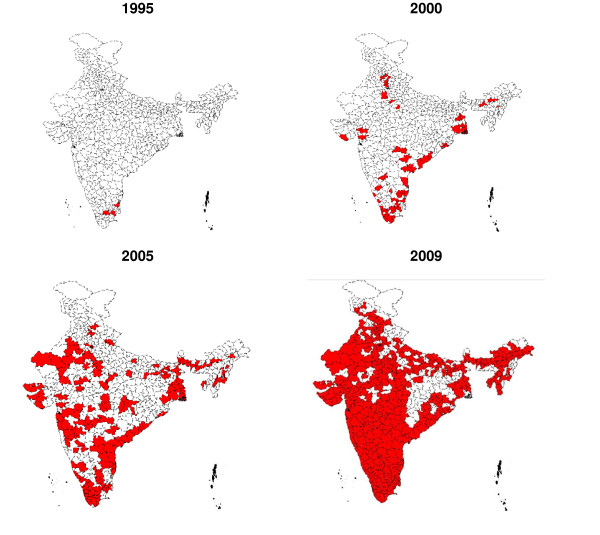
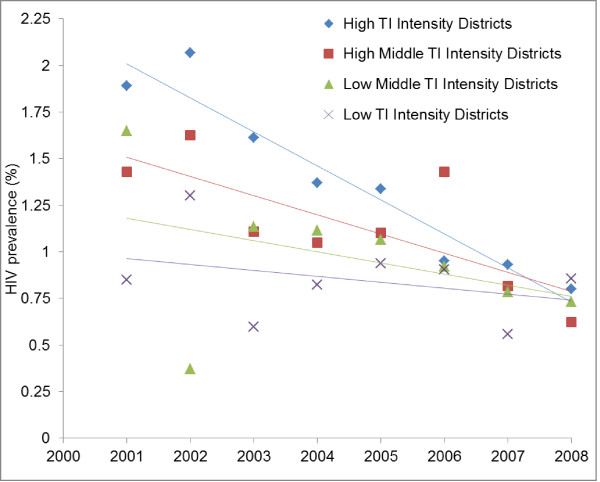
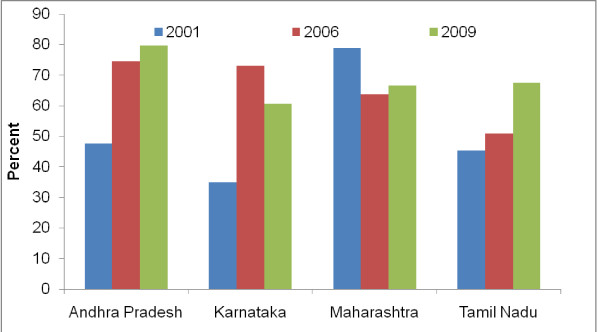
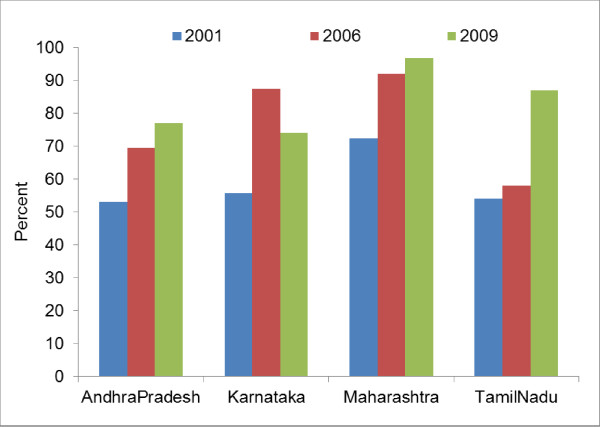
In the high HIV prevalence southern states, the number of TI projects for FSWs increased from 5 to 310 between 1995 and 2008. In high TI intensity quartile districts (n = 30), 186 condoms per FSW/year were distributed through TIs as compared to 45 condoms/FSW/year in the low TI intensity districts (n = 29). Behavioral surveillance indicated significant rise in condom use from 2001 to 2009. Among FSWs consistent condom use with last paying clients increased from 58.6% to 83.7% (p < 0.001), and among men of reproductive age, the condom use during sex with non-regular partner increased from 51.7% to 68.6% (p < 0.001). A significant decline in HIV and syphilis prevalence has occurred in high prevalence southern states among FSWs and young antenatal women. Among young (15-24 years) antenatal clinic attendees significant decline was observed in HIV prevalence from 2001 to 2008 (OR = 0.42, 95% CI 0.28-0.62) in high TI intensity districts whereas in low TI intensity districts the change was not significant (OR = 1.01, 95% CI 0.67-1.5).
Targeted interventions are associated with HIV prevalence decline.
目标干预(TIs)一直是印度预防艾滋病的主要策略。我们评估了 TIs 对南部高 HIV 流行地区(泰米尔纳德邦、卡纳塔克邦、安得拉邦和马哈拉施特拉邦)HIV 流行率的影响。
采用准实验方法,根据目标干预实施强度的变化,回顾性比较 HIV 流行率的变化。避孕套差距(目标干预提供的避孕套数量与所需避孕套数量之差)用作 TI 强度的指标。通过行为监测调查中报告的每位女性性工作者(FSW)的年平均商业性性行为次数乘以每个地区的估计 FSW 数量,计算出该地区每年的避孕套需求。从项目记录中获取 1995 年至 2008 年 TIs 提供的避孕套数据。根据 TI 强度将每个州的地区分为四组。根据 TI 强度地区的四分位数,以 2001 年为参考年,使用广义线性模型和对数链接以及二项式分布,对 HIV 哨点监测的原始数据进行分析,以计算每年的 HIV 流行率降低情况,调整了年龄、教育和居住地(城市或农村)的影响。
在南部高 HIV 流行地区,1995 年至 2008 年间,FSW 的 TIs 项目从 5 个增加到 310 个。在高 TI 强度四分位数地区(n=30),每年通过 TIs 为每个 FSW 分配 186 个避孕套,而在低 TI 强度地区(n=29),每个 FSW 每年分配 45 个避孕套。行为监测表明,从 2001 年到 2009 年,避孕套的使用显著增加。在定期客户中,性工作者坚持使用避孕套的比例从 58.6%增加到 83.7%(p<0.001),在生殖年龄的男性中,与非固定伴侣发生性行为时使用避孕套的比例从 51.7%增加到 68.6%(p<0.001)。在南部高流行地区的性工作者和年轻孕妇中,HIV 和梅毒的流行率均显著下降。在年轻(15-24 岁)孕妇中,在高 TI 强度地区,从 2001 年到 2008 年,HIV 流行率显著下降(OR=0.42,95%CI 0.28-0.62),而在低 TI 强度地区,这一变化并不显著(OR=1.01,95%CI 0.67-1.5)。
目标干预与 HIV 流行率下降有关。