College of Environmental Science and Engineering, Anhui Normal University, Wuhu 241000, China.
Sensors (Basel). 2013 Jun 7;13(6):7492-504. doi: 10.3390/s130607492.
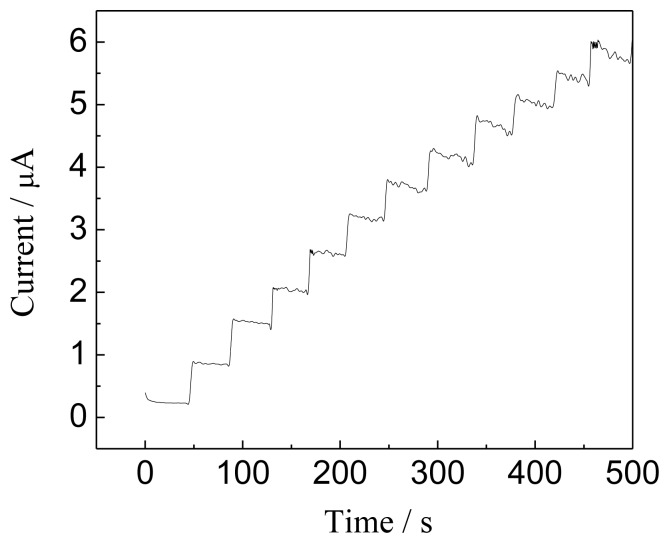
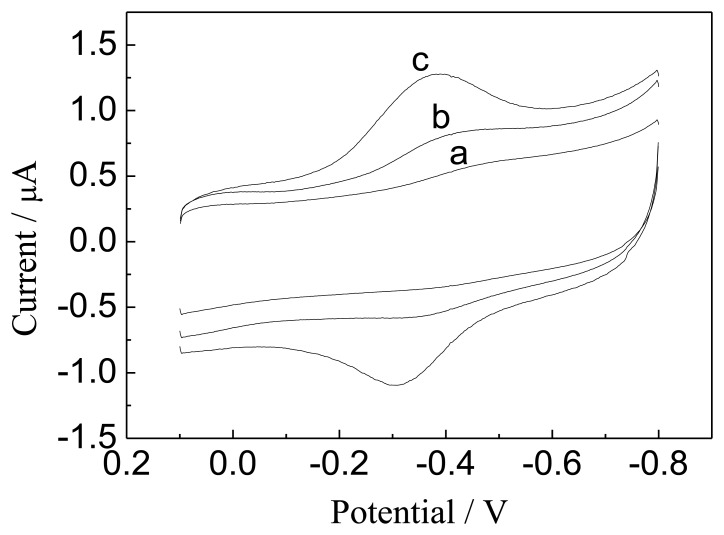
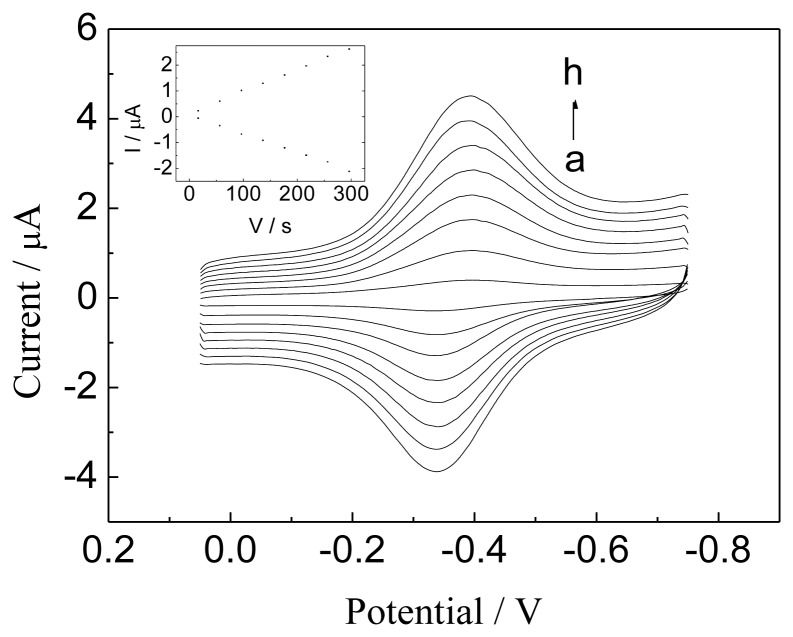
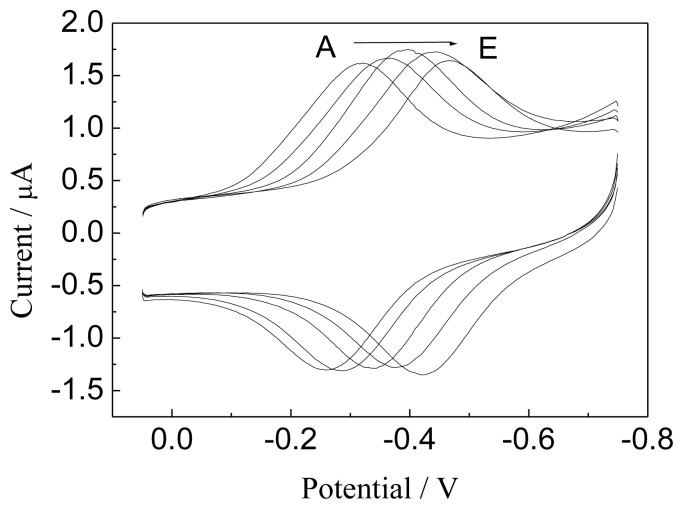
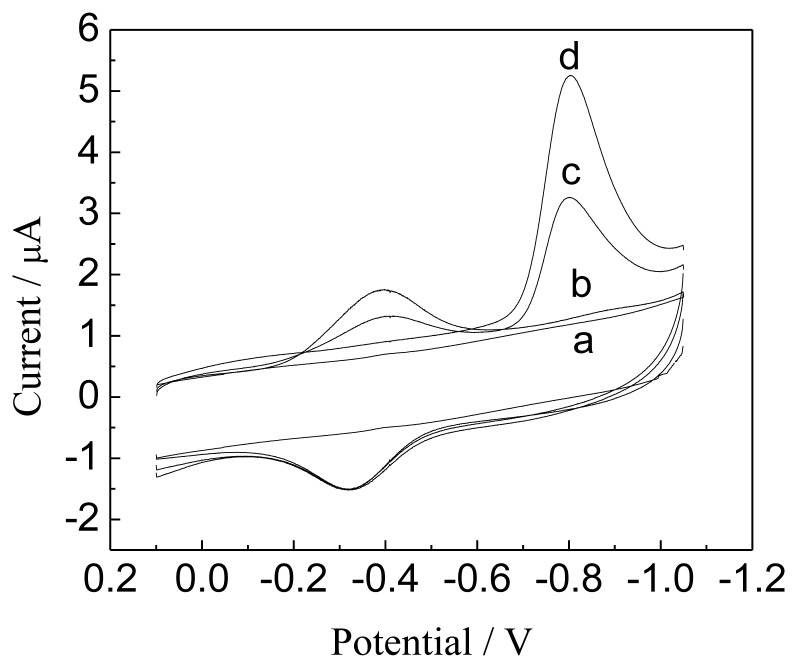
A simple two-step method was employed for preparing nano-sized gold nanoparticles-graphene composite to construct a GNPs-GR-SDS modified electrode. Hemoglobin (Hb) was successfully immobilized on the surface of a basal plane graphite (BPG) electrode through a simple dropping technique. Direct electrochemistry and electrocatalysis of the hemoglobin-modified electrode was investigated. The as-prepared composites showed an obvious promotion of the direct electro-transfer between hemoglobin and the electrode. A couple of well-defined and quasi-reversible Hb CV peaks can be observed in a phosphate buffer solution (pH 7.0). The separation of anodic and cathodic peak potentials is 81 mV, indicating a fast electron transfer reaction. The experimental results also clarified that the immobilized Hb retained its biological activity for the catalysis toward NO. The biosensor showed high sensitivity and fast response upon the addition of NO, under the conditions of pH 7.0, potential -0.82 V. The time to reach the stable-state current was less than 3 s, and the linear response range of NO was 0.72-7.92 μM, with a correlation coefficient of 0.9991.
采用简单的两步法制备纳米金纳米粒子-石墨烯复合材料,构建 GNPs-GR-SDS 修饰电极。通过简单的滴涂技术将血红蛋白(Hb)成功固定在基底平面石墨(BPG)电极表面。研究了血红蛋白修饰电极的直接电化学和电催化性能。所制备的复合材料明显促进了血红蛋白与电极之间的直接电子转移。在磷酸盐缓冲溶液(pH 7.0)中可以观察到一对定义良好且近乎可逆的 Hb CV 峰。阳极和阴极峰电位的分离为 81 mV,表明电子转移反应较快。实验结果还表明,固定化血红蛋白保持了其对 NO 的生物催化活性。在 pH 7.0、电位-0.82 V 的条件下,加入 NO 后,生物传感器表现出高灵敏度和快速响应。达到稳定电流的时间小于 3 s,NO 的线性响应范围为 0.72-7.92 μM,相关系数为 0.9991。