Centre for Integrative Neuroscience and Neurodynamics, The University of Reading Reading, UK.
Front Hum Neurosci. 2013 May 30;7:228. doi: 10.3389/fnhum.2013.00228. eCollection 2013.
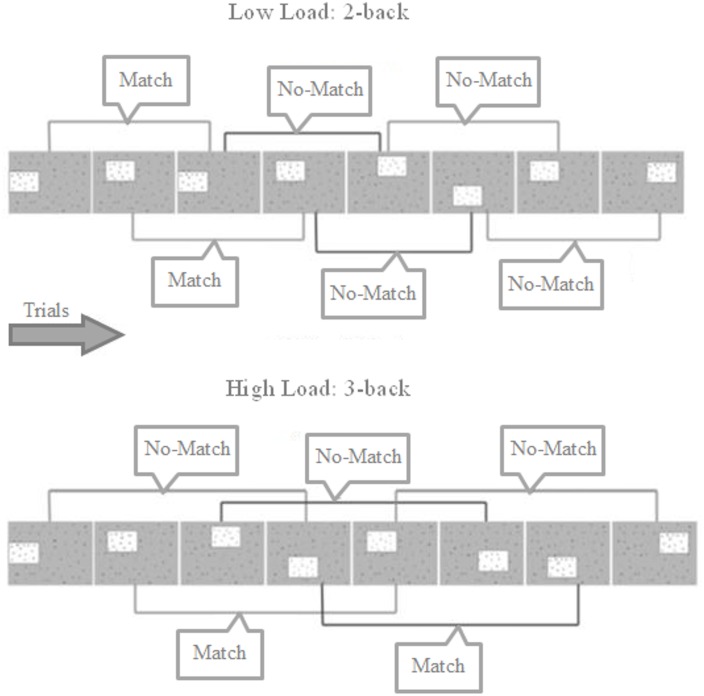
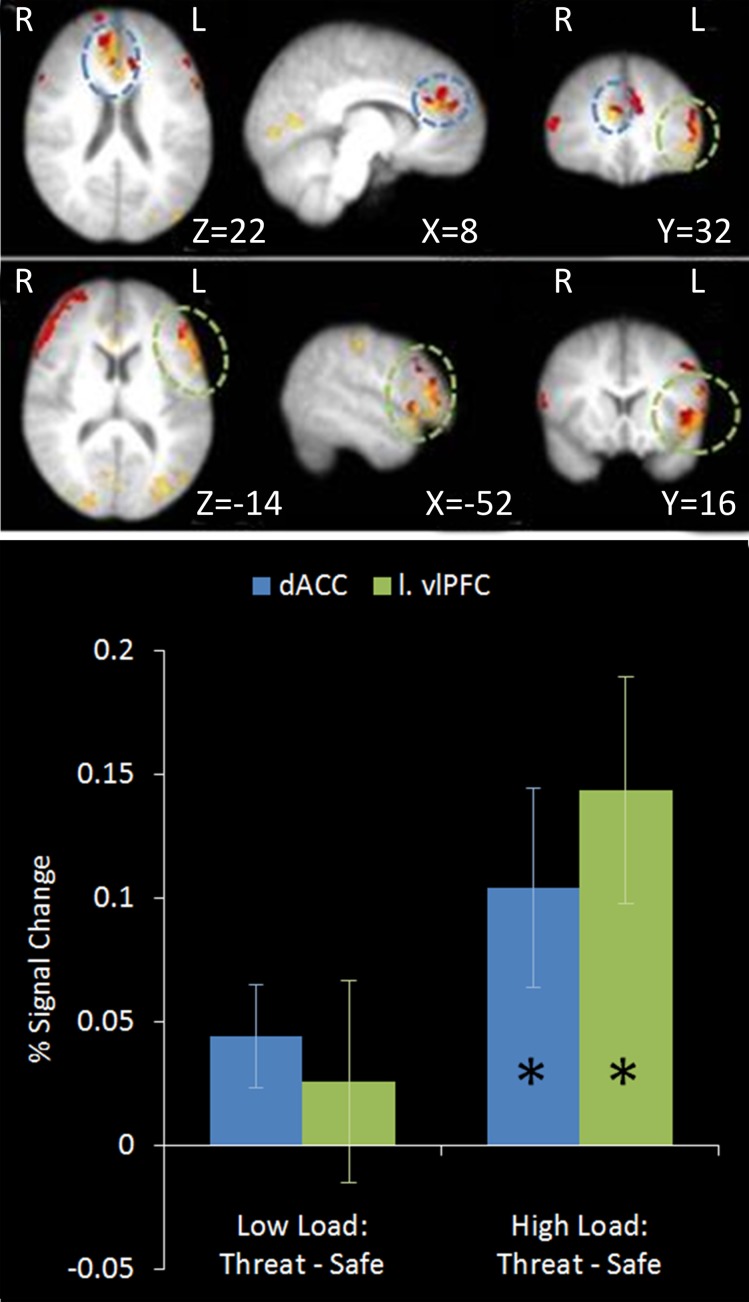
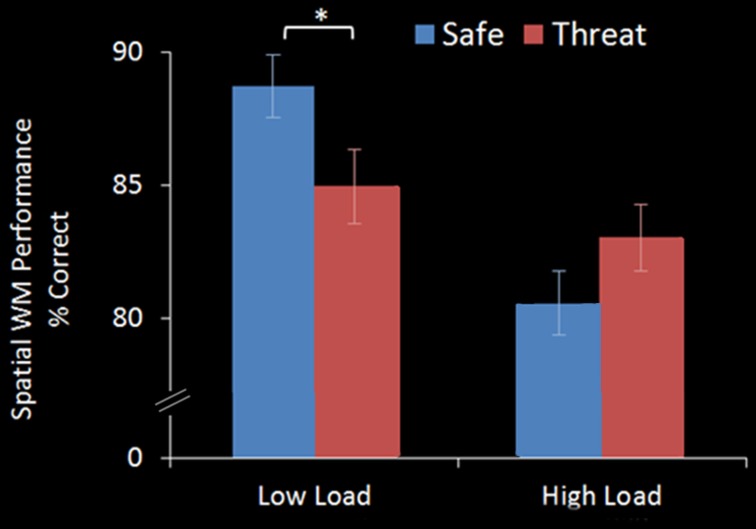
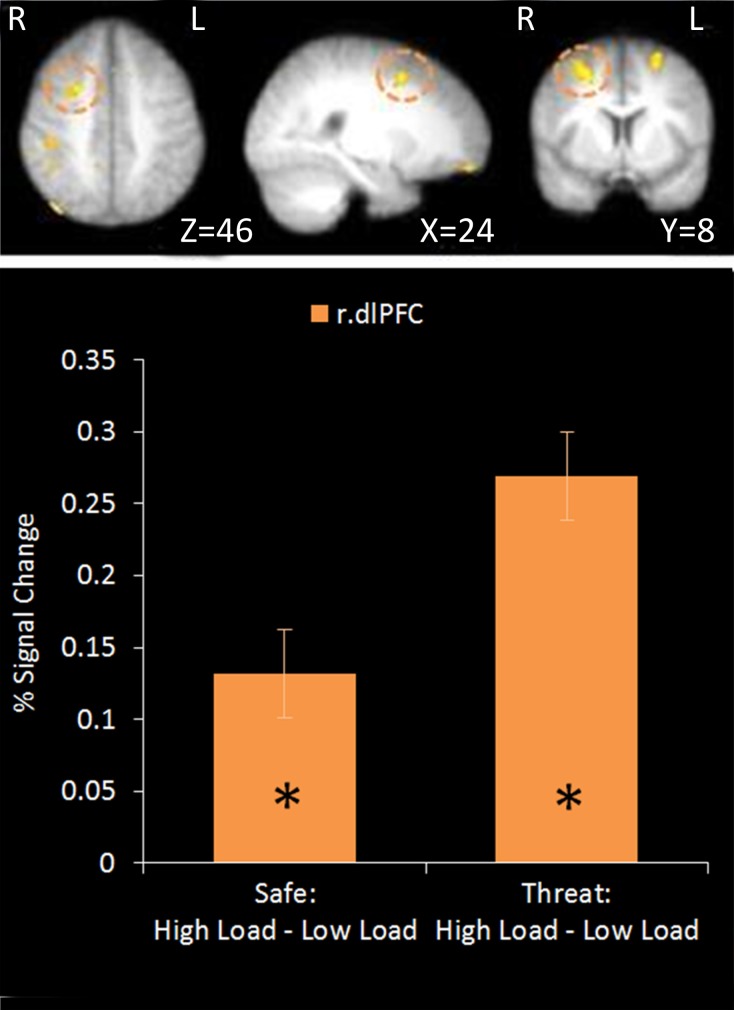
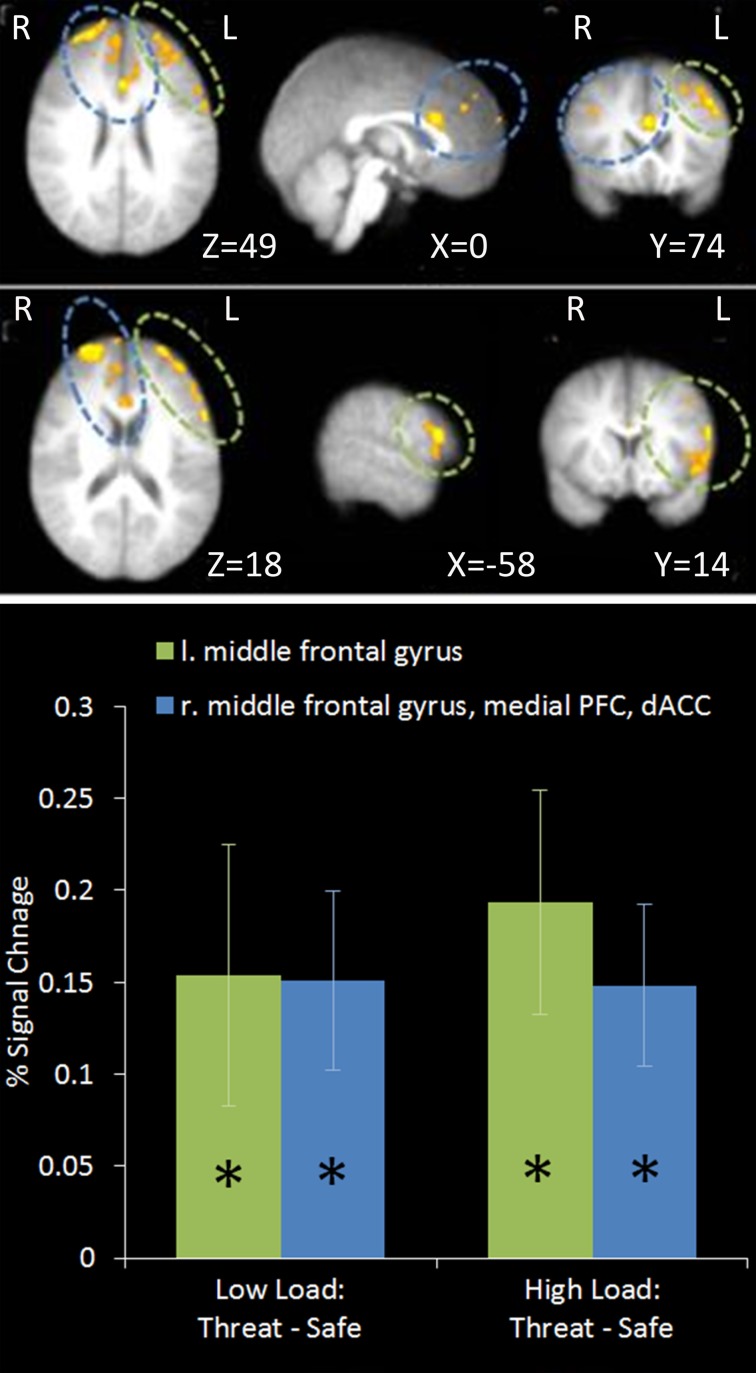
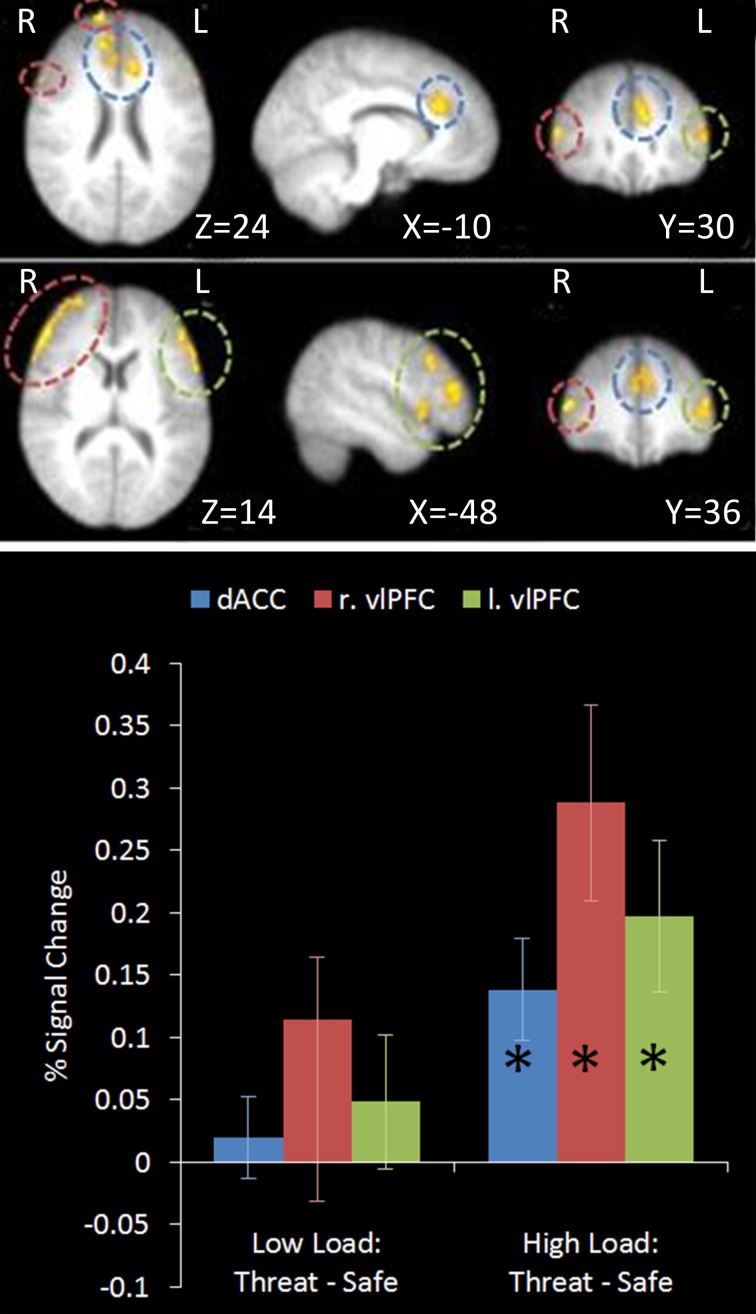
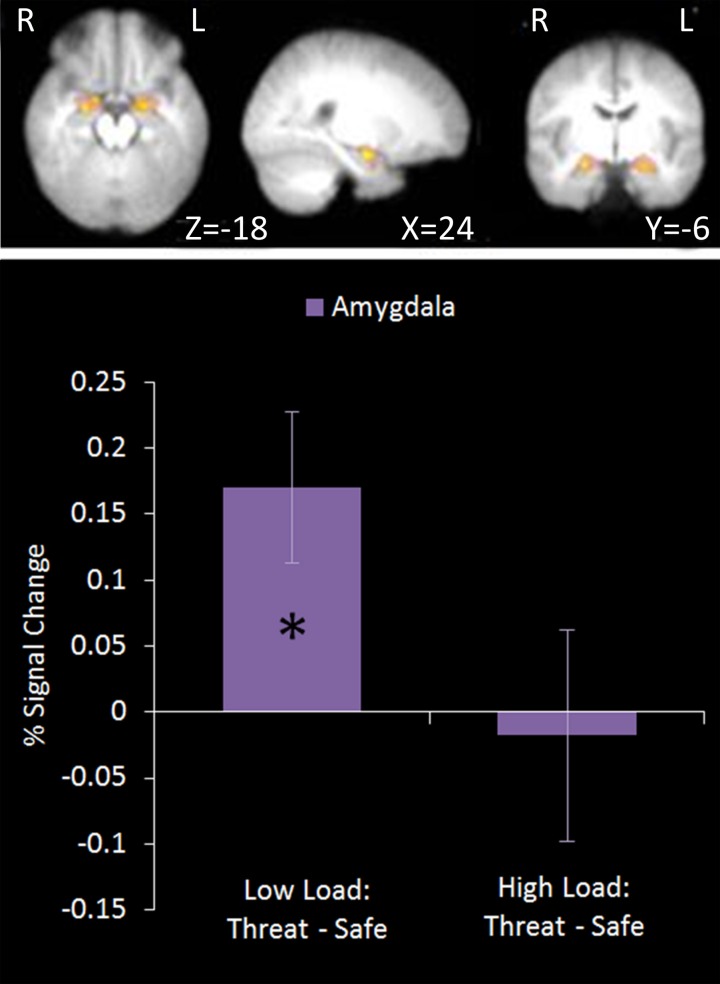
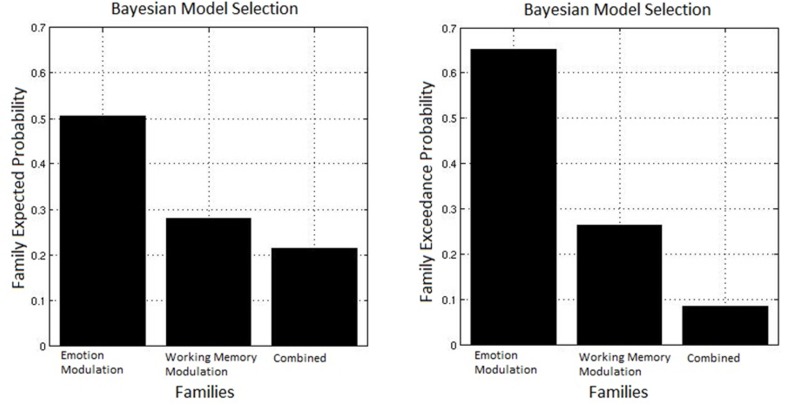
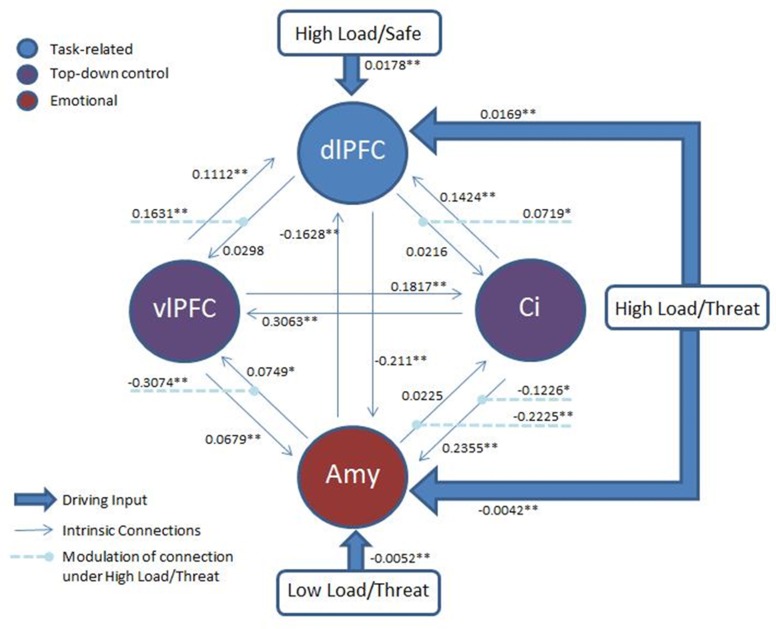
Bottom-up processes can interrupt ongoing cognitive processing in order to adaptively respond to emotional stimuli of high potential significance, such as those that threaten wellbeing. However it is vital that this interference can be modulated in certain contexts to focus on current tasks. Deficits in the ability to maintain the appropriate balance between cognitive and emotional demands can severely impact on day-to-day activities. This fMRI study examined this interaction between threat processing and cognition; 18 adult participants performed a visuospatial working memory (WM) task with two load conditions, in the presence and absence of anxiety induction by threat of electric shock. Threat of shock interfered with performance in the low cognitive load condition; however interference was eradicated under high load, consistent with engagement of emotion regulation mechanisms. Under low load the amygdala showed significant activation to threat of shock that was modulated by high cognitive load. A directed top-down control contrast identified two regions associated with top-down control; ventrolateral PFC and dorsal ACC. Dynamic causal modeling provided further evidence that under high cognitive load, top-down inhibition is exerted on the amygdala and its outputs to prefrontal regions. Additionally, we hypothesized that individual differences in a separate, non-emotional top-down control task would predict the recruitment of dorsal ACC and ventrolateral PFC during top-down control of threat. Consistent with this, performance on a separate dichotic listening task predicted dorsal ACC and ventrolateral PFC activation during high WM load under threat of shock, though activation in these regions did not directly correlate with WM performance. Together, the findings suggest that under high cognitive load and threat, top-down control is exerted by dACC and vlPFC to inhibit threat processing, thus enabling WM performance without threat-related interference.
自下而上的过程可以中断正在进行的认知处理,以便对具有高度潜在意义的情绪刺激做出适应性反应,例如那些威胁到幸福感的刺激。然而,在某些情况下,至关重要的是能够调节这种干扰,以便专注于当前任务。在认知和情绪需求之间保持适当平衡的能力缺陷会严重影响日常生活活动。这项 fMRI 研究考察了威胁处理和认知之间的这种相互作用;18 名成年参与者在存在和不存在电击威胁引起的焦虑的情况下,进行了视觉空间工作记忆 (WM) 任务和两种负荷条件。威胁会干扰低认知负荷条件下的表现;然而,在高负荷下,干扰被消除,这与情绪调节机制的参与一致。在低负荷下,杏仁核对电击威胁表现出显著的激活,这种激活受到高认知负荷的调节。一个有向的自上而下的控制对比确定了两个与自上而下的控制相关的区域;腹外侧前额叶皮层和背侧前扣带皮层。动态因果建模提供了进一步的证据,表明在高认知负荷下,自上而下的抑制作用于杏仁核及其对前额叶区域的输出。此外,我们假设,在单独的非情绪自上而下控制任务中的个体差异,将预测在威胁下进行自上而下控制时背侧前扣带皮层和腹外侧前额叶皮层的招募。与这一假设一致,在单独的双耳分听任务中的表现预测了在威胁下高 WM 负荷期间背侧前扣带皮层和腹外侧前额叶皮层的激活,尽管这些区域的激活与 WM 表现没有直接相关。总之,这些发现表明,在高认知负荷和威胁下,背侧前扣带皮层和腹外侧前额叶皮层通过 dACC 和 vlPFC 来施加自上而下的控制,从而在没有威胁相关干扰的情况下实现 WM 表现。