Department of Health Industry and Policy, Korea Health Industry Development Institute, Gangoe-Myeon, Republic of Korea.
Nutr Diabetes. 2013 Jun 10;3(6):e73. doi: 10.1038/nutd.2013.16.
Parental obesity has been identified as a predominant risk factor for childhood overweight and obesity. We investigated the relationship between parent and child obesity in South Korea, particularly linked with varying family structures.
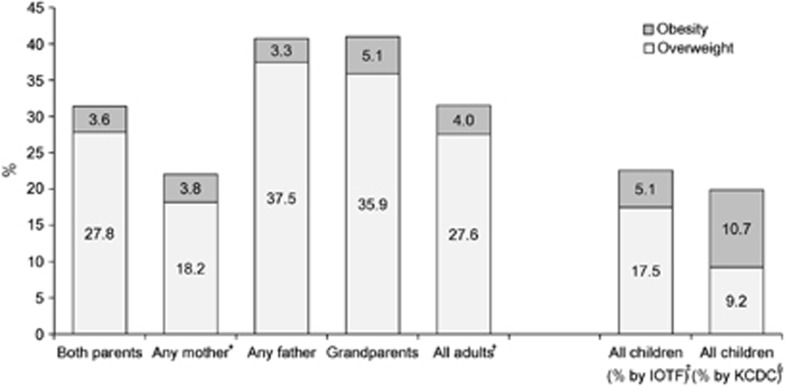
Data for households with children aged 2-18 years were taken from the pooled data of the Korea National Health and Nutrition Examination Survey (KNHANES) 2007-2010 conducted by the Korea Centers for Disease Control and Prevention (KCDC). The sample consisted of 17 453 individuals (7879 children and 9574 adults) from 5048 households with children for this study. Children's overweight and obesity prevalence was compared using both International Obesity Taskforce (IOTF) and KCDC cutoff points according to parental weight status and household structure. Logistic regression analysis was used.
Significantly greater odds of overweight and obesity existed among children living with both parents (odds ratio (OR)=3.5, 95% confidence interval (CI): 2.71, 4.65) or one parent (mother: OR=1.6, 95% CI: 1.22, 2.12; father: OR=1.7, 95% CI: 1.37, 1.99). The adjusted ORs for overweight and obesity among children living with overweight mother only or overweight grandparent only were approximately double that of children living with normal-weight mother (OR=2.2, 95% CI: 1.22-3.82) or normal-weight grandparent (OR=2.1, 95% CI: 1.06-4.05).
Children living with overweight parent(s) or grandparent(s) were positively correlated with the risk for childhood overweight and obesity. Socioeconomic status did not affect the observed relationships in this population, whereas the role of genetic, dietary and activity patterns requires further exploration.
父母肥胖已被确定为儿童超重和肥胖的主要危险因素。我们研究了韩国父母与子女肥胖之间的关系,特别是与不同家庭结构的关系。
本研究的数据来自韩国疾病控制与预防中心(KCDC)进行的韩国国家健康与营养检查调查(KNHANES)2007-2010 的合并数据,该数据涉及 2-18 岁儿童的家庭。该样本由 5048 户有儿童的家庭中的 17453 个人(7879 名儿童和 9574 名成年人)组成。根据父母的体重状况和家庭结构,使用国际肥胖工作组(IOTF)和 KCDC 切点比较儿童超重和肥胖的患病率。使用逻辑回归分析。
与父母双全(比值比(OR)=3.5,95%置信区间(CI):2.71,4.65)或单亲(母亲:OR=1.6,95%CI:1.22,2.12;父亲:OR=1.7,95%CI:1.37,1.99)生活在一起的儿童超重和肥胖的可能性显著更高。与与正常体重母亲(OR=2.2,95%CI:1.22-3.82)或正常体重祖父母(OR=2.1,95%CI:1.06-4.05)生活在一起的儿童相比,仅与超重母亲或超重祖父母生活在一起的儿童超重和肥胖的调整后比值比(OR)约为两倍。
与超重父母或祖父母生活在一起的儿童超重和肥胖的风险呈正相关。在该人群中,社会经济地位并未影响观察到的关系,而遗传、饮食和活动模式的作用需要进一步探讨。