Department of Public Health, College of Health Sciences, Mekelle University, Mekelle, Ethiopia.
PLoS One. 2013 Jun 6;8(6):e65840. doi: 10.1371/journal.pone.0065840. Print 2013.
Outpatient Therapeutic feeding Program (OTP) brings the services for management of Severe Acute Malnutrition (SAM) closer to the community by making services available at decentralized treatment points within the primary health care settings, through the use of ready-to-use therapeutic foods, community outreach and mobilization. Little is known about the program outcomes. This study revealed the levels of program outcome indictors and determinant factors to recovery rate.
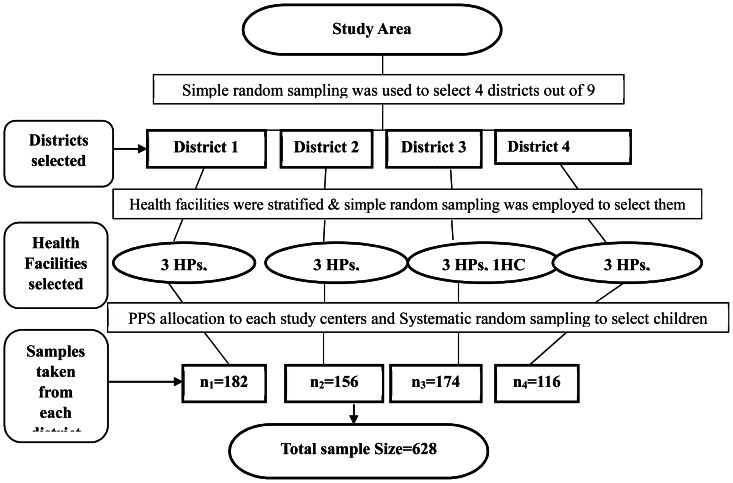
A retrospective cohort study was conducted on 628 children who had been managed for SAM under OTP from April/2008 to January/2012. The children were selected using systematic random sampling from 12 health posts and 4 health centers. The study relied on information of demographic characteristics, anthropometries, Plumpy'Nut, medical problems and routine medications intakes. The results were estimated using Kaplan-Meier survival curves, log-rank test and Cox-regression.
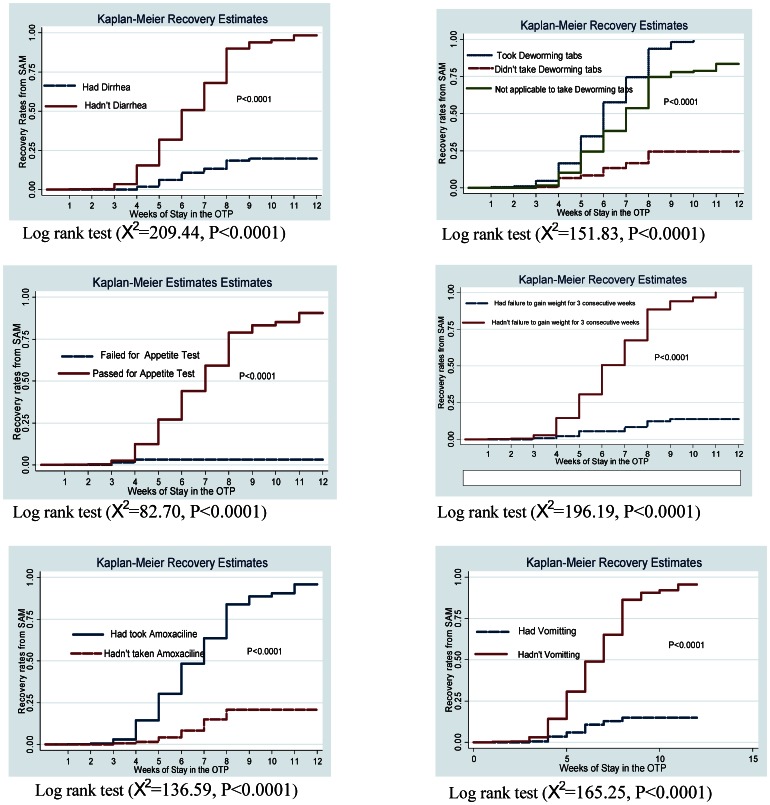
The recovery, defaulter, mortality and weight gain rates were 61.78%, 13.85%, 3.02% and 5.23 gm/kg/day, respectively. Routine medications were administered partially and children with medical problems were managed inappropriately under the program. As a child consumed one more sachet of Plumpy'Nut, the recovery rate from SAM increased by 4% (HR = 1.04, 95%-CI = 1.03, 1.05, P<0.001). The adjusted hazard ratios to recovery of children with diarrhea, appetite loss with Plumpy'Nut and failure to gain weight were 2.20 (HR = 2.20, 95%-CI = 1.31, 3.41, P = 0.001), 4.49 (HR = 1.74, 95%-CI = 1.07, 2.83, P = 0.046) and 3.88 (HR = 1.95, 95%-CI = 1.17, 3.23, P<0.001), respectively. Children who took amoxicillin and de-worming had 95% (HR = 1.95, 95%-CI = 1.17, 3.23) and 74% (HR = 1.74, 95%-CI = 1.07, 2.83) more probability to recover from SAM as compared to those who didn't take them.
The OTP was partially successful. Management of children with comorbidities under the program and partial administration of routine drugs were major threats for the program effectiveness. The stakeholders should focus on creating the capacity of the OTP providers on proper management of SAM to achieve fully effective program.
门诊治疗喂养计划(OTP)通过在基层医疗保健环境中的分散治疗点提供即用型治疗食品、社区外展和动员,使管理严重急性营养不良(SAM)的服务更接近社区,从而使服务接近社区。人们对该计划的结果知之甚少。本研究揭示了程序结果指标和决定因素对恢复率的水平。
对 2008 年 4 月至 2012 年 1 月期间在 OTP 下接受 SAM 管理的 628 名儿童进行了回顾性队列研究。这些儿童是从 12 个卫生所和 4 个卫生中心通过系统随机抽样选择的。该研究依赖于人口统计学特征、人体测量学、Plumpy'Nut、医疗问题和常规药物摄入量的信息。使用 Kaplan-Meier 生存曲线、对数秩检验和 Cox 回归来估计结果。
恢复、违约、死亡率和体重增加率分别为 61.78%、13.85%、3.02%和 5.23 gm/kg/天。常规药物部分给予,患有医疗问题的儿童在该计划下管理不当。由于儿童多服用一份 Plumpy'Nut,SAM 恢复率增加了 4%(HR=1.04,95%-CI=1.03,1.05,P<0.001)。腹泻、食欲减退与 Plumpy'Nut 和体重增加失败的儿童恢复的调整后危险比分别为 2.20(HR=2.20,95%-CI=1.31,3.41,P=0.001)、4.49(HR=1.74,95%-CI=1.07,2.83,P=0.046)和 3.88(HR=1.95,95%-CI=1.17,3.23,P<0.001)。与未服用这些药物的儿童相比,服用阿莫西林和驱虫药的儿童从 SAM 中恢复的可能性分别增加了 95%(HR=1.95,95%-CI=1.17,3.23)和 74%(HR=1.74,95%-CI=1.07,2.83)。
OTP 部分成功。该计划中合并症儿童的管理和常规药物的部分管理是该计划有效性的主要威胁。利益相关者应侧重于提高 OTP 提供者对 SAM 进行适当管理的能力,以实现完全有效的计划。