Lapidus Nathanael, Luquero Francisco J, Gaboulaud Valérie, Shepherd Susan, Grais Rebecca F
Epicentre, Paris, France.
PLoS Med. 2009 Mar 3;6(3):e39. doi: 10.1371/journal.pmed.1000039.
Important differences exist in the diagnosis of malnutrition when comparing the 2006 World Health Organization (WHO) Child Growth Standards and the 1977 National Center for Health Statistics (NCHS) reference. However, their relationship with mortality has not been studied. Here, we assessed the accuracy of the WHO standards and the NCHS reference in predicting death in a population of malnourished children in a large nutritional program in Niger.
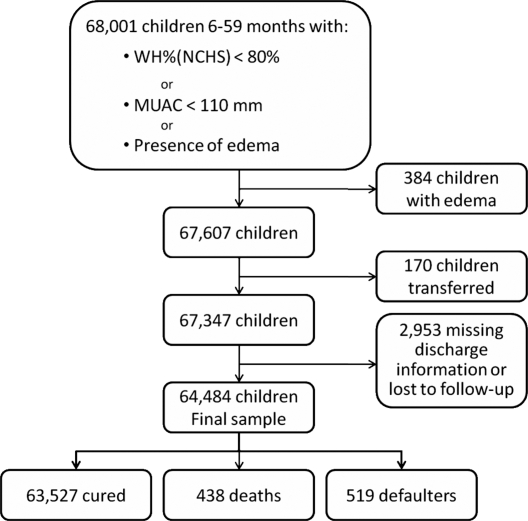
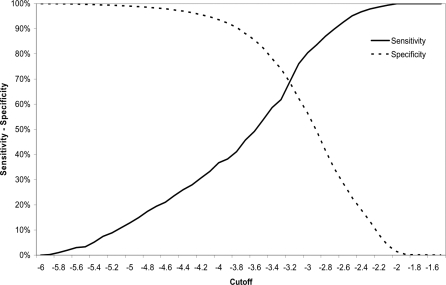
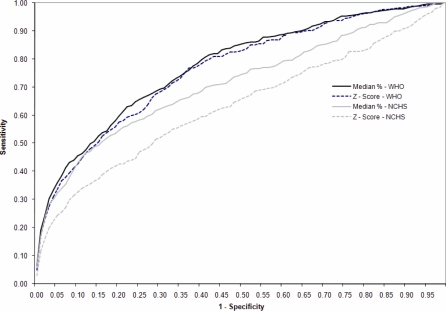
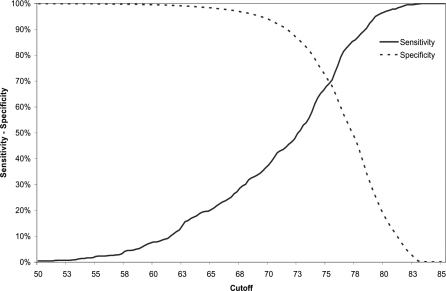
We analyzed data from 64,484 children aged 6-59 mo admitted with malnutrition (<80% weight-for-height percentage of the median [WH]% [NCHS] and/or mid-upper arm circumference [MUAC] <110 mm and/or presence of edema) in 2006 into the Médecins Sans Frontières (MSF) nutritional program in Maradi, Niger. Sensitivity and specificity of weight-for-height in terms of Z score (WHZ) and WH% for both WHO standards and NCHS reference were calculated using mortality as the gold standard. Sensitivity and specificity of MUAC were also calculated. The receiver operating characteristic (ROC) curve was traced for these cutoffs and its area under curve (AUC) estimated. In predicting mortality, WHZ (NCHS) and WH% (NCHS) showed AUC values of 0.63 (95% confidence interval [CI] 0.60-0.66) and 0.71 (CI 0.68-0.74), respectively. WHZ (WHO) and WH% (WHO) appeared to provide higher accuracy with AUC values of 0.76 (CI 0.75-0.80) and 0.77 (CI 0.75-0.80), respectively. The relationship between MUAC and mortality risk appeared to be relatively weak, with AUC = 0.63 (CI 0.60-0.67). Analyses stratified by sex and age yielded similar results.
These results suggest that in this population of children being treated for malnutrition, WH indicators calculated using WHO standards were more accurate for predicting mortality risk than those calculated using the NCHS reference. The findings are valid for a population of already malnourished children and are not necessarily generalizable to a population of children being screened for malnutrition. Future work is needed to assess which criteria are best for admission purposes to identify children most likely to benefit from therapeutic or supplementary feeding programs.
在比较2006年世界卫生组织(WHO)儿童生长标准与1977年美国国家卫生统计中心(NCHS)参考标准时,营养不良的诊断存在重要差异。然而,它们与死亡率的关系尚未得到研究。在此,我们评估了WHO标准和NCHS参考标准在预测尼日尔一项大型营养项目中营养不良儿童群体死亡情况方面的准确性。
我们分析了2006年纳入尼日尔马拉迪无国界医生组织(MSF)营养项目的64484名年龄在6至59个月的营养不良儿童(身高别体重百分比低于中位数的80%[WH]%[NCHS]和/或上臂中段周长[MUAC]<110mm和/或存在水肿)的数据。以死亡率作为金标准,计算了WHO标准和NCHS参考标准下身高别体重Z评分(WHZ)和WH%的敏感性和特异性。还计算了MUAC的敏感性和特异性。针对这些临界值绘制了受试者工作特征(ROC)曲线并估计了曲线下面积(AUC)。在预测死亡率方面,WHZ(NCHS)和WH%(NCHS)的AUC值分别为0.63(95%置信区间[CI]0.60 - 0.66)和0.71(CI 0.68 - 0.74)。WHZ(WHO)和WH%(WHO)似乎具有更高的准确性,AUC值分别为0.76(CI 0.75 - 0.80)和0.77(CI 0.75 - 0.80)。MUAC与死亡风险之间的关系似乎相对较弱,AUC = 0.63(CI 0.60 - 0.67)。按性别和年龄分层的分析得出了类似的结果。
这些结果表明,在这个接受营养不良治疗的儿童群体中,使用WHO标准计算的WH指标在预测死亡风险方面比使用NCHS参考标准计算的指标更准确。这些发现对于已经营养不良的儿童群体是有效的,不一定能推广到正在接受营养不良筛查的儿童群体。未来需要开展工作来评估哪些标准最适合用于入院目的,以识别最有可能从治疗性或补充性喂养项目中受益的儿童。