Department of Molecular Neuroscience, UCL Institute of Neurology, London, UK.
Curr Opin Neurol. 2013 Aug;26(4):406-12. doi: 10.1097/WCO.0b013e3283633696.
The dystonias are a common but complex group of disorders that show considerable variation in cause and clinical presentation. The purpose of this review is to highlight the most important discoveries and insights from across the field over the period of the past 18 months.
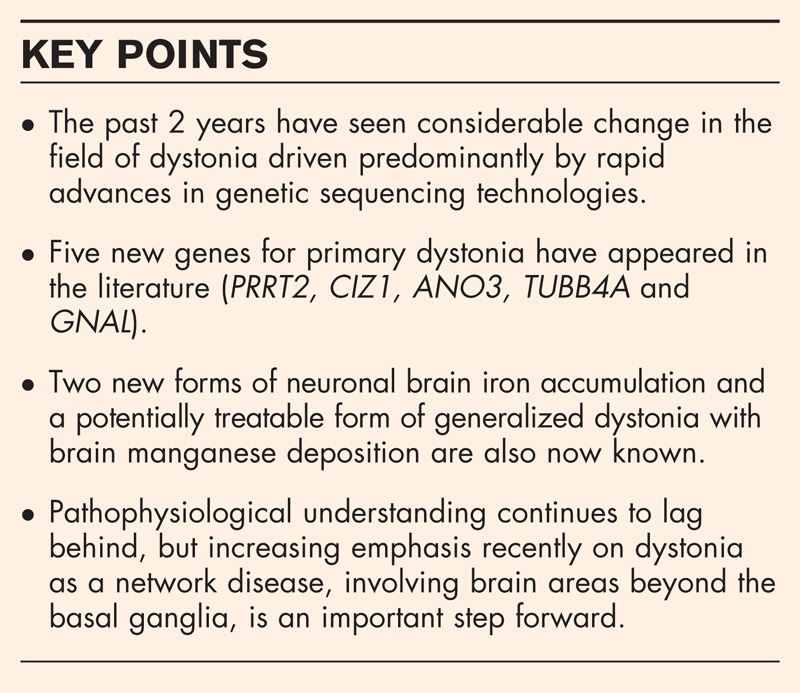
Five new genes for primary dystonia (PRRT2, CIZ1, ANO3, TUBB4A and GNAL) have made their appearance in the literature. New subtypes of neuronal brain iron accumulation have been delineated and linked to mutations in C19orf12 and WDR45, while a new treatable form of dystonia with brain manganese deposition related to mutations in SLC30A10 has been described. At the same time, the phenotypes of other forms of dystonic syndromes have been expanded or linked together. Finally, there has been increasing recognition of both the extramotor phenotype in dystonia and the part played by the cerebellum in its pathophysiology.
Recently, there has been unprecedented change in the scientific landscape with respect to the cause of various dystonic syndromes that is likely to make a direct impact on clinical practice in the near future. Understanding the genetic cause of these syndromes and the often wide phenotypic variation in their presentations will improve diagnosis and treatment. With time, these discoveries may also lead to much-needed progress in elucidating the underlying pathophysiology of dystonia.
肌张力障碍是一组常见但复杂的疾病,其病因和临床表现存在很大差异。本文的目的是重点介绍过去 18 个月来该领域最重要的发现和进展。
已有五项新的原发性肌张力障碍基因(PRRT2、CIZ1、ANO3、TUBB4A 和 GNAL)在文献中出现。新的神经元脑铁蓄积亚型已被描绘出来,并与 C19orf12 和 WDR45 的突变相关,而一种与 SLC30A10 突变相关的新的可治疗性锰沉积性肌张力障碍形式也已被描述。与此同时,其他类型的肌张力障碍综合征的表型也得到了扩展或联系在一起。最后,人们越来越认识到肌张力障碍的运动外表型以及小脑在其病理生理学中的作用。
总之,最近,各种肌张力障碍综合征的病因在科学领域发生了前所未有的变化,这很可能在不久的将来直接影响临床实践。了解这些综合征的遗传病因及其表现的广泛表型差异将改善诊断和治疗。随着时间的推移,这些发现也可能有助于阐明肌张力障碍的潜在病理生理学。