Discipline of Physiotherapy, Faculty of Health Science, The University of Sydney, PO Box 170, Sydney, Lidcombe NSW 1825, Australia.
BMC Health Serv Res. 2013 Jun 13;13:213. doi: 10.1186/1472-6963-13-213.
Implementation strategies for clinical guidelines have shown modest effects in changing health professional's knowledge and practice, however, targeted implementations are suggested to achieve greater improvements. This study aimed to examine the effect of a targeted implementation strategy of the Australian whiplash guidelines on health professionals' knowledge, beliefs and practice and to identify predictors of improved knowledge.
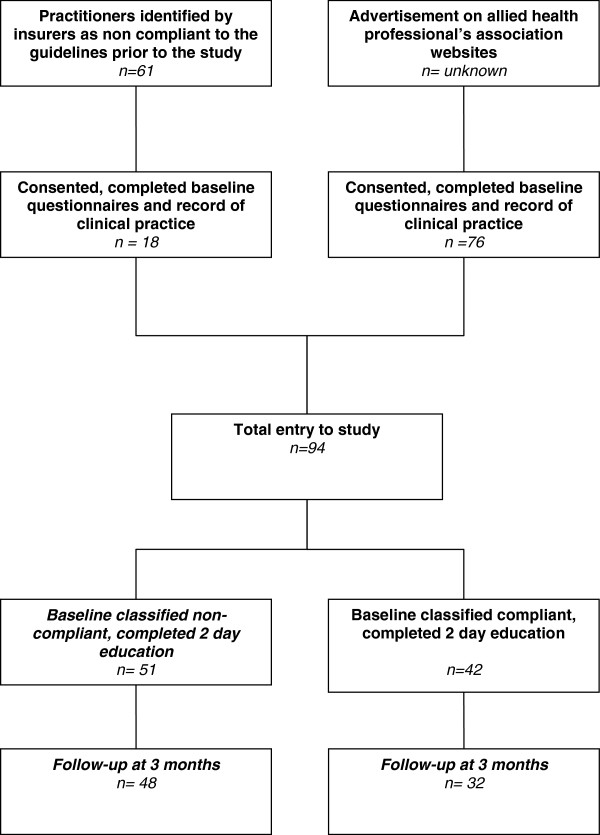
94 health professionals (Physiotherapists, Chiropractors and Osteopaths) who manage whiplash participated in this study. Prior to their inclusion in the study, health professionals were classified as compliant with clinical guidelines for whiplash (n = 52) or non-compliant (n = 42), according to a record of clinical practice. All participants completed a 2- day interactive workshop with outcomes measured at baseline and 3 months following the workshop. The workshop was delivered by opinion leaders, with the educational content focused on the pre-identified knowledge and practice gaps in relation to clinical guidelines for whiplash. Knowledge and health professional beliefs were assessed by a questionnaire and professional practice by record of clinical practice.
Participants significantly increased knowledge (p < 0.0001) and were more likely to be compliant with the guidelines at follow-up (compliant at baseline 58%, follow-up 79%, p = 0.002). Health professional belief systems significantly changed to be more behavioural (p = 0.02) and less biomedical (p = 0.000). Predictors of improved knowledge were baseline knowledge (parameter estimate = -0.6, p = 0.000) and profession (parameter estimate = -3.8, p = 0.003) (adj R2 = 35%).
A targeted implementation strategy improved health professional's knowledge and clinical practice so that they became more compliant with clinical guidelines for whiplash. In addition health professionals' belief systems significantly changed to be more behavioural in orientation. Baseline knowledge and profession predicted 35% of the variance in improved knowledge.
临床指南的实施策略在改变卫生专业人员的知识和实践方面显示出适度的效果,但建议采取有针对性的实施策略以实现更大的改善。本研究旨在检验澳大利亚挥鞭样损伤指南的针对性实施策略对卫生专业人员知识、信念和实践的影响,并确定知识提高的预测因素。
94 名管理挥鞭样损伤的卫生专业人员(物理治疗师、脊椎按摩师和整骨医生)参与了本研究。在纳入研究之前,根据临床实践记录,将卫生专业人员分为符合(n=52)或不符合(n=42)挥鞭样损伤临床指南。所有参与者均参加了为期 2 天的互动式研讨会,在研讨会结束后 3 个月测量结果。研讨会由意见领袖授课,教育内容侧重于与挥鞭样损伤临床指南相关的预先确定的知识和实践差距。通过问卷评估知识和卫生专业人员信念,通过临床实践记录评估专业实践。
参与者的知识显著提高(p<0.0001),并且在随访时更有可能符合指南(基线时符合率为 58%,随访时为 79%,p=0.002)。卫生专业人员的信念系统显著改变,更具行为性(p=0.02),较少生物医学性(p=0.000)。知识提高的预测因素是基线知识(参数估计值=-0.6,p=0.000)和专业(参数估计值=-3.8,p=0.003)(调整 R2=35%)。
有针对性的实施策略提高了卫生专业人员的知识和临床实践水平,使他们更符合挥鞭样损伤的临床指南。此外,卫生专业人员的信念系统显著改变,更倾向于行为导向。基线知识和专业知识预测了知识提高的 35%的差异。