Department of Environmental Health Sciences, University of Alabama at Birmingham UAB, Ryals Public Health Building 530, 1665 University Ave, Birmingham, AL, 35294, USA.
BMC Pregnancy Childbirth. 2013 Jun 10;13:129. doi: 10.1186/1471-2393-13-129.
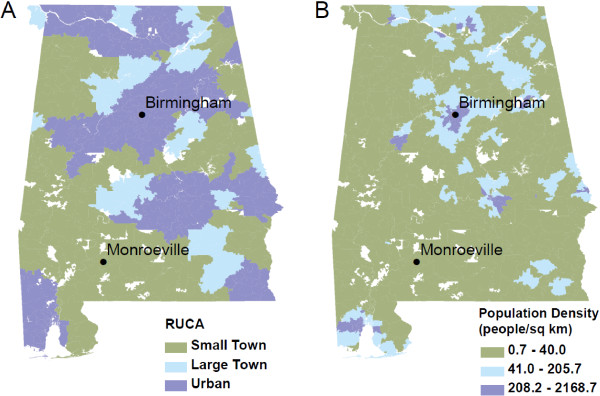
Significant and persistent racial and income disparities in birth outcomes exist in the US. The analyses in this manuscript examine whether adverse birth outcome time trends and associations between area-level variables and adverse birth outcomes differ by urban-rural status.
Alabama births records were merged with ZIP code-level census measures of race, poverty, and rurality. B-splines were used to determine long-term preterm birth (PTB) and low birth weight (LBW) trends by rurality. Logistic regression models were used to examine differences in the relationships between ZIP code-level percent poverty or percent African-American with either PTB or LBW. Interactions with rurality were examined.
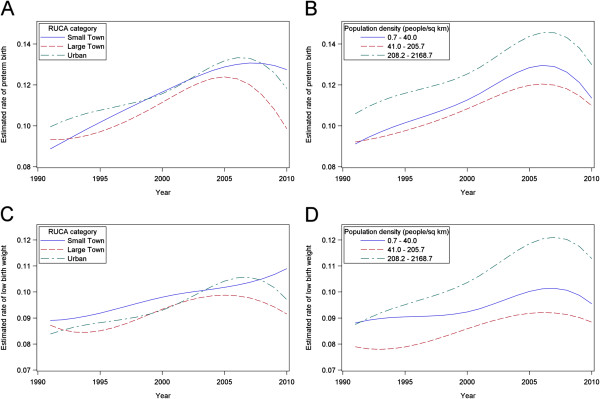
Population dense areas had higher adverse birth outcome rates compared to other regions. For LBW, the disparity between population dense and other regions increased during the 1991-2005 time period, and the magnitude of the disparity was maintained through 2010. Overall PTB and LBW rates have decreased since 2006, except within isolated rural regions. The addition of individual-level socioeconomic or race risk factors greatly attenuated these geographical disparities, but isolated rural regions maintained increased odds of adverse birth outcomes. ZIP code-level percent poverty and percent African American both had significant relationships with adverse birth outcomes. Poverty associations remained significant in the most population-dense regions when models were adjusted for individual-level risk factors.
Population dense urban areas have heightened rates of adverse birth outcomes. High-poverty African American areas have higher odds of adverse birth outcomes in urban versus rural regions. These results suggest there are urban-specific social or environmental factors increasing risk for adverse birth outcomes in underserved communities. On the other hand, trends in PTBs and LBWs suggest interventions that have decreased adverse birth outcomes elsewhere may not be reaching isolated rural areas.
在美国,出生结果存在显著且持续的种族和收入差距。本文中的分析研究了不良出生结果的时间趋势以及地区层面变量与不良出生结果之间的关系是否因城乡状况而异。
阿拉巴马州的出生记录与邮政编码级别的种族、贫困和农村性的人口普查数据相匹配。使用 B 样条来确定农村性的早产(PTB)和低出生体重(LBW)的长期趋势。使用逻辑回归模型来研究邮政编码级别的贫困百分比或非裔美国人百分比与 PTB 或 LBW 之间的关系的差异。检验了与农村性的交互作用。
人口密集地区的不良出生结果发生率高于其他地区。对于 LBW,1991-2005 年期间人口密集地区与其他地区之间的差距增加,并且通过 2010 年保持了差距的幅度。自 2006 年以来,整体 PTB 和 LBW 率有所下降,但孤立的农村地区除外。添加个体层面的社会经济或种族风险因素大大减弱了这些地理差异,但孤立的农村地区仍然存在不良出生结果的几率增加。邮政编码级别的贫困百分比和非裔美国人百分比都与不良出生结果有显著关系。当模型调整为个体层面的风险因素时,贫困相关性在人口最密集的地区仍然显著。
人口密集的城市地区不良出生结果发生率较高。高贫困的非裔美国人地区在城市地区比农村地区的不良出生结果的几率更高。这些结果表明,在服务不足的社区中,存在增加不良出生结果风险的城市特定的社会或环境因素。另一方面,PTB 和 LBW 的趋势表明,减少其他地方不良出生结果的干预措施可能无法到达孤立的农村地区。