Department of Microbiology and Immunology, Tohoku University Graduate School of Medicine , Sendai , Japan.
Front Immunol. 2013 Jun 7;4:139. doi: 10.3389/fimmu.2013.00139. eCollection 2013.
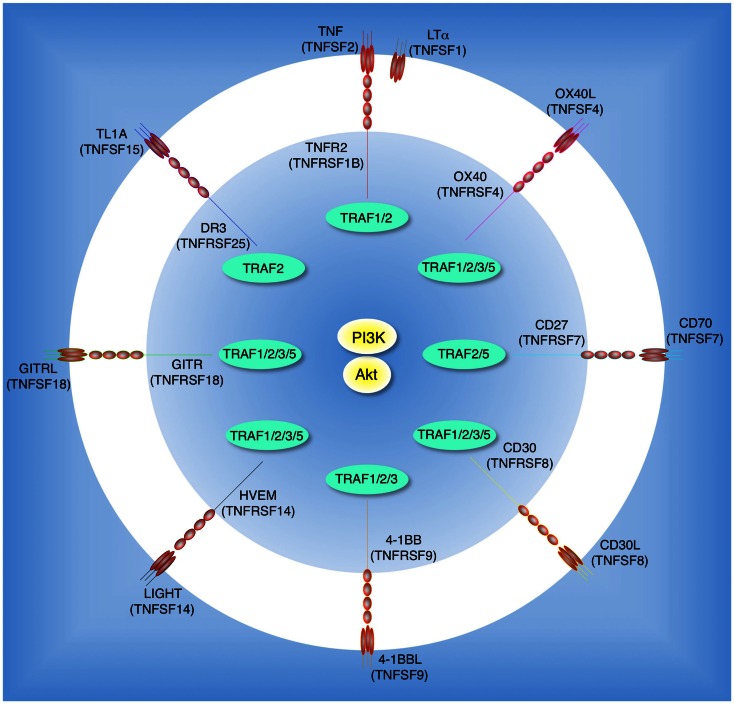
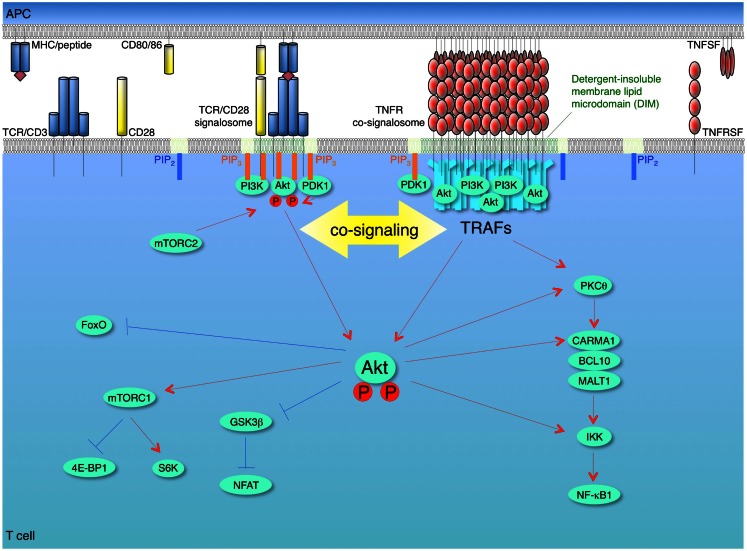
Activation of phosphoinositide 3-kinase (PI3K) and Akt (protein kinase B) is a common response triggered by a range of membrane-bound receptors on many cell types. In T lymphocytes, the PI3K-Akt pathway promotes clonal expansion, differentiation, and survival of effector cells and suppresses the generation of regulatory T cells. PI3K activation is tightly controlled by signals through the T cell receptor (TCR) and the co-stimulatory receptor CD28, however sustained and periodic signals from additional co-receptors are now being recognized as critical contributors to the activation of this pathway. Accumulating evidence suggests that many members of the Tumor Necrosis Factor receptor (TNFR) superfamily, TNFR2 (TNFRSF1B), OX40 (TNFRSF4), 4-1BB (TNFRSF9), HVEM (TNFRSF14), and DR3 (TNFRSF25), that are constitutive or inducible on T cells, can directly or indirectly promote activity in the PI3K-Akt pathway. We discuss recent data which suggests that ligation of one TNFR family molecule organizes a signalosome, via TNFR-associated factor (TRAF) adapter proteins in T cell membrane lipid microdomains, that results in the subsequent accumulation of highly concentrated depots of PI3K and Akt in close proximity to TCR signaling units. We propose this may be a generalizable mechanism applicable to other TNFR family molecules that will result in a quantitative contribution of these signalosomes to enhancing and sustaining PI3K and Akt activation triggered by the TCR. We also review data that other TNFR molecules, such as CD40 (TNFRSF5), RANK (TNFRSF11A), FN14 (TNFRSF12A), TACI (TNFRSF13B), BAFFR (TNFRSF13C), and NGFR (TNFRSF16), contribute to the activation of this pathway in diverse cell types through a similar ability to recruit PI3K or Akt into their signaling complexes.
磷酸肌醇 3-激酶 (PI3K) 和 Akt(蛋白激酶 B)的激活是许多细胞类型上的一系列膜结合受体触发的常见反应。在 T 淋巴细胞中,PI3K-Akt 途径促进效应细胞的克隆扩增、分化和存活,并抑制调节性 T 细胞的产生。PI3K 的激活受到 T 细胞受体 (TCR) 和共刺激受体 CD28 的信号的严格控制,然而,现在人们认识到来自其他共受体的持续和周期性信号对于该途径的激活是至关重要的。越来越多的证据表明,T 细胞上许多肿瘤坏死因子受体 (TNFR) 超家族成员,如 TNFR2(TNFRSF1B)、OX40(TNFRSF4)、4-1BB(TNFRSF9)、HVEM(TNFRSF14)和 DR3(TNFRSF25),无论是组成型表达还是诱导型表达,都可以直接或间接促进 PI3K-Akt 途径的活性。我们讨论了最近的数据,这些数据表明,TNFR 家族分子的配体通过 TCR 信号转导单元附近的 TNFR 相关因子 (TRAF) 适配器蛋白在 T 细胞膜脂质微区中组织信号小体,从而直接或间接促进 PI3K-Akt 途径的活性。我们提出,这可能是一种可推广的机制,适用于其他 TNFR 家族分子,这些信号小体将对增强和维持 TCR 触发的 PI3K 和 Akt 激活产生定量贡献。我们还回顾了其他 TNFR 分子,如 CD40(TNFRSF5)、RANK(TNFRSF11A)、FN14(TNFRSF12A)、TACI(TNFRSF13B)、BAFFR(TNFRSF13C)和 NGFR(TNFRSF16),通过类似的将 PI3K 或 Akt 募集到其信号复合物中的能力,在不同的细胞类型中对该途径的激活做出贡献。