Department of Neuroscience, University of Pennsylvania School of Medicine Philadelphia, PA, USA ; Center for Autism Research, Children's Hospital of Philadelphia Philadelphia, PA, USA.
Front Hum Neurosci. 2013 Jun 6;7:241. doi: 10.3389/fnhum.2013.00241. eCollection 2013.
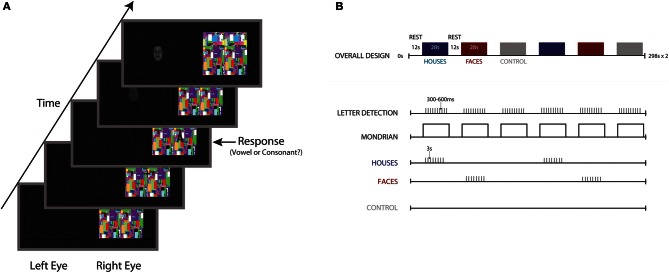
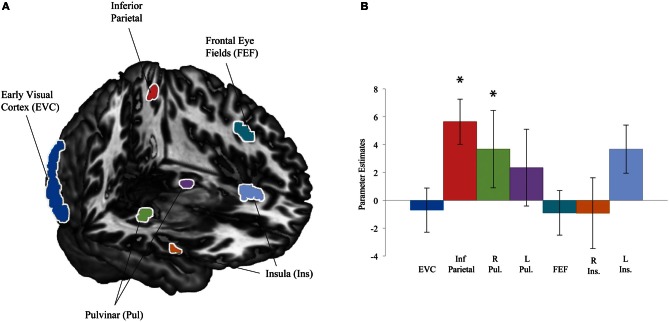
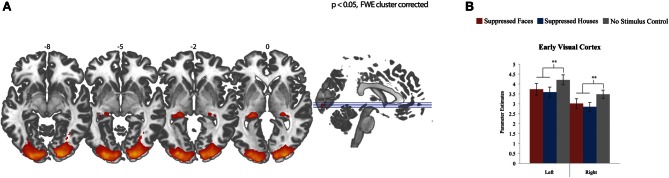
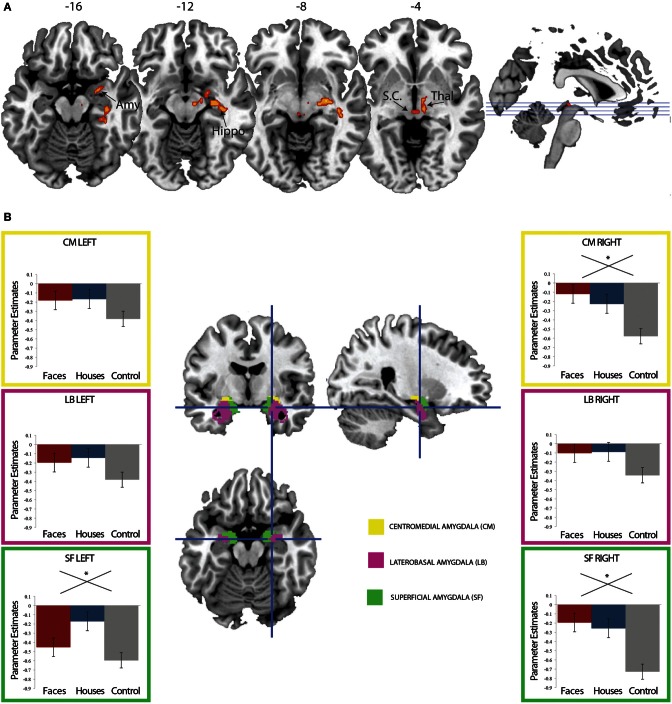
The goals of the present study were 2-fold. First, we wished to investigate the neural correlates of stimulus-driven processing of stimuli strongly suppressed from awareness and in the absence of top-down influences. We accomplished this using a novel approach in which participants performed an orthogonal task atop a flash suppression noise image to prevent top-down search. Second, we wished to investigate the extent to which amygdala responses differentiate between suppressed stimuli (fearful faces and houses) based on their motivational relevance. Using continuous flash suppression (CFS) in conjunction with fMRI, we presented fearful faces, houses, and a no stimulus control to one eye while participants performed an orthogonal task that appeared atop the flashing Mondrian image presented to the opposite eye. In 29 adolescents, we show activation in subcortical regions, including the superior colliculus, amygdala, thalamus, and hippocampus for suppressed objects (fearful faces and houses) compared to a no stimulus control. Suppressed stimuli showed less activation compared to a no stimulus control in early visual cortex (EVC), indicating that object information was being suppressed from this region. Additionally, we find no activation in regions associated with conscious processing of these percepts (fusiform gyrus and/or parahippocampal cortex) as assessed by mean activations and multi-voxel patterns. A psychophysiological interaction analysis (PPI) that seeded the amygdala showed task-specific (fearful faces greater than houses) modulation of right pulvinar and left inferior parietal cortex. Taken together, our results support a role for the amygdala in stimulus-driven attentional guidance toward objects of relevance and a potential mechanism for successful suppression of rivalrous stimuli.
本研究的目的有两个。首先,我们希望探究在没有自上而下的影响且强烈抑制意识的情况下,刺激驱动处理的神经相关性。我们使用一种新颖的方法来实现这一目标,即让参与者在抑制噪声图像上执行正交任务,以防止自上而下的搜索。其次,我们希望探究杏仁核反应在多大程度上能够根据刺激的动机相关性来区分被抑制的刺激(恐惧的面孔和房子)。我们使用连续闪光抑制(CFS)结合 fMRI,向一只眼睛呈现恐惧的面孔、房子和无刺激控制,同时让参与者在呈现给另一只眼睛的闪烁蒙德里安图像上执行一个正交任务。在 29 名青少年中,我们发现与无刺激控制相比,被抑制的物体(恐惧的面孔和房子)在皮质下区域(包括上丘、杏仁核、丘脑和海马体)有激活。与无刺激控制相比,被抑制的刺激在早期视觉皮层(EVC)的激活程度较低,表明物体信息正在从该区域被抑制。此外,我们在与这些知觉的意识加工相关的区域(梭状回和/或旁海马皮质)没有发现激活,这是通过平均激活和多体素模式来评估的。对杏仁核进行的心理生理交互分析(PPI)显示,右侧丘和左侧下顶叶皮层的任务特异性(恐惧的面孔大于房子)调制。总之,我们的结果支持杏仁核在对相关物体的刺激驱动注意力引导中的作用,以及对竞争刺激成功抑制的潜在机制。