Department of Psychology, University of Texas at Austin, Austin, TX 78712, USA.
Institute for Neuroscience, University of Texas at Austin, Austin, TX 78712, USA.
Philos Trans R Soc Lond B Biol Sci. 2022 Feb 28;377(1845):20200444. doi: 10.1098/rstb.2020.0444. Epub 2022 Jan 10.
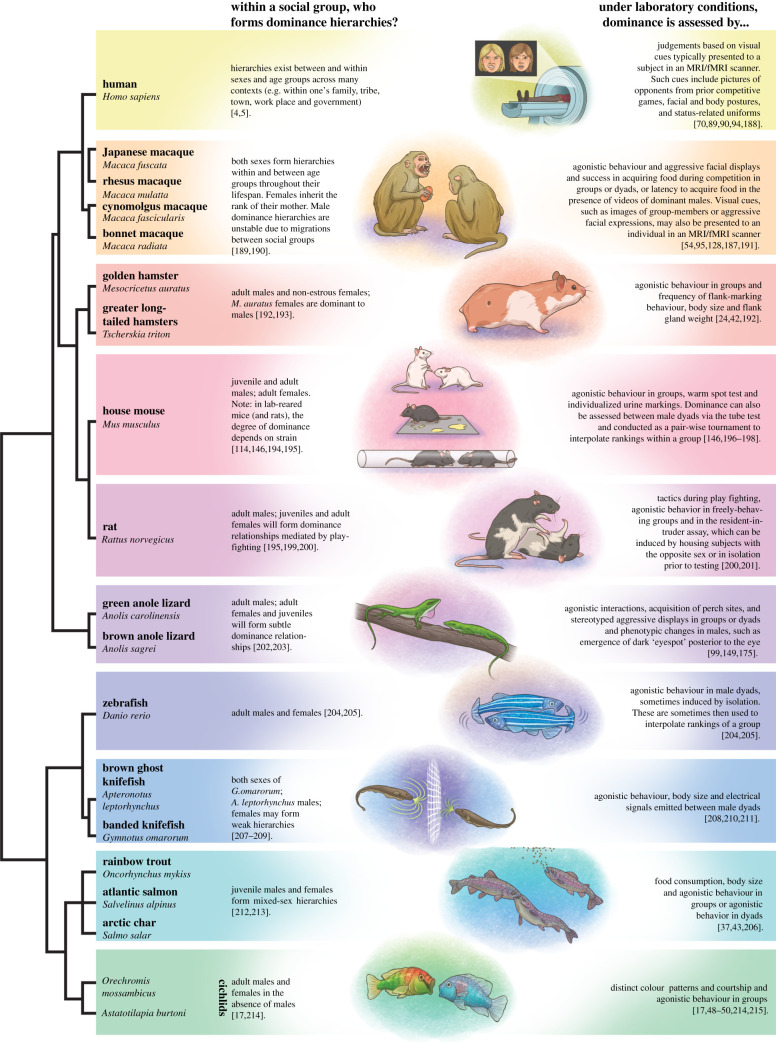
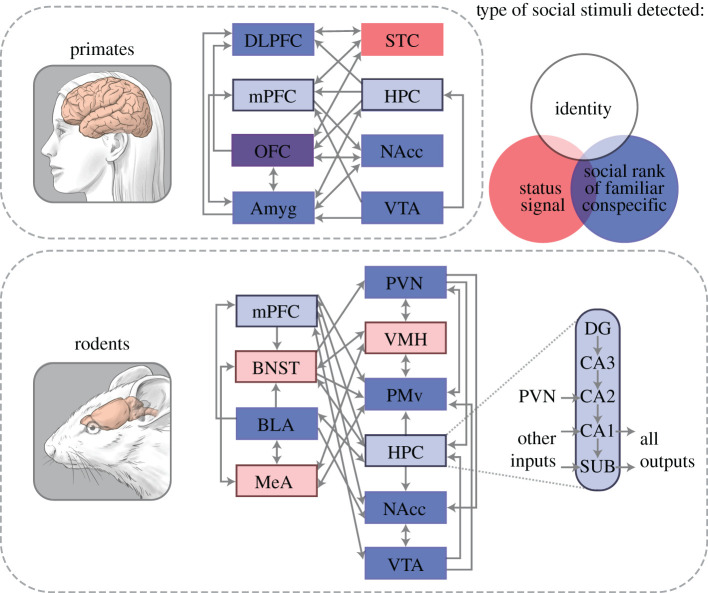
Across species, animals organize into social dominance hierarchies that serve to decrease aggression and facilitate survival of the group. Neuroscientists have adopted several model organisms to study dominance hierarchies in the laboratory setting, including fish, reptiles, rodents and primates. We review recent literature across species that sheds light onto how the brain represents social rank to guide socially appropriate behaviour within a dominance hierarchy. First, we discuss how the brain responds to social status signals. Then, we discuss social approach and avoidance learning mechanisms that we propose could drive rank-appropriate behaviour. Lastly, we discuss how the brain represents memories of individuals (social memory) and how this may support the maintenance of unique individual relationships within a social group. This article is part of the theme issue 'The centennial of the pecking order: current state and future prospects for the study of dominance hierarchies'.
在不同物种中,动物会形成社会等级制度,以减少攻击行为并促进群体的生存。神经科学家采用了几种模式生物来研究实验室环境中的等级制度,包括鱼类、爬行动物、啮齿动物和灵长类动物。我们综述了不同物种的最新文献,这些文献揭示了大脑如何通过代表社会等级来指导等级制度内的适当行为。首先,我们讨论了大脑对社会地位信号的反应。然后,我们讨论了社会接近和回避学习机制,我们认为这些机制可能会驱动等级适当的行为。最后,我们讨论了大脑如何代表个体的记忆(社会记忆),以及这如何支持在一个社会群体中维持独特的个体关系。本文是“啄序百年:支配等级研究的现状与未来展望”主题特刊的一部分。