Di Benedetto Adriana, Gigante Isabella, Colucci Silvia, Grano Maria
Department of Basic Medical Sciences, Neurosciences and Sense Organs, Section of Human Anatomy and Histology "R. Amprino", University of Bari, Piazza Giulio Cesare 11, 70124 Bari, Italy.
Clin Dev Immunol. 2013;2013:503754. doi: 10.1155/2013/503754. Epub 2013 May 23.
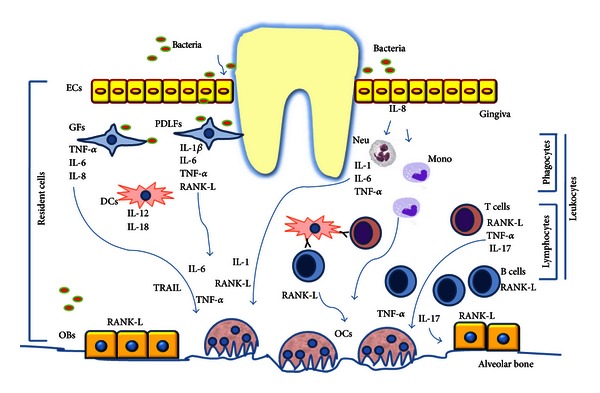
Periodontal disease (PD), or periodontitis, is defined as a bacterially induced disease of the tooth-supporting (periodontal) tissues. It is characterized by inflammation and bone loss; therefore understanding how they are linked would help to address the most efficacious therapeutic approach. Bacterial infection is the primary etiology but is not sufficient to induce the disease initiation or progression. Indeed, bacteria-derived factors stimulate a local inflammatory reaction and activation of the innate immune system. The innate response involves the recognition of microbial components by host cells, and this event is mediated by toll-like receptors (TLRs) expressed by resident cells and leukocytes. Activation of these cells leads to the release of proinflammatory cytokines and recruitment of phagocytes and lymphocytes. Activation of T and B cells initiates the adaptive immunity with Th1 Th2 Th17 Treg response and antibodies production respectively. In this inflammatory scenario, cytokines involved in bone regulation and maintenance have considerable relevance because tissue destruction is believed to be the consequence of host inflammatory response to the bacterial challenge. In the present review, we summarize host factors including cell populations, cytokines, and mechanisms involved in the destruction of the supporting tissues of the tooth and discuss treatment perspectives based on this knowledge.
牙周病(PD),即牙周炎,被定义为一种由细菌引发的牙齿支持组织(牙周组织)疾病。其特征为炎症和骨质流失;因此,了解它们之间的联系将有助于找到最有效的治疗方法。细菌感染是主要病因,但不足以引发疾病的起始或进展。实际上,细菌衍生因子会刺激局部炎症反应并激活先天性免疫系统。先天性免疫反应涉及宿主细胞对微生物成分的识别,这一过程由驻留细胞和白细胞表达的Toll样受体(TLR)介导。这些细胞的激活会导致促炎细胞因子的释放以及吞噬细胞和淋巴细胞的募集。T细胞和B细胞的激活分别通过Th1、Th2、Th17、Treg反应和抗体产生启动适应性免疫。在这种炎症情况下,参与骨骼调节和维持 的细胞因子具有相当重要 的意义,因为组织破坏被认为是宿主对细菌挑战的炎症反应的结果。在本综述中,我们总结了包括细胞群体、细胞因子以及参与牙齿支持组织破坏的机制在内的宿主因素,并基于这些知识讨论了治疗前景。