Eiró Noemi, Fernandez-Garcia Belen, González Luis O, Vizoso Francisco J
Unidad de Investigación; Fundación Hospital de Jove; Gijón, Asturias, Spain.
Oncoimmunology. 2013 May 1;2(5):e24010. doi: 10.4161/onci.24010.
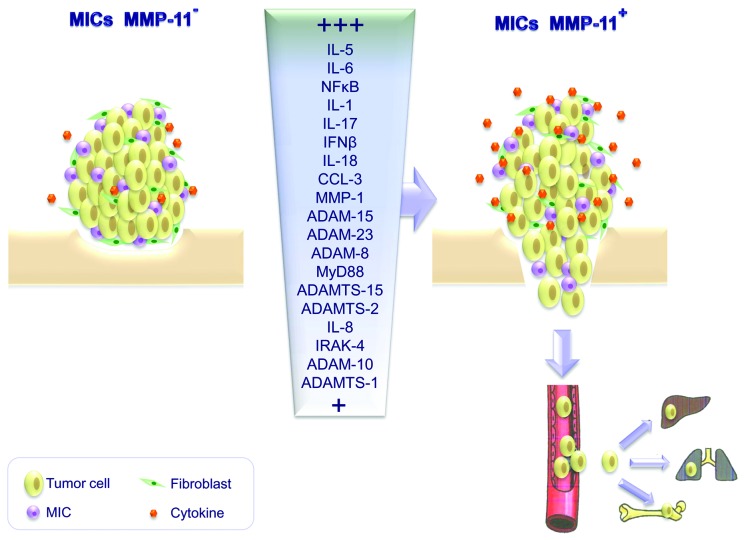
Breast tumors infiltrated by matrix metalloprotease 11 (MMP-11) mononuclear inflammatory cells are prone to form metastases; express high levels of interleukin (IL)-1, IL-5, IL-6, IL-17, interferon β (IFNβ) and NFκB; and exhibit an increased CD68/(CD3CD20) cell ratio at their invasive front. These factors, which are implicated in the crosstalk between tumors and their inflammatory microenvironment, may emerge as attractive prognostic factors and therapeutic targets.
被基质金属蛋白酶11(MMP - 11)单核炎性细胞浸润的乳腺肿瘤易于形成转移;表达高水平的白细胞介素(IL)-1、IL - 5、IL - 6、IL - 17、干扰素β(IFNβ)和核因子κB(NFκB);并且在其浸润前沿表现出CD68/(CD3CD20)细胞比率增加。这些与肿瘤及其炎性微环境之间的串扰有关的因素,可能成为有吸引力的预后因素和治疗靶点。