Department of Food and Nutrition, Chungbuk National University, 52 Naesudong-ro, Heungdeok-gu, Cheongju 361-763, Korea.
Nutr Res Pract. 2013 Jun;7(3):216-23. doi: 10.4162/nrp.2013.7.3.216. Epub 2013 Jun 3.
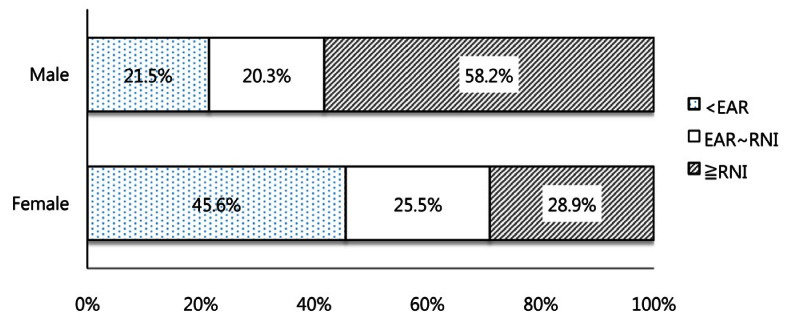
The purpose of this study is to assess folate intake, and serum and red blood cell (RBC) folate concentrations, and investigate the association between folate status and health-related behaviors among Korean college students. A total of 169 students, aged between 18 and 27 years, participated in this study. Dietary intake data were collected by trained interviewers using a 24-hour recall method for three non-consecutive days in 2009. Information on health-related behaviors was obtained by a self-administered questionnaire. Serum and RBC folate concentrations were measured by microbiological assay. The average intakes of folate were 456 µgDFE and 347 µgDFE in male and female students, respectively. While the average serum folate concentration was significantly lower in male students (8.9 ng/mL) compared to female students (12.5 ng/mL), RBC concentrations were not significantly different between male (398.6 ng/mL) and female students (405.3 ng/mL). In male students, low serum folate concentrations were associated with total folate intake less than the Estimated Average Requirement, non-use of folic acid supplements, smoking, alcohol drinking at least once a week and low physical activity. In female students, low serum folate concentrations were associated with smoking and alcohol drinking at least two drinks at a time and BMI ≥ 25. Alcohol drinking and low physical activity were also associated with low RBC folate concentrations in both male and female students. In order to improve folate nutritional status of college students, the practice of desirable health-related behaviors, such as non-smoking, moderate alcohol drinking, regular physical activity, and maintenance of healthy BMI should be encouraged along with consumption of folate-rich foods and supplements.
本研究旨在评估叶酸摄入量、血清和红细胞(RBC)叶酸浓度,并探讨韩国大学生叶酸状况与健康相关行为之间的关系。共有 169 名年龄在 18 至 27 岁之间的学生参与了这项研究。2009 年,通过 24 小时回忆法对三天非连续时间进行了三次饮食摄入数据收集,由经过培训的访谈者进行。通过自我管理的问卷获取了与健康相关的行为信息。采用微生物学测定法测量血清和 RBC 叶酸浓度。男性和女性学生叶酸的平均摄入量分别为 456µgDFE 和 347µgDFE。虽然男性学生的血清叶酸浓度(8.9ng/mL)明显低于女性学生(12.5ng/mL),但男性(398.6ng/mL)和女性(405.3ng/mL)学生的 RBC 浓度没有明显差异。在男性学生中,低血清叶酸浓度与总叶酸摄入量低于估计平均需求量、不使用叶酸补充剂、吸烟、每周至少饮酒一次以及体力活动水平低有关。在女性学生中,低血清叶酸浓度与吸烟、每周至少饮酒两次且 BMI≥25 有关。男性和女性学生中,饮酒和低体力活动与 RBC 叶酸浓度低也有关。为了改善大学生的叶酸营养状况,应鼓励他们养成健康的相关行为习惯,如不吸烟、适量饮酒、定期进行身体活动和保持健康的 BMI,同时还要摄入富含叶酸的食物和补充剂。