van Engelen Arna, Niessen Wiro J, Klein Stefan, Groen Harald C, van Gaalen Kim, Verhagen Hence J, Wentzel Jolanda J, van der Lugt Aad, de Bruijne Marleen
Biomedical Imaging Group Rotterdam, Department of Medical Informatics and Radiology, Erasmus Medical Centre, Rotterdam, Netherlands.
J Pathol Inform. 2013 Mar 30;4(Suppl):S3. doi: 10.4103/2153-3539.109844. Print 2013.
Histology sections provide accurate information on atherosclerotic plaque composition, and are used in various applications. To our knowledge, no automated systems for plaque component segmentation in histology sections currently exist.
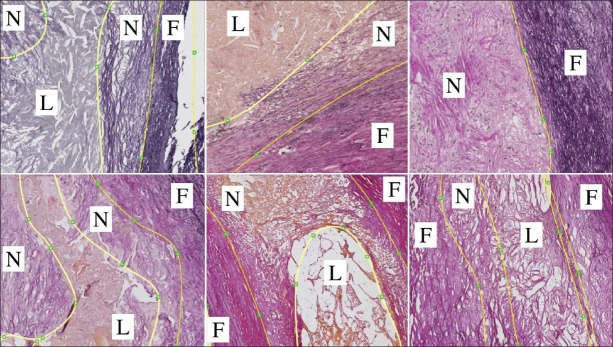
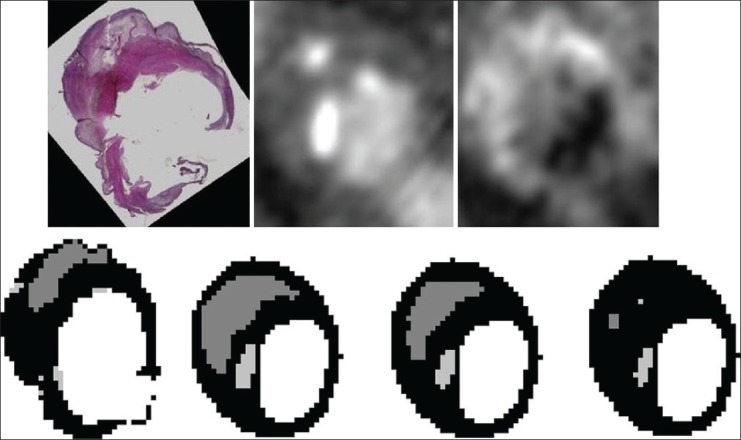
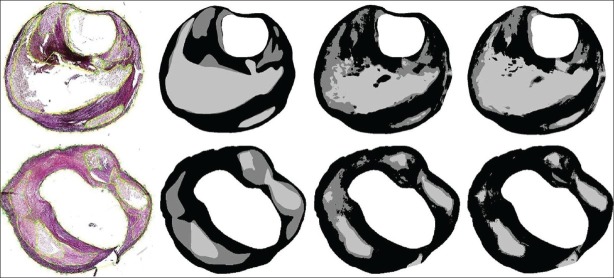
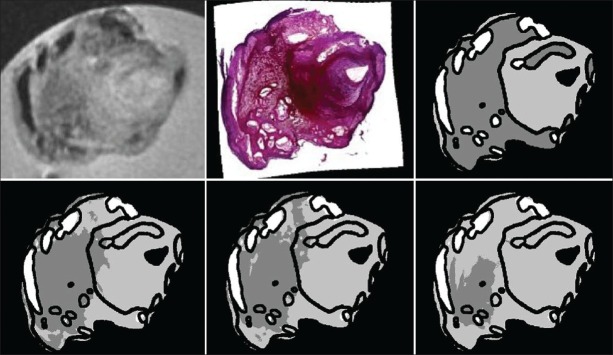
We perform pixel-wise classification of fibrous, lipid, and necrotic tissue in Elastica Von Gieson-stained histology sections, using features based on color channel intensity and local image texture and structure. We compare an approach where we train on independent data to an approach where we train on one or two sections per specimen in order to segment the remaining sections. We evaluate the results on segmentation accuracy in histology, and we use the obtained histology segmentations to train plaque component classification methods in ex vivo Magnetic resonance imaging (MRI) and in vivo MRI and computed tomography (CT).
In leave-one-specimen-out experiments on 176 histology slices of 13 plaques, a pixel-wise accuracy of 75.7 ± 6.8% was obtained. This increased to 77.6 ± 6.5% when two manually annotated slices of the specimen to be segmented were used for training. Rank correlations of relative component volumes with manually annotated volumes were high in this situation (P = 0.82-0.98). Using the obtained histology segmentations to train plaque component classification methods in ex vivo MRI and in vivo MRI and CT resulted in similar image segmentations for training on the automated histology segmentations as for training on a fully manual ground truth. The size of the lipid-rich necrotic core was significantly smaller when training on fully automated histology segmentations than when manually annotated histology sections were used. This difference was reduced and not statistically significant when one or two slices per section were manually annotated for histology segmentation.
Good histology segmentations can be obtained by automated segmentation, which show good correlations with ground truth volumes. In addition, these can be used to develop segmentation methods in other imaging modalities. Accuracy increases when one or two sections of the same specimen are used for training, which requires a limited amount of user interaction in practice.
组织学切片可提供有关动脉粥样硬化斑块成分的准确信息,并应用于各种领域。据我们所知,目前尚无用于组织学切片中斑块成分分割的自动化系统。
我们利用基于颜色通道强度以及局部图像纹理和结构的特征,对弹性冯吉森染色组织学切片中的纤维、脂质和坏死组织进行逐像素分类。我们将在独立数据上进行训练的方法与在每个标本的一两个切片上进行训练以分割其余切片的方法进行比较。我们评估组织学分割准确性的结果,并使用获得的组织学分割结果来训练离体磁共振成像(MRI)、活体MRI和计算机断层扫描(CT)中的斑块成分分类方法。
在对13个斑块的176个组织学切片进行留一标本法实验中,获得了75.7±6.8%的逐像素准确率。当使用待分割标本的两个手动标注切片进行训练时,该准确率提高到了77.6±6.5%。在这种情况下,相对成分体积与手动标注体积的等级相关性很高(P = 0.82 - 0.98)。使用获得的组织学分割结果来训练离体MRI、活体MRI和CT中的斑块成分分类方法,对于基于自动化组织学分割进行训练所得到的图像分割,与基于完全手动的真实情况进行训练所得到的相似。与使用手动标注的组织学切片进行训练相比,基于完全自动化组织学分割进行训练时,富含脂质的坏死核心的大小显著更小。当每个标本手动标注一两个切片用于组织学分割时,这种差异减小且无统计学意义。
通过自动分割可获得良好的组织学分割结果,其与真实体积显示出良好的相关性。此外,这些结果可用于开发其他成像模态下的分割方法。当使用同一标本的一两个切片进行训练时,准确率会提高,而这在实际操作中只需有限的用户交互。