Janowczyk Andrew, Chandran Sharat, Madabhushi Anant
Department of Computer Science, IIT Bombay, India, USA ; Department of Biomedical Engineering, Case Western Reserve University, USA.
J Pathol Inform. 2013 Mar 30;4(Suppl):S8. doi: 10.4103/2153-3539.109865. Print 2013.
The notion of local scale was introduced to characterize varying levels of image detail so that localized image processing tasks could be performed while simultaneously yielding a globally optimal result. In this paper, we have presented the methodological framework for a novel locally adaptive scale definition, morphologic scale (MS), which is different from extant local scale definitions in that it attempts to characterize local heterogeneity as opposed to local homogeneity.
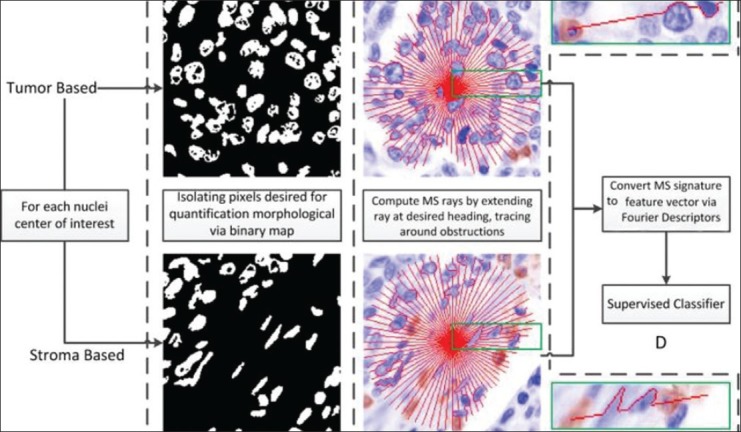
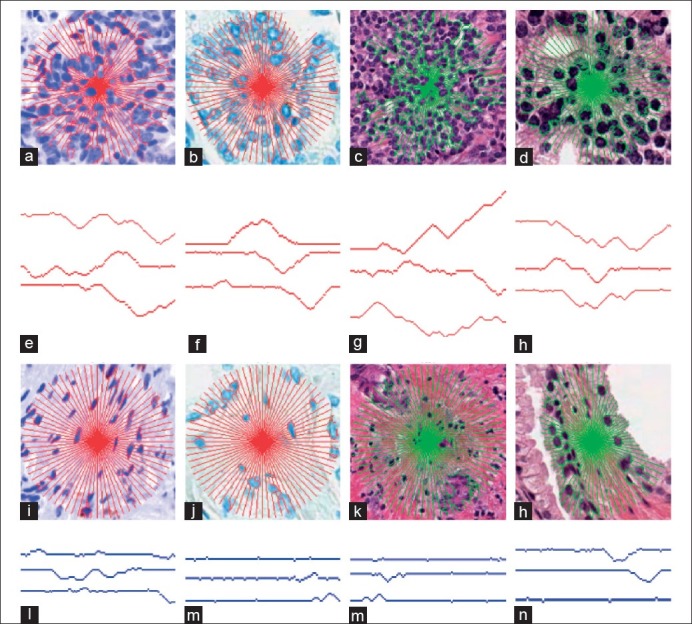
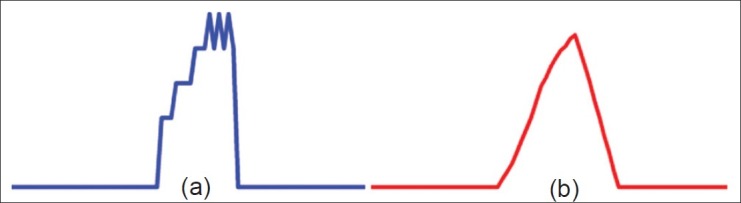
At every point of interest, the MS is determined as a series of radial paths extending outward in the direction of least resistance, navigating around obstructions. Each pixel can then be directly compared to other points of interest via a rotationally invariant quantitative feature descriptor, determined by the application of Fourier descriptors to the collection of these paths.
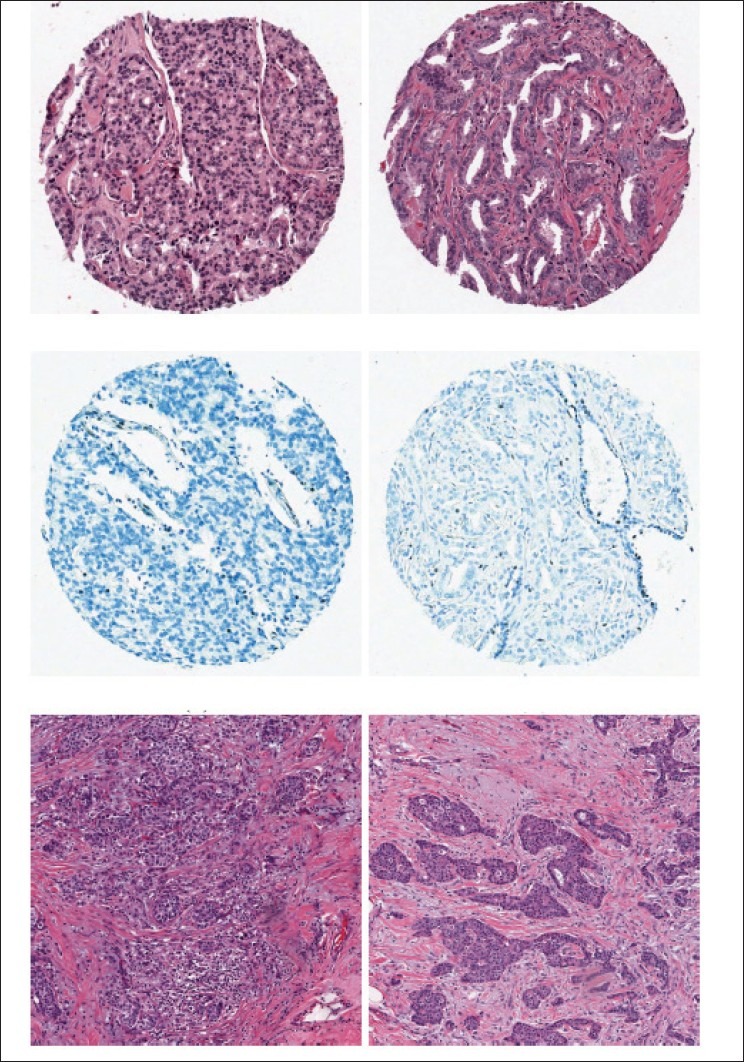
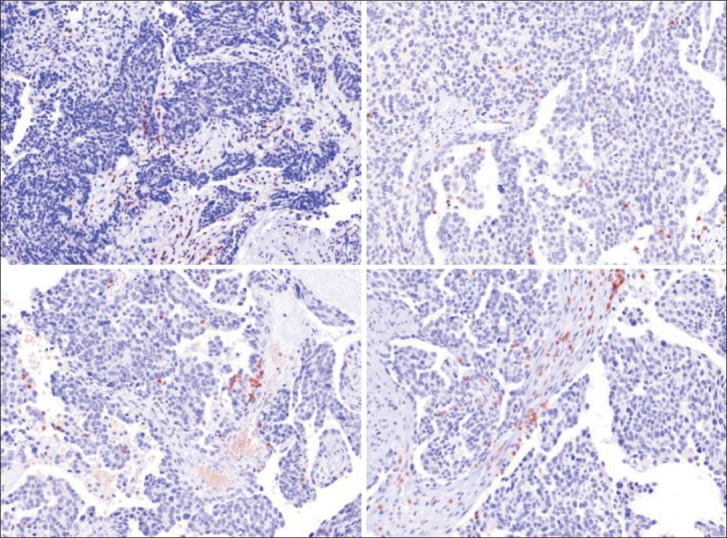
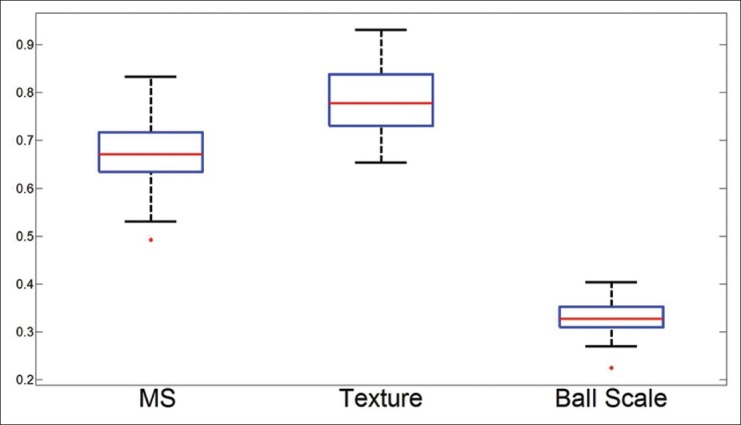
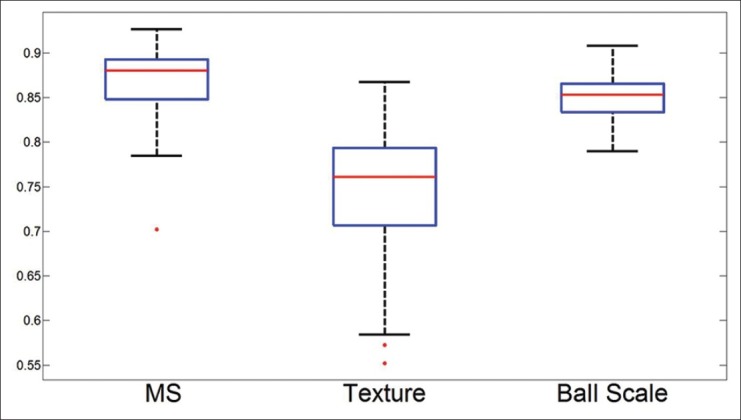
OUR GOAL IS TO DISTINGUISH TUMOR AND STROMAL TISSUE CLASSES IN THE CONTEXT OF FOUR DIFFERENT DIGITIZED PATHOLOGY DATASETS: prostate tissue microarrays (TMAs) stained with hematoxylin and eosin (HE) (44 images) and TMAs stained with only hematoxylin (H) (44 images), slide mounts of ovarian H (60 images), and HE breast cancer (51 images) histology images. Classification performance over 50 cross-validation runs using a Bayesian classifier produced mean areas under the curve of 0.88 ± 0.01 (prostate HE), 0.87 ± 0.02 (prostate H), 0.88 ± 0.01 (ovarian H), and 0.80 ± 0.01 (breast HE).
For each dataset listed in Table 3, we randomly selected 100 points per image, and using the procedure described in Experiment 1, we attempted to separate them as belonging to stroma or epithelium.
引入局部尺度的概念是为了表征不同层次的图像细节,以便在执行局部图像处理任务的同时能够产生全局最优结果。在本文中,我们提出了一种新颖的局部自适应尺度定义——形态学尺度(MS)的方法框架,它与现有的局部尺度定义不同,因为它试图表征局部异质性而非局部同质性。
在每个感兴趣的点上,MS被确定为一系列沿阻力最小方向向外延伸、绕过障碍物的径向路径。然后,通过将傅里叶描述符应用于这些路径的集合所确定的旋转不变定量特征描述符,可以将每个像素直接与其他感兴趣的点进行比较。
我们的目标是在四个不同的数字化病理数据集的背景下区分肿瘤和基质组织类别:苏木精和伊红(HE)染色的前列腺组织微阵列(TMA)(44张图像)和仅苏木精(H)染色的TMA(44张图像)、卵巢H的载玻片(60张图像)以及HE乳腺癌(51张图像)组织学图像。使用贝叶斯分类器在50次交叉验证运行中的分类性能产生的曲线下平均面积为:0.88±0.01(前列腺HE)、0.87±0.02(前列腺H)、0.88±0.01(卵巢H)和0.80±0.01(乳腺HE)。
对于表3中列出的每个数据集,我们每张图像随机选择100个点,并使用实验1中描述的程序,试图将它们区分为属于基质或上皮。