Department of Pharmacology and Physiology, Drexel University College of Medicine, Philadelphia, PA 19102, USA.
Neuroscience. 2013 Sep 17;248:708-18. doi: 10.1016/j.neuroscience.2013.06.007. Epub 2013 Jun 14.
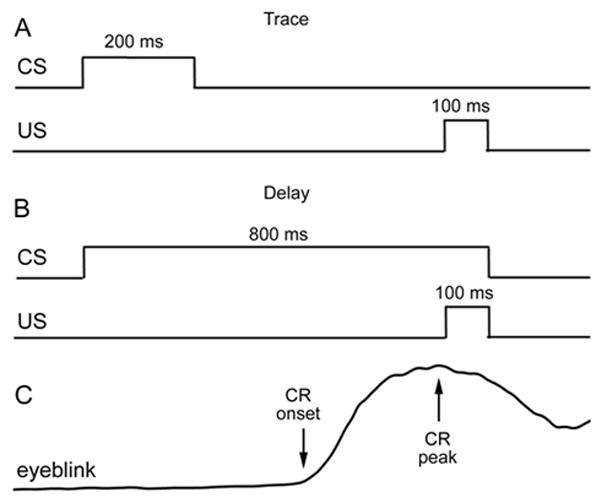
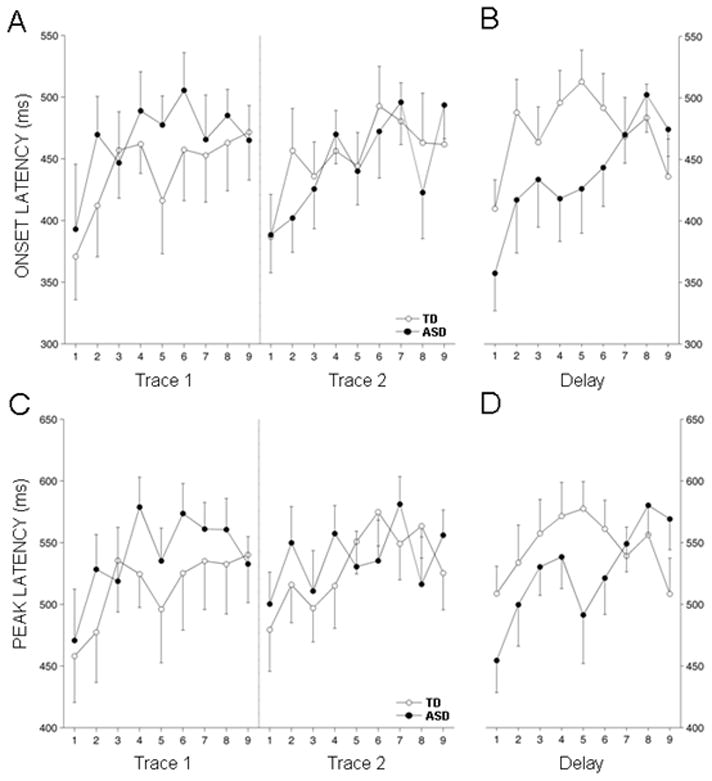
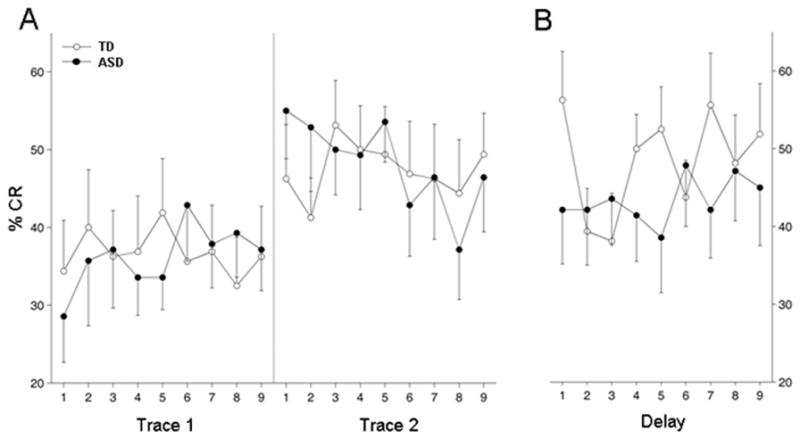
Children with autism spectrum disorder (ASD) and age-matched typically-developing (TD) peers were tested on two forms of eyeblink conditioning (EBC), a Pavlovian associative learning paradigm where subjects learn to execute an appropriately-timed eyeblink in response to a previously neutral conditioning stimulus (CS). One version of the task, trace EBC, interposes a stimulus-free interval between the presentation of the CS and the unconditioned stimulus (US), a puff of air to the eye which causes the subjects to blink. In delay EBC, the CS overlaps in time with the delivery of the US, usually with both stimuli terminating simultaneously. ASD children performed normally during trace EBC, exhibiting no differences from TD subjects with regard to the learning rate or the timing of the conditioned response. However, when subsequently tested on delay EBC, subjects with ASD displayed abnormally-timed conditioned eye blinks that began earlier and peaked sooner than those of TD subjects, consistent with previous findings. The results suggest an impaired ability of children with ASD to properly time conditioned eye blinks which appears to be specific to delay EBC. We suggest that this deficit may reflect a dysfunction of the cerebellar cortex in which increases in the intensity or duration of sensory input can temporarily disrupt the accuracy of motor timing over short temporal intervals.
自闭症谱系障碍(ASD)儿童和年龄匹配的典型发育(TD)同龄人在两种眨眼条件反射(EBC)形式上接受了测试,这是一种巴甫洛夫式的联想学习范例,其中受试者学会在先前的中性条件刺激(CS)下执行适当的定时眨眼。任务的一种形式是痕迹 EBC,在 CS 和非条件刺激(US,通常是向眼睛吹气以引起眨眼的空气脉冲)呈现之间插入一个无刺激间隔。在延迟 EBC 中,CS 与 US 的传递时间重叠,通常两个刺激同时终止。ASD 儿童在痕迹 EBC 中表现正常,在学习率或条件反应的时间方面与 TD 受试者没有差异。然而,当随后在延迟 EBC 上进行测试时,ASD 受试者的条件眨眼开始得更早,峰值出现得更早,与之前的发现一致。结果表明,ASD 儿童正确定时条件眨眼的能力受损,这似乎是延迟 EBC 特有的。我们认为这种缺陷可能反映了小脑皮层的功能障碍,其中感官输入的强度或持续时间增加会在短时间间隔内暂时破坏运动定时的准确性。