Department of Human Development, University of Maryland, College Park, Maryland, United States of America.
PLoS One. 2012;7(1):e30511. doi: 10.1371/journal.pone.0030511. Epub 2012 Jan 23.
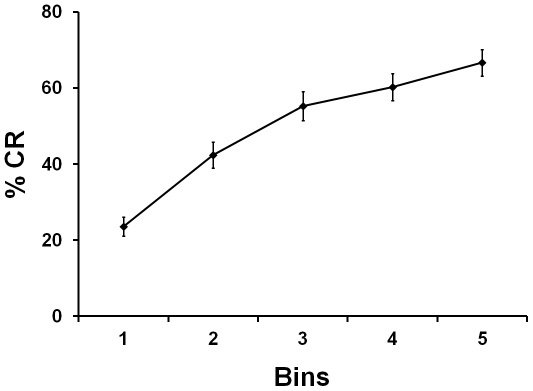
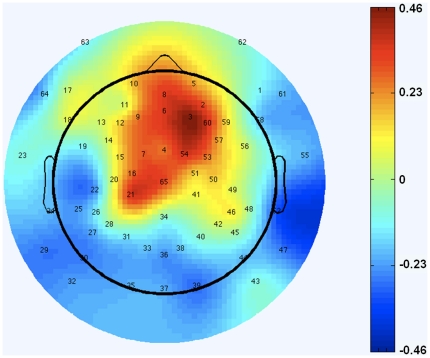
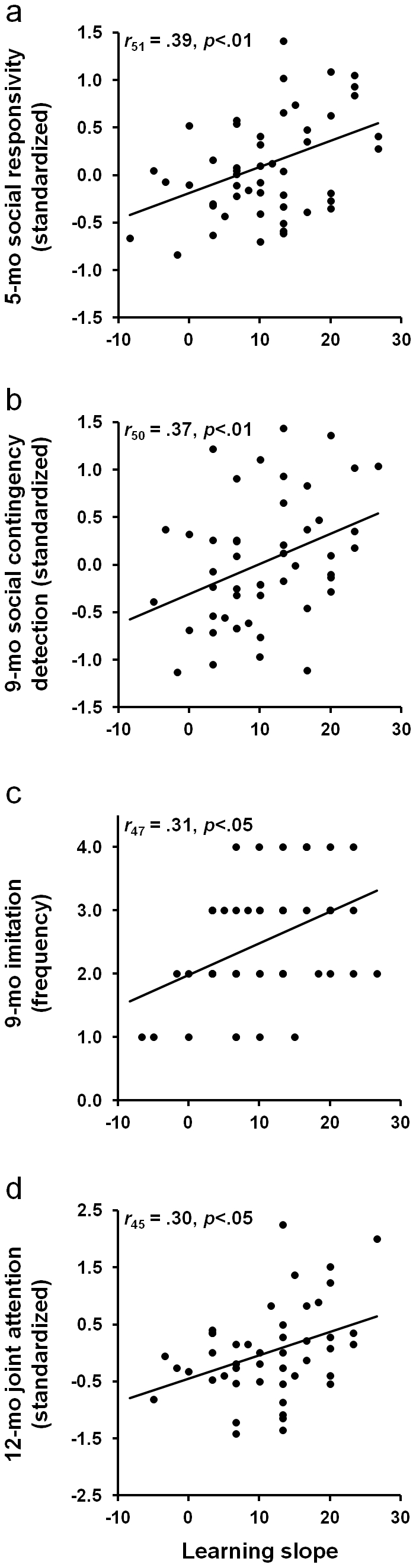
Across the first year of life, infants achieve remarkable success in their ability to interact in the social world. The hierarchical nature of circuit and skill development predicts that the emergence of social behaviors may depend upon an infant's early abilities to detect contingencies, particularly socially-relevant associations. Here, we examined whether individual differences in the rate of associative learning at one month of age is an enduring predictor of social, imitative, and discriminative behaviors measured across the human infant's first year. One-month learning rate was predictive of social behaviors at 5, 9, and 12 months of age as well as face-evoked discriminative neural activity at 9 months of age. Learning was not related to general cognitive abilities. These results underscore the importance of early contingency learning and suggest the presence of a basic mechanism underlying the ontogeny of social behaviors.
在生命的第一年,婴儿在社交世界中互动的能力取得了显著的成功。电路和技能发展的层次性预示着社会行为的出现可能取决于婴儿早期检测关联的能力,特别是与社会相关的关联。在这里,我们研究了一个月大时的联想学习速度的个体差异是否是整个婴儿第一年测量的社会、模仿和辨别行为的持久预测指标。一个月的学习速度可以预测 5、9 和 12 个月大时的社会行为,以及 9 个月大时的面孔诱发的辨别神经活动。学习与一般认知能力无关。这些结果强调了早期关联学习的重要性,并表明存在一种基本机制,这种机制是社会行为发生的基础。