Chitapanarux Imjai, Tharavichitkul Ekkasit, Jakrabhandu Somvilai, Klunklin Pitchayaponne, Onchan Wimrak, Srikawin Jirawattana, Pukanhaphan Nantaka, Traisathit Patrinee, Vongtama Roy
Division of Therapeutic Radiology and Oncology, Faculty of Medicine, Chiang Mai University, 110 Intawarorod Road, Chiang Mai, 50200, Thailand.
J Radiat Res. 2014 Jan 1;55(1):121-8. doi: 10.1093/jrr/rrt084. Epub 2013 Jun 20.
To assess the treatment outcomes and to explore the determinants of clinical outcome in breast cancer patients with 1-3 positive nodes who did or did not receive postmastectomy radiotherapy (PMRT) in a tertiary care referral cancer center in Northern Thailand.
We investigated a retrospective cohort of registered breast cancer patients at the Faculty of Medicine, Chiang Mai University, Thailand from 2001-2007. Analysis was performed using Cox regression models to identify factors affecting the overall survival (OS) and relapse-free survival (RFS) rates. Comparisons were made between two cohorts: women who received adjuvant PMRT (74 patients) and women who did not receive adjuvant PMRT (81 patients).
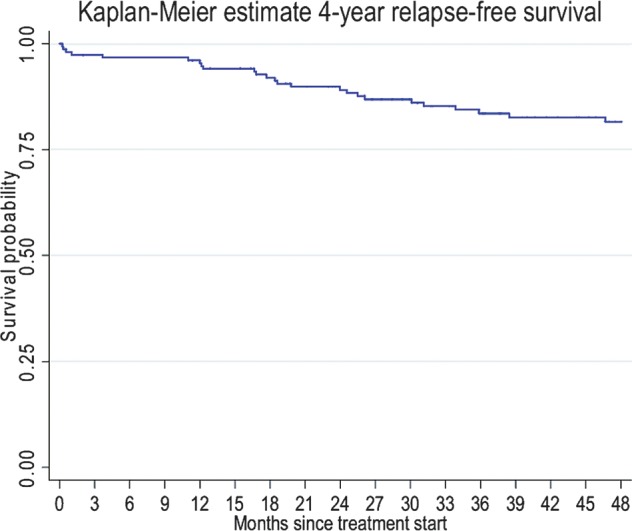
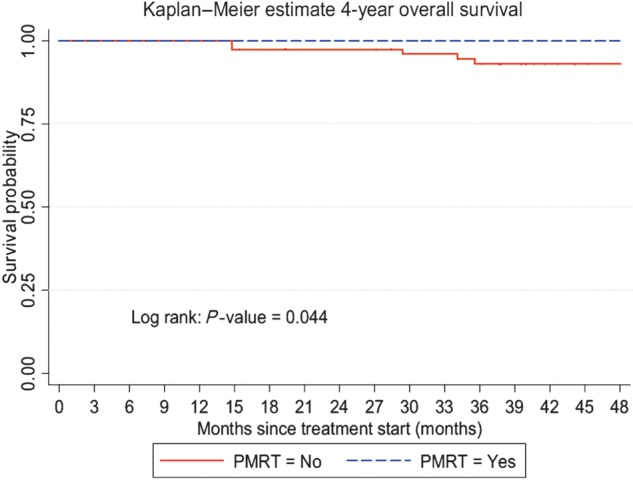
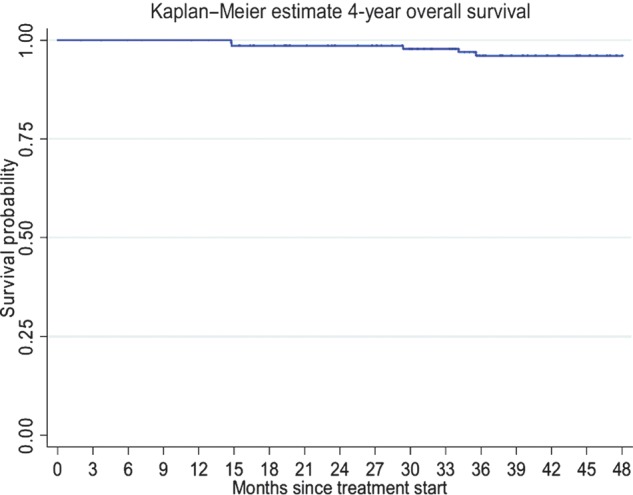
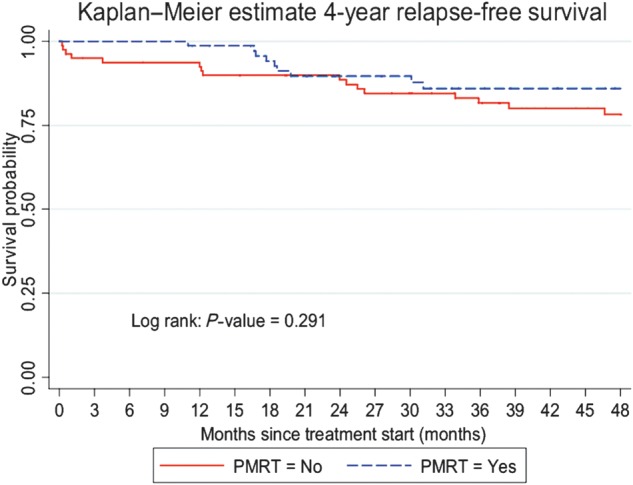
A total of 155 patients were included with a median follow-up period of 4.45 years. There was a statistically significant 4-year OS difference between the two groups of patients: 100% for the PMRT group and 93.1% for the non-PMRT group (P = 0.044). The 4-year RFS was 85.9% for patients receiving PMRT and 78.3% for patients who did not receive PMRT (P = 0.291). On multivariate analysis of OS, using hormonal treatment was the only significant independent factor associated with improved OS. On multivariate analysis of RFS, none of the variables were significantly associated with improved RFS. PMRT was notfound to be a prognostic variable related to the outcome of patients using a logistic regression model.
Our retrospective, hospital-based analysis demonstrated that PMRT improved the treatment outcome in terms of OS for women with 1-3 node positive early-stage breast cancer.
在泰国北部一家三级转诊癌症中心,评估接受或未接受乳房切除术后放疗(PMRT)的1 - 3个阳性淋巴结乳腺癌患者的治疗结果,并探讨临床结果的决定因素。
我们调查了泰国清迈大学医学院2001年至2007年登记的乳腺癌患者的回顾性队列。使用Cox回归模型进行分析,以确定影响总生存期(OS)和无复发生存期(RFS)率的因素。对两个队列进行了比较:接受辅助性PMRT的女性(74例患者)和未接受辅助性PMRT的女性(81例患者)。
共纳入155例患者,中位随访期为4.45年。两组患者的4年总生存期存在统计学显著差异:PMRT组为100%,非PMRT组为93.1%(P = 0.044)。接受PMRT的患者4年无复发生存率为85.9%,未接受PMRT的患者为78.3%(P = 0.291)。在总生存期的多变量分析中,使用激素治疗是与总生存期改善相关的唯一显著独立因素。在无复发生存期的多变量分析中,没有变量与无复发生存期改善显著相关。使用逻辑回归模型未发现PMRT是与患者预后相关的变量。
我们基于医院的回顾性分析表明,对于1 - 3个淋巴结阳性的早期乳腺癌女性,PMRT在总生存期方面改善了治疗结果。