Department of Psychological Sciences, University of Liverpool, Liverpool, UK.
Addiction. 2013 Nov;108(11):1916-23. doi: 10.1111/add.12283. Epub 2013 Aug 14.
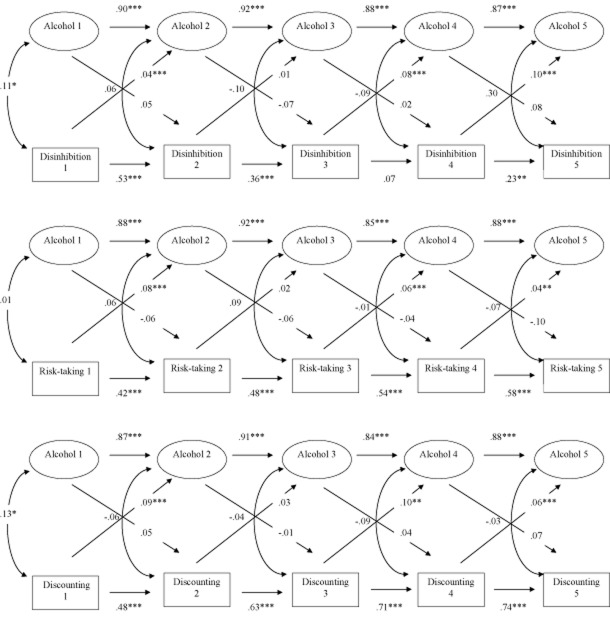
We investigated reciprocal prospective relationships between multiple behavioural impulsivity tasks (assessing delay discounting, risk-taking and disinhibition) and alcohol involvement (consumption, drunkenness and problems) among adolescents. We hypothesized that performance on the tasks would predict subsequent alcohol involvement, and that alcohol involvement would lead to increases in behavioural impulsivity over time.
Cross-lagged prospective design in which impulsivity and alcohol involvement were assessed five times over 2 years (once every 6 months, on average).
Classrooms in secondary schools in North West England.
Two hundred and eighty-seven adolescents (51.2% male) who were aged 12 or 13 years at study enrolment.
Participants reported their alcohol involvement and completed computerized tasks of disinhibition, delay discounting and risk-taking at each assessment. Cross-sectional and prospective relationships between the variables of interest were investigated using cross-lagged analyses.
All behavioural impulsivity tasks predicted a composite index of alcohol involvement 6 months later (all Ps < 0.01), and these prospective relationships were reliable across the majority of time-points. Importantly, we did not observe the converse relationship across time: alcohol involvement did not predict performance on behavioural impulsivity tasks at any subsequent time point.
Several measures of impulsivity predict escalation in alcohol involvement in young adolescents, but alcohol use does not appear to alter impulsivity.
我们调查了多项行为冲动性任务(评估延迟折扣、冒险和抑制解除)与青少年饮酒行为(饮酒、醉酒和问题)之间的相互前瞻性关系。我们假设这些任务的表现将预测随后的饮酒行为,并且随着时间的推移,饮酒行为将导致行为冲动性的增加。
在 2 年内进行了 5 次交叉前瞻性设计(平均每 6 个月评估一次),评估冲动性和饮酒行为。
英格兰西北部的中学教室。
287 名青少年(51.2%为男性),在研究开始时年龄为 12 或 13 岁。
参与者报告了他们的饮酒行为,并在每次评估中完成了抑制解除、延迟折扣和冒险的计算机化任务。使用交叉滞后分析研究了感兴趣变量之间的横断面和前瞻性关系。
所有行为冲动性任务均能预测 6 个月后饮酒行为的综合指数(均 P<0.01),并且这些前瞻性关系在大多数时间点都是可靠的。重要的是,我们没有观察到随着时间的推移而出现相反的关系:在任何后续时间点,饮酒行为都不能预测行为冲动性任务的表现。
几项冲动性测量指标预测了青少年饮酒行为的升级,但饮酒似乎不会改变冲动性。