Department of Applied Mathematics and Theoretical Physics, University of Cambridge, Wilberforce Road, Cambridge CB3 0WA, UK.
Philos Trans R Soc Lond B Biol Sci. 2013 Jun 24;368(1623):20120137. doi: 10.1098/rstb.2012.0137. Print 2013 Aug 5.
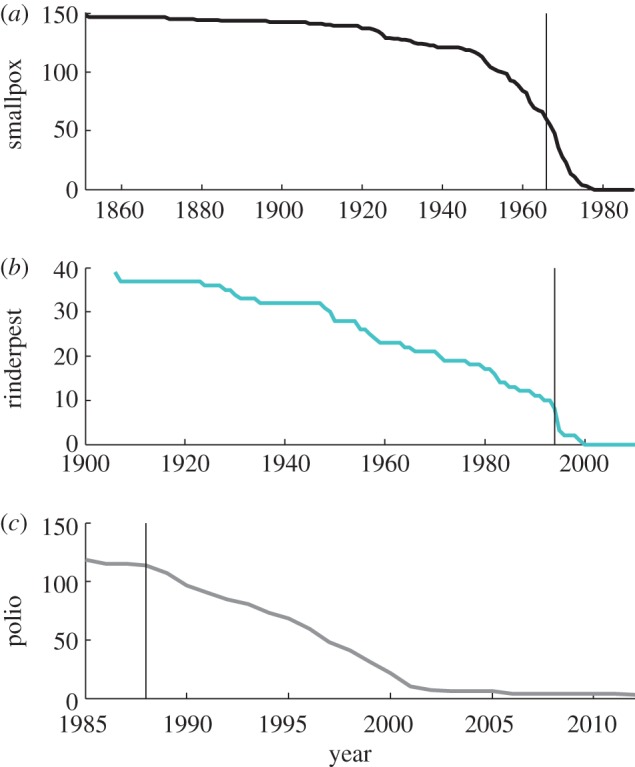
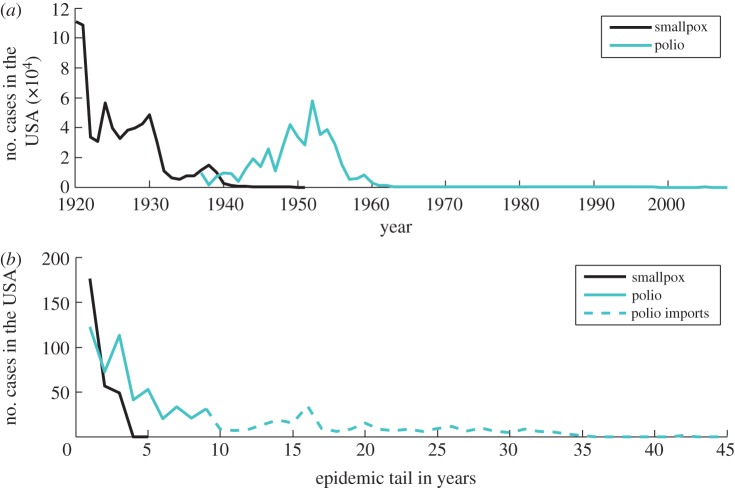
Successful control measures have interrupted the local transmission of human infectious diseases such as measles, malaria and polio, and saved and improved billions of lives. Similarly, control efforts have massively reduced the incidence of many infectious diseases of animals, such as rabies and rinderpest, with positive benefits for human health and livelihoods across the globe. However, disease elimination has proven an elusive goal, with only one human and one animal pathogen globally eradicated. As elimination targets expand to regional and even global levels, hurdles may emerge within the endgame when infections are circulating at very low levels, turning the last mile of these public health marathons into the longest mile. In this theme issue, we bring together recurring challenges that emerge as we move towards elimination, highlighting the unanticipated consequences of particular ecologies and pathologies of infection, and approaches to their management.
成功的控制措施已经中断了麻疹、疟疾和脊髓灰质炎等人类传染病的本地传播,并挽救和改善了数十亿人的生命。同样,控制工作也大大降低了许多动物传染病的发病率,如狂犬病和牛瘟,这对全球人类健康和生计都有积极的好处。然而,消除疾病已被证明是一个难以实现的目标,全球只有一种人类病原体和一种动物病原体被根除。随着消除目标扩大到区域甚至全球水平,当感染水平非常低时,在终局中可能会出现障碍,这些公共卫生马拉松的最后一英里将变成最长的一英里。在本期特刊中,我们汇集了在向消除迈进的过程中出现的反复出现的挑战,强调了感染的特定生态和病理学的意外后果,以及对这些感染的管理方法。