Mondal Bikash, Maiti Soumyajit, Biswas Biplab Kumar, Ghosh Debidas, Paul Shyamapada
Department of Pathology, Bankura Sammilani Medical College and Hospital, Bankura, West Bengal, India.
J Res Med Sci. 2012 Aug;17(8):772-6.
Hemoglobinopathies are a group of inherited disorders of hemoglobin synthesis. It could be formed a fatal scenario in concern of lacking of actual information. Beside this, ABO and Rh blood grouping are also important matter in transfusion and forensic medicine and to reduce new born hemolytic disease (NHD).
The spectrum and prevalence of various hemoglobinopathies, ABO and rhesus (Rh) blood groups was screened among patients who visited B.S. Medical College and Hospital, Bankura, West Bengal, India. This study was carried out on 958 patients of different ages ranging from child to adults from January to June 2011. High-performance liquid chromatography (HPLC), complete blood count (CBC) and hemagglutination technique were performed for the assessment of abnormal hemoglobin variants, ABO and Rh blood groups, respectively.
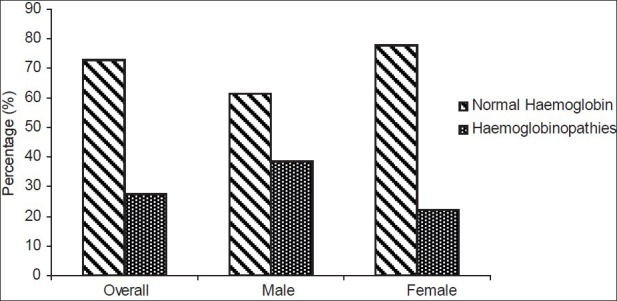
Results from this study had been shown that there was high prevalence of hemoglobinpathies (27.35%) where β-thalassemia in heterozygous state occurred more frequent than other hemoglobinopathies. Out of 958 patients, 72.65% were HbAA and 27.35% were hemoglobinopathies individuals where 17.64% β-thalassemia heterozygous, 2.92% β-thalassemia homozygous, 3.86% HbAE, 1.15% HbAS trait, 1.25% HbE-β thalassemia trait and 0.52% HbS-β thalassemia trait were found. No incidence of HbSS, HbSC, HbCC, HbD and other variants of hemoglobinpathies were observed. The gene frequencies with respect to ABO systems had been shown as O > B > A > AB. Blood group O was the highest (35.8%) and the least percentage distribution was blood group AB (6.68%). Rhesus positive (Rh+) were 97.7%, while the remaining was 2.3% Rhesus negative (Rh-). The frequencies of A(+), B(+), AB(+,) and O(+) blood groups were 22.44%, 33.61%, 6.58%, and 35.07%, respectively.
Remarkable percentages of hemoglobinopathies were prevalent from the present study. An extensive screening of the population is needed to assess the prevalence of hemoglobinopathies, which will help in identification of carriers of hemoglobinopathies and further it will be of assistance in taking adequate therapeutic and preventive measures.
血红蛋白病是一组遗传性血红蛋白合成障碍疾病。由于缺乏实际信息,可能会形成一种致命的情况。除此之外,ABO和Rh血型在输血和法医学以及减少新生儿溶血病(NHD)方面也是重要问题。
在印度西孟加拉邦班库拉的B.S.医学院和医院就诊的患者中,筛查了各种血红蛋白病、ABO和恒河猴(Rh)血型的谱系和患病率。本研究于2011年1月至6月对958名不同年龄段的患者进行,这些患者从儿童到成人。分别采用高效液相色谱法(HPLC)、全血细胞计数(CBC)和血凝技术评估异常血红蛋白变异体、ABO和Rh血型。
本研究结果表明,血红蛋白病的患病率较高(27.35%),其中杂合状态的β地中海贫血比其他血红蛋白病更为常见。在958名患者中,72.65%为HbAA,27.35%为血红蛋白病个体,其中17.64%为β地中海贫血杂合子,2.92%为β地中海贫血纯合子,3.86%为HbAE,1.15%为HbAS性状,1.25%为HbE-β地中海贫血性状,0.52%为HbS-β地中海贫血性状。未观察到HbSS、HbSC、HbCC、HbD及其他血红蛋白病变异的发生率。ABO系统的基因频率显示为O > B > A > AB。O血型最高(35.8%),AB血型的分布百分比最低(6.68%)。恒河猴阳性(Rh+)为97.7%,其余为2.3%恒河猴阴性(Rh-)。A(+)、B(+)、AB(+)和O(+)血型的频率分别为22.44%、33.61%、6.58%和35.07%。
本研究中血红蛋白病的患病率相当高。需要对人群进行广泛筛查以评估血红蛋白病的患病率,这将有助于识别血红蛋白病携带者,并进一步有助于采取适当的治疗和预防措施。